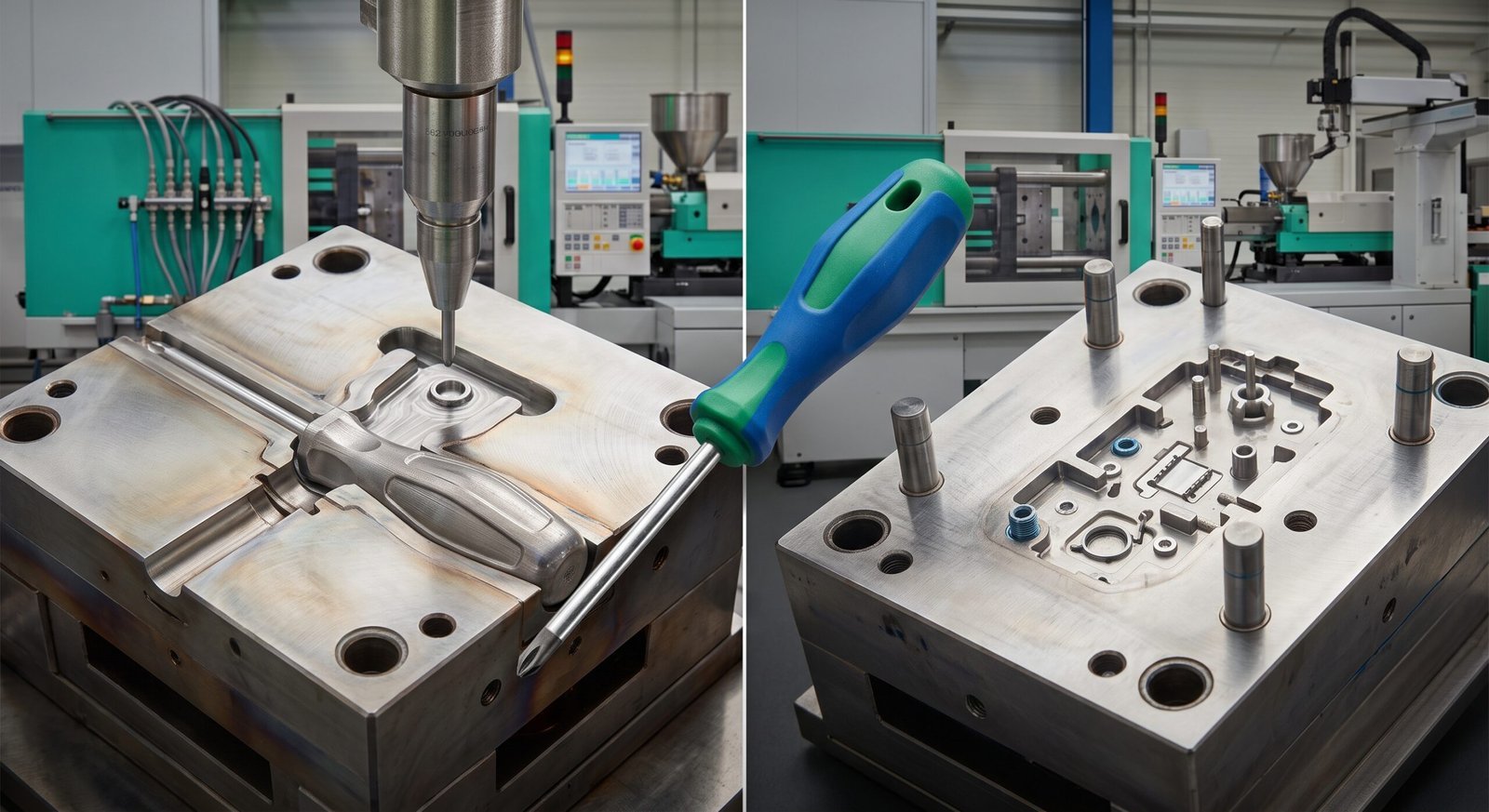
An undercut is any feature that stops a molded part from ejecting straight out of the mold, such as a side hole, a snap-fit hook or an internal groove. Undercuts in injection molding are handled by moving tool parts, such as side actions, lifters and collapsible cores, or designed out. Every moving part adds tool cost, cycle time and maintenance.
What Counts as an Undercut
A mold opens in one direction, called the draw direction. Any surface that faces sideways or backward relative to that direction traps the part in the steel. Common examples:
- Holes or slots in side walls
- Snap-fit hooks and latches
- Internal grooves, O-ring seats and threads
- Recessed text or logos on side faces
- Lips and flanges that curl back over the part
Some features look like undercuts but are not, once the part is rotated in the tool. Choosing the draw direction and parting line is the first and cheapest step in handling undercut features.
Side Actions: Moving Features Sideways
A side action, also called a slide, is a block of steel that moves sideways to form an external undercut, then pulls clear before the part ejects.
- Angle pins (horn pins) drive most slides. As the mold opens, an angled pin pulls the slide outward, and a heel block locks it in place against injection pressure when the mold closes.
- Hydraulic cylinders drive slides that need a long stroke, move at a set time in the cycle, or sit where an angle pin cannot reach.
- Cam actions handle angled or compound movements.
Side actions are robust and handle large molding undercuts such as side windows and connector openings. They need space, though. That limits cavity count.
Lifters: Internal Undercuts
A lifter is an angled insert in the core that moves with the ejector system. As the ejector plate pushes forward, the lifter rises at an angle, sliding sideways out of an internal undercut such as a snap hook on the inside of a housing wall.
Lifters fit in tight spaces where a slide cannot, and they are common for internal clips and bosses. Their limits are travel and strength. The sideways movement is small, so they suit shallow undercuts, and slender lifters can wear or bend if the plastic grips them hard.
Threads and Round Internal Undercuts
A single slide or lifter cannot release internal threads or full-round grooves.
- A collapsible core is a segmented core that shrinks inward at the end of the cycle, releasing threads or grooves. It suits caps and closures in high volume.
- An unscrewing mechanism rotates the threaded core out of the part with a motor or rack. It produces clean, full threads, and it is also the most complex solution on this list.
- Thread splits, two slides meeting across an external thread, work for outside threads and leave a small parting line along the thread.
At low volume, skip the mechanism: a threaded metal insert or a thread-forming screw usually costs less than molding the thread.
Bump-Offs: Stripping a Shallow Undercut
A bump-off, also called stripping, pushes a flexible part over a shallow undercut during ejection. The plastic stretches, clears the steel and snaps back.
It works only with shallow undercuts, rounded lead-in edges and forgiving resins such as PP, PE and TPE. Rigid or glass-filled plastics like PC or glass-filled nylon tend to crack or whiten. The part must also be warm enough to flex without being so soft that it distorts. When the material and geometry suit it, a bump-off is the cheapest mechanical solution for injection molding undercuts, since the tool needs no extra moving parts.
Design Workarounds That Remove the Undercut
The cheapest undercut is the one that is not there.
Pass-through core (shutoff). A snap hook can often be molded with a core that passes through the part from the opposite side, leaving a small window under the hook. The window removes the undercut, and no slide is needed. For snap-fits it is usually the first option worth trying.
Move the parting line. Placing the parting line through a side hole or groove can let both mold halves form it without an action.
Rotate the part. Changing the draw direction can turn a side feature into a straight-pull feature.
Change the feature. Replace a side hole with a slot open to one edge, or move text from a side wall to the top face.
Hand-loaded insert. For low volumes, an operator places a loose insert into the mold each cycle and removes it with the part. It avoids an automated action, at the cost of labor and a slower cycle.
Cost Ladder for Undercuts in Injection Molding
Our recommendation is to work down this list and stop at the first option that meets the part’s function:
| Solution | Tool cost impact | Cycle impact | 最適 |
| Redesign or rotate the part | なし | なし | Any feature that can change |
| Pass-through core | 極めて低い | なし | Snap-fits, simple hooks |
| Bump-off | 極めて低い | Slight | Shallow undercuts in flexible resins |
| Hand-loaded insert | 低い | Slower, labor | Prototypes, low volume |
| Lifter | 中程度 | Slight | Internal clips, small internal undercuts |
| Side action (angle pin) | 中~高 | Slight | External holes, windows, side features |
| Thread split (two slides) | 中~高 | Slight | External threads |
| Hydraulic side action | 高い | 中程度 | Long travel or timed movements |
| Collapsible core | 高い | 中程度 | Internal threads, round grooves, high volume |
| Unscrewing mechanism | 最高 | Moderate to longer | Precise internal threads |
Each moving component also adds maintenance, and our injection mold cost guide shows how actions add up in a tool quote.
Draft and Ejection Around Undercut Features
Every surface that moves against the part needs draft, including the faces of slides and lifters. Without it, the plastic drags as the action retracts, leaving scuffs or pulling the part out of position before ejection.
Ejection also matters. A part held by a lifter or slide until the last moment may need extra ejector pins nearby so it does not stick to the moving steel. Treat both as part of the undercut design. They decide whether molded undercuts release cleanly.
Side Effects: Witness Lines, Flash and Tolerance
Moving tool parts leave traces on the part, and that is easy to forget when choosing how to form an undercut in injection molding. Every slide or lifter creates a shutoff line on the part where it meets the fixed steel. On cosmetic surfaces that line may show, and as the tool wears it can grow into flash.
Tolerance is affected too. A dimension that crosses a slide shutoff carries the slide’s positional error, so it cannot hold as tight as a dimension formed in one steel block. Apply general tolerance standards such as ISO 20457 with that in mind, and keep critical dimensions within one mold half where possible.
Mold terminology varies between suppliers and languages. ISO 12165 lists standard component names, which helps when slides, lifters and cores are discussed across English and Chinese drawings.
Undercuts in Die Casting and Metal Parts
The same logic applies to die cast metal parts. Die casting tools use slides and core pulls to form side holes and pockets, but metal gives no flexibility, so bump-offs are not an option. Undercut features in die castings are often machined afterward instead, which is why cast-and-machine routes are common for complex aluminum housings.
Undercut Review Checklist for Your RFQ
Before sending a part for quote, run through these injection molding undercuts checks:
- Is the draw direction marked, and does every feature release along it?
- Can any snap-fit use a pass-through core instead of a lifter?
- Are cosmetic surfaces marked, so slide lines stay off them?
- Are dimensions across moving components toleranced realistically?
- Could a feature become a secondary operation, such as drilling a side hole after molding?
A part that passes a flexible silicone mold in prototyping may still contain undercuts that a steel tool cannot release, as our comparison of vacuum casting and injection molding explains.
よくある質問
What is an undercut in injection molding?
An undercut is any feature that blocks a part from ejecting straight out of the mold along its opening direction, such as a side hole, snap hook, internal groove or thread. It must be formed by a moving mold component, stripped off a flexible part, or designed out of the part.
How much do side actions add to mold cost?
It depends on size, travel and drive method. An angle-pin slide adds machining, a heel block and fitting work, while a hydraulic slide adds cylinders and controls. Each action also raises maintenance and can reduce how many cavities fit. Ask for actions as separate lines in the quote to see their true cost.
What is the difference between a side action and a lifter?
A side action is a slide that moves sideways, usually driven by an angle pin or hydraulic cylinder, to form external undercuts. A lifter sits inside the core and moves at an angle with the ejector system to release internal undercuts. Lifters fit tighter spaces, while slides handle larger features.
Can undercuts be molded without side actions?
Often, yes. Pass-through cores, rotating the part, moving the parting line and bump-offs can all form or release undercuts without a slide. For low volumes, hand-loaded inserts are another option. Redesigning the feature is usually cheaper than adding a moving component, so review these first.
How are internal threads molded?
Internal threads are released by a collapsible core, which shrinks inward, or an unscrewing mechanism, which rotates the core out. Both add significant tool cost and suit higher volumes. For low volumes, threaded metal inserts or thread-forming screws are often a cheaper alternative than molding the thread.
Designing Around Undercuts in Injection Molding
Treat undercuts in injection molding as a cost decision. Remove them where you can, strip them where the resin allows, and add moving steel only where the feature earns it. At エリート・モールド・テック, our DFM engineers can review each undercut before quoting a プラスチック射出成形 tool, and the right gate and mold layout, covered in our 2-plate vs 3-plate guide, is settled in the same review.