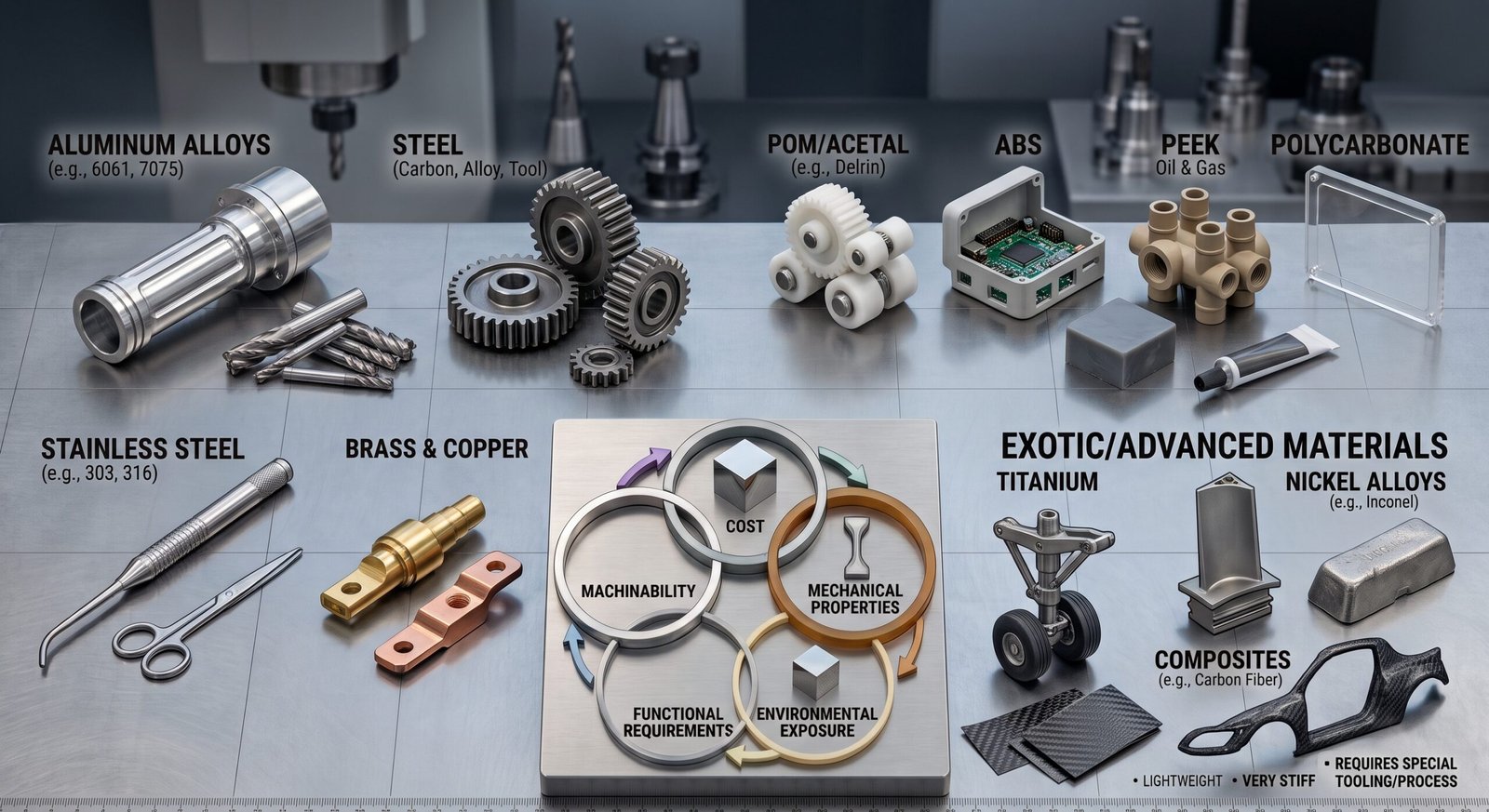
Material selection is where most part cost is decided, but it is rarely where most engineering attention goes. A team will spend three weeks optimizing a CAD model and thirty minutes picking the material, then wonder why the per-part quote comes back 60 percent higher than expected or why the first batch fails field testing.
The material you specify determines how fast the machine can cut, how many tools it burns through, how long the setup takes, and how the finished part performs in its service environment. Get it right and machining is fast, cheap, and predictable. Get it wrong and no amount of programming optimization or fixturing cleverness recovers the cost.
This guide covers every major CNC machining material across metals, engineering plastics, and specialty alloys. Each material is assessed on machinability, mechanical properties, cost, and the applications where it genuinely belongs. By the end, you will have a clear, data-backed framework for picking the right material before the quote, not after it.
| Quick AnswerThe most machinable CNC materials are aluminum 6061-T6 (easiest, lowest cost), brass C360, and Delrin POM. Mid-range machinability materials include stainless steel 304, mild steel, and ABS. Difficult materials requiring slow feeds, specialized tooling, and higher per-part cost include titanium Ti-6Al-4V, Inconel 625, and PEEK. Material selection should start with the functional requirement (strength, corrosion resistance, temperature, biocompatibility) and then optimize for machinability within that constraint. Never choose the material for its machinability alone if the application demands a specific performance property. |
What Does Machinability Actually Mean, and Why Does It Drive Cost?
Machinability is the relative ease with which a material can be cut to produce a dimensionally accurate part with an acceptable surface finish, at a reasonable tool life and cutting speed. It is not a single property. It is the combined result of a material’s hardness, thermal conductivity, chip formation behavior, work hardening tendency, and abrasiveness.
Why machinability drives cost directly: a high-machinability material like aluminum 6061 allows cutting speeds of 300 to 600 meters per minute with standard carbide tooling, producing thousands of parts per tool before replacement. A low-machinability material like Inconel 625 requires cutting speeds below 30 meters per minute, consumes tooling at 20 to 50 times the rate, and demands significantly more machine time per part. The same geometry in Inconel costs 8 to 15 times more to machine than in aluminum, before even accounting for raw material price differences.
Machinability ratings for metals are typically expressed as a percentage relative to AISI 1112 free-machining steel, which is assigned a baseline of 100 percent. Materials above 100 are easier to machine than that reference steel; materials below 100 are harder. The American Machinist reference values [1] place aluminum alloys at 300 to 1,500 percent, brass at 200 percent, mild steel at 65 percent, stainless steel 304 at 45 to 50 percent, titanium Grade 5 at 22 percent, and Inconel 625 at 8 to 12 percent. These numbers tell you, before a single chip is cut, how the part cost will scale relative to your baseline material choice.
How Do the Most Common CNC Metals Compare on Machinability, Strength, and Cost?
The table below covers the twelve metals most frequently specified for CNC machining. Properties reflect typical values for the most common temper or grade used in CNC production. Relative cost is indexed to aluminum 6061-T6 as baseline 1.0x.
| Материал | Рейтинг обрабатываемости | Прочность на разрыв | Yield Strength | Density g/cm3 | Relative Cost | Лучшее приложение |
|---|---|---|---|---|---|---|
| Алюминий 6061-T6 | 1,500% | 310 MPa | 276 MPa | 2.70 | 1.0x | General machining, enclosures, brackets, heat sinks |
| Алюминий 7075-T6 | 1,200% | 540 MPa | 503 MPa | 2.81 | 2.0x to 3.0x | Aerospace, high-load structural, performance parts |
| Латунь C360 | 200% | 385 MPa | 310 MPa | 8.50 | 1.8x | Fittings, valves, electrical connectors, decorative |
| Медь C110 | 100% | 220 MPa | 70 MPa | 8.96 | 2.5x | Heat exchangers, bus bars, electrical conductors |
| Мягкая сталь 1045 | 65% | 585 MPa | 450 MPa | 7.85 | 0.8x | Shafts, gears, structural machine components |
| Легированная сталь 4140 | 55% | 655 MPa | 415 MPa | 7.85 | 1.0x | High-strength shafts, dies, pressure components |
| Нержавеющая сталь 304 | 45% | 515 MPa | 205 MPa | 7.93 | 1.5x | Food equipment, architecture, general industrial |
| Stainless Steel 316L | 43% | 515 MPa | 170 MPa | 7.99 | 1.8x | Marine, medical, chemical processing environments |
| Нержавеющая сталь 17-4 PH | 48% | 1,310 MPa | 1,170 MPa | 7.78 | 2.5x | High-strength aerospace, oil and gas, surgical tools |
| Titanium Grade 5 (Ti-6Al-4V) | 22% | 900 MPa | 830 MPa | 4.43 | 5.0x to 8.0x | Aerospace, medical implants, high-performance motorsport |
| Inconel 625 | 8 to 12% | 930 MPa | 517 MPa | 8.44 | 12.0x to 20.0x | Turbine blades, exhaust systems, subsea components |
| Инконель 718 | 10% | 1,375 MPa | 1,100 MPa | 8.19 | 15.0x to 25.0x | Jet engine discs, rocket components, extreme temp parts |
The cost multipliers in the table above account for raw material price, machining time (driven by machinability and cutting speed), and tooling consumption. A titanium Grade 5 part that takes 2 hours to machine in aluminum may take 8 to 12 hours in titanium with significantly higher tool change frequency. That ratio, not the raw material price alone, is what drives the final part cost differential.
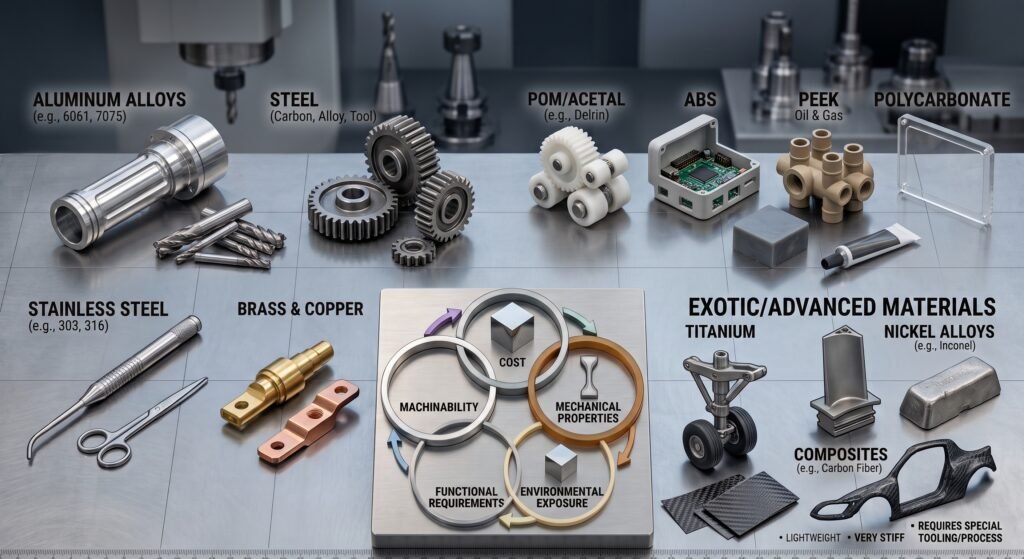
Which Metal Should You Choose for Your CNC Part?
Aluminum 6061-T6: The Default Choice
Aluminum 6061-T6 is the most widely specified CNC machining material in the world, and for good reason. Its machinability rating of 1,500 percent relative to free-machining steel means tools last long, cycle times are short, and surface finishes of Ra 0.8 to 1.6 µm are achievable without heroic effort. Tensile strength of 310 MPa and yield strength of 276 MPa cover the structural requirements of the vast majority of enclosures, brackets, housings, and structural components in aerospace, automotive, consumer electronics, and industrial equipment.
Thermal conductivity of 167 W/m·K makes it the first choice for heat sinks and thermal management components. It anodizes cleanly in any color, accepts powder coat and chemical conversion coatings, and welds readily. If you have not identified a specific property that 6061 cannot deliver, 6061 is your material.
Aluminum 7075-T6: When Strength Must Rise
When 6061 cannot meet the structural requirement, 7075-T6 is the next call. Tensile strength of 540 MPa and yield strength of 503 MPa make it the strongest commonly machined aluminum alloy, nearly twice as strong as 6061 at T6 temper. This earns it a dominant position in aerospace structural components, high-performance bicycle frames, and defense hardware where weight is the hard constraint and strength cannot be compromised.
The trade-offs are real. 7075 costs 2.0 to 3.0 times more than 6061 in raw material alone. It is effectively unweldable for structural purposes due to stress corrosion cracking at weld heat-affected zones. Its corrosion resistance is lower than 6061, requiring protective anodizing or painting in outdoor or marine environments. Anodized color quality is less consistent than on 6061. Specify 7075 only when yield strength genuinely exceeds 6061’s 276 MPa limit for your application. Specifying it by instinct on parts that 6061 handles comfortably is one of the most common and expensive material selection errors in precision manufacturing.
Stainless Steel 304 vs 316L: Environment Decides
Both 304 and 316L are austenitic stainless steels with nearly identical mechanical properties: tensile strength around 515 MPa, good toughness at cryogenic temperatures, and non-magnetic behavior in the annealed condition. The difference between them is entirely corrosion resistance, driven by 316L’s 2 to 3 percent molybdenum content. That molybdenum raises the pitting resistance equivalent number (PRE) from 18 in 304 to 26 in 316L, a 44 percent improvement in resistance to chloride attack.
Use 304 when the part operates in indoor or non-chloride environments: kitchen equipment, indoor architectural hardware, liquid storage tanks for non-corrosive fluids, and general industrial brackets. Use 316L when chlorides are present anywhere in the service environment: marine hardware, medical devices that contact saline or sterilization chemicals, chemical processing equipment, and coastal outdoor structures. The raw material cost premium for 316L is 30 to 40 percent over 304. CNC machining cost is nearly identical, since both grades work-harden at similar rates and machine at approximately 45 to 50 percent of free-machining steel speed.
Titanium Ti-6Al-4V (Grade 5): Performance at a Price
Titanium Grade 5 delivers a specific strength (strength divided by density) that no other commonly machined metal matches. At 900 MPa tensile strength and 4.43 g/cm3 density, it achieves the structural performance of many steels at 45 percent of the weight. Combined with corrosion resistance that titanium maintains in seawater, concentrated nitric acid, and biological environments without any surface treatment, it is the mandatory choice for permanent medical implants, aerospace structural weight-critical components, and high-performance motorsport parts.
The machining cost premium is not a minor consideration. Ti-6Al-4V machines at 22 percent of free-machining steel’s relative rate, requires slow cutting speeds (typically 30 to 60 meters per minute), generates significant heat at the tool-chip interface that must be managed with aggressive coolant strategies, and consumes tooling at 5 to 10 times the rate of aluminum. A part that costs USD 50 to machine in 6061 aluminum may cost USD 300 to USD 600 or more in titanium Grade 5. That premium is justified when the application genuinely requires it. It is unjustified, and common, when engineers default to titanium for prestige rather than necessity [2].
Inconel 625 and 718: Extreme Environment Only
Inconel alloys are nickel-chromium superalloys that retain their mechanical properties at temperatures where aluminum has melted and steel has softened. Inconel 625 maintains useful strength up to 980 degrees Celsius. Inconel 718, with its higher aluminum and titanium content, achieves tensile strengths exceeding 1,375 MPa after aging heat treatment while retaining oxidation resistance at elevated temperatures. These properties make them the only viable choice for gas turbine hot section components, jet engine discs, rocket engine nozzles, and subsea oil and gas equipment where pressure, temperature, and corrosion combine.
The machinability penalty is severe. Inconel 625 machines at 8 to 12 percent of free-machining steel’s rate, requires premium carbide or ceramic tooling, and demands flood coolant at all times. Machining cost relative to aluminum is 12 to 20 times higher for 625 and 15 to 25 times higher for 718. These materials belong in designs where no other alloy survives the service condition. They do not belong in any design where a cheaper material can meet the specification.
How Do Engineering Plastics Compare as CNC Machining Materials?
Engineering plastics have become a major category in precision CNC machining. They offer significant weight reduction over metals (typically 75 to 85 percent lighter), electrical insulation, chemical resistance, and in some cases mechanical properties that approach those of aluminum. Their machinability is generally excellent, but they present different challenges from metals: heat buildup from poor thermal conductivity, surface melting at high cutting speeds, dimensional instability from moisture absorption, and chip control issues in some grades.
| Материал | Machinability | Прочность на разрыв | Max Continuous Temp | Relative Cost | Key Property | Avoid When |
|---|---|---|---|---|---|---|
| ABS | Превосходно | 40 to 50 MPa | 80 to 90°C | Низкий | Impact resistance, easy finishing | High temp, chemical exposure |
| Дельрин (POM) | Превосходно | 70 MPa | 90 to 105°C | От низкого до среднего | Dimensional stability, low friction | Strong acids, high humidity |
| Nylon PA6/PA66 | Хорошо | 75 to 85 MPa | 100 to 120°C | От низкого до среднего | Wear resistance, toughness | Moisture-sensitive applications |
| Поликарбонат (PC) | Хорошо | 65 MPa | 120 to 130°C | Средний | Optical clarity, impact resistance | Certain solvents, UV exposure |
| PTFE (тефлон) | Good (soft, gummy) | 20 to 35 MPa | 260°C | Высокий | Chemical inertness, non-stick | Load-bearing structural parts |
| UHMW-PE | Хорошо | 35 to 45 MPa | 80 to 90°C | От низкого до среднего | Abrasion resistance, toughness | Precision tight-tolerance parts |
| Акрил (PMMA) | Good (brittle) | 70 to 80 MPa | 70 to 80°C | От низкого до среднего | Optical clarity, surface quality | Impact loading environments |
| PEEK | Excellent (with care) | 100 MPa | 250°C continuous | Очень высокий | Highest-performance engineering plastic | Budget-sensitive applications |
Delrin (POM): The Precision Plastic
Delrin, the trade name for polyoxymethylene (POM) acetal, is the closest thing to a default engineering plastic for precision CNC machining. It machines with exceptional dimensional stability: low coefficient of thermal expansion, minimal moisture absorption, and clean chip formation that allows tolerances of 0.05mm or better on machined features. Its low friction coefficient and excellent wear resistance make it the standard choice for precision gears, bushings, rollers, and sliding components where metal would be too heavy or create noise and wear issues on mating surfaces. Cost is moderate and machining is fast. For any application where an engineering plastic is appropriate, evaluate Delrin first.
PEEK: The High-Performance Choice
PEEK (polyether ether ketone) sits at the top of the engineering plastics hierarchy. It combines tensile strength of 100 MPa with continuous service temperatures up to 250 degrees Celsius and chemical resistance to virtually all industrial solvents, fuels, and sterilization agents. Its specific strength competes with aluminum in some orientations. In medical device manufacturing, PEEK’s radiolucency (it does not appear on X-rays), biocompatibility, and ability to be sterilized repeatedly without degradation make it the standard material for spinal implants, bone plates, and surgical instrument components. The material cost is 10 to 20 times that of Delrin, and machining requires sharp tooling, conservative feeds to prevent heat buildup, and careful fixture design to prevent part distortion. Specify PEEK only when the application genuinely requires its performance properties. When it does, no other machinable plastic substitutes for it.
How Do You Select the Right CNC Machining Material for Your Part?
Material selection follows a hierarchy of constraints. Work through them in order: function first, then environment, then tolerance and finish requirements, then machinability and cost. Reversing this order is how teams end up with over-engineered or under-performing parts.
- Step 1: Define the mechanical requirement: tensile strength, yield strength, fatigue limit, impact resistance. If aluminum 6061 meets the load case, stop there and evaluate cost. If it does not, move to 7075, then steel, then titanium. Do not jump to titanium because a part is “structural.”
- Step 2: Define the environment: temperature range, corrosive media, UV exposure, humidity, and electrical requirements. If temperatures exceed 150 degrees Celsius, aluminum is out. If chlorides are present, 304 stainless is out. If the part must be biocompatible for permanent implantation, titanium Grade 5 or PEEK are your candidates.
- Step 3: Define the tolerance and surface finish requirement. Materials like Delrin and 6061 hold tight tolerances easily. Materials like PEEK and Inconel require more careful process control to achieve the same tolerance level. If your tolerance is 0.005mm across multiple faces, the material must be dimensionally stable under machining forces and temperature.
- Step 4: Optimize for machinability within your constraint set. If two materials meet your functional and environmental requirements, the one with the higher machinability rating produces lower per-part cost. This is not compromise. It is engineering discipline.
- Step 5: Request DFM review before finalizing. A 30-minute DFM conversation with Elite Mold Tech’s engineering team before the drawing is released can identify material substitutions that reduce cost by 20 to 40 percent without sacrificing any required performance property.
| Not Sure Which Material Fits Your Part?Upload your STEP or IGES file to Elite Mold Tech and receive a free DFM review with a material recommendation within 12 hours. Our engineering team works with over 50 metals and plastics and will identify the material that meets your functional requirement at the lowest per-part machining cost. All uploads are secure and NDA protection is available on request.Visit elitemoldtech.com to explore the full materials library and upload your CAD file. |
Related Elite Mold Tech Guides and Sources
Related guides: complete manufacturing process selector guide, CNC machining tolerances explained, Услуги по обработке на станках с ЧПУ.
Authoritative references: ASM International materials data, ASTM International material standards.
Get a DFM Review from Elite Mold Tech
Ready to move from drawing to part? Upload your CAD file to Elite Mold Tech and receive a DFM review within 12 hours, with tolerance, material, and cost feedback from our engineering team before you commit to tooling.
Часто задаваемые вопросы
Why is aluminum 6061 the most common CNC machining material when there are stronger options available?
Aluminum 6061-T6 dominates CNC machining because it delivers the best combination of machinability, mechanical performance, corrosion resistance, and cost for the broadest range of industrial applications. Its machinability rating of 1,500 percent relative to free-machining steel means machines run fast, tooling lasts long, and cycle times stay short. Its tensile strength of 310 MPa and yield strength of 276 MPa cover the structural needs of enclosures, brackets, housings, heat sinks, and structural components across aerospace, automotive, electronics, and consumer products. The fact that stronger options exist does not make them better choices unless the load case genuinely exceeds what 6061 can handle. Specifying 7075 or titanium for parts that 6061 can carry comfortably is one of the most reliable ways to double or triple your per-part cost for no functional benefit.
What is the difference between 304 and 316L stainless steel for CNC machined parts?
The mechanical properties of 304 and 316L stainless steel are nearly identical: both have tensile strength around 515 MPa, both machine at approximately 45 percent of free-machining steel speed, and both are non-magnetic in the annealed condition. The single meaningful difference is corrosion resistance in chloride environments. Stainless 316L contains 2 to 3 percent molybdenum, which raises its pitting resistance equivalent number from 18 (304) to 26 (316L), a 44 percent improvement in resistance to pitting and crevice corrosion when chlorides are present. Use 304 for indoor, non-chloride environments. Use 316L for marine environments, medical device applications where sterilization chemicals contact the part, chemical processing equipment, and any outdoor application in coastal or de-icing salt environments. The raw material price premium for 316L over 304 is approximately 30 to 40 percent. Since machining cost is almost identical, the total part cost premium is typically 15 to 25 percent.
When is PEEK the right plastic for a CNC machined part, and when is it overkill?
PEEK is the right material when an engineering plastic must simultaneously meet high mechanical loads, elevated continuous service temperatures above 150 degrees Celsius, exposure to aggressive chemicals or sterilization agents, and biocompatibility requirements for medical or food contact applications. Its tensile strength of 100 MPa, continuous service temperature of 250 degrees Celsius, and resistance to virtually all industrial solvents and sterilization cycles justify its 10 to 20 times premium over Delrin in applications where those properties are genuinely required. PEEK is overkill when a part operates at room temperature in a non-corrosive environment under moderate mechanical loads. In that case, Delrin or polycarbonate delivers equivalent dimensional performance at 5 to 10 percent of the material cost. The most common PEEK over-specification occurs in medical device components that must be biocompatible but never experience elevated temperatures or aggressive chemical exposure, where UHMW-PE or Delrin would perform identically for a fraction of the cost.
Why does machining titanium cost so much more than machining aluminum?
The cost difference between machining titanium and aluminum has three sources: cutting speed, tool life, and raw material price. Titanium Ti-6Al-4V machines at cutting speeds of 30 to 60 meters per minute. Aluminum 6061 machines at 300 to 600 meters per minute. That 10-to-1 speed difference alone means titanium takes 10 times longer to machine the same geometry. On top of that, titanium generates significant heat at the tool-chip interface, which accelerates tool wear to 5 to 10 times the rate seen in aluminum machining, driving up tooling cost per part. Raw material prices add a further 5 to 8 times premium over aluminum. When you combine longer cycle times, faster tool consumption, and higher material cost, a titanium part that would cost USD 50 in aluminum 6061 typically costs USD 300 to USD 600 or more. That premium is fully justified in applications requiring titanium’s specific strength, corrosion resistance, and biocompatibility. It is entirely unjustified in applications where a cheaper material meets the spec.
Can engineering plastics replace metals in structural CNC machined parts?
In specific applications, yes, but the substitution requires careful engineering rather than a general assumption that plastics are lighter and cheaper. PEEK at 100 MPa tensile strength can substitute for aluminum 6061 in load cases where aluminum’s 310 MPa would be over-engineered, particularly when weight reduction beyond aluminum’s capability is needed and the part geometry allows for larger cross-sections. Delrin (POM) substitutes effectively for brass or aluminum in bushings, gears, and sliding components where metal-on-metal contact creates noise, wear, or galling. Polycarbonate substitutes for glass in transparent protective covers and optical shields where impact resistance matters. What engineering plastics cannot replace is the combination of high strength, stiffness (elastic modulus), and thermal stability that steel and titanium provide in load-bearing structural components. The elastic modulus of PEEK is approximately 3.6 GPa. Aluminum 6061 is 68.9 GPa. A PEEK part that sees the same deflection requirements as an aluminum part needs roughly 19 times the cross-sectional area to achieve equivalent stiffness, which typically makes the substitution impractical for thin-walled structural applications.
What surface finishes are available for CNC machined aluminum and stainless steel parts?
For aluminum, the standard finishing sequence begins with CNC machined as-produced surface (Ra 0.8 to 3.2 µm), which is functional for most industrial applications. Anodizing Type II adds a 5 to 25 µm hard oxide layer in any color, improving corrosion and wear resistance. Anodizing Type III (hard anodizing) builds 25 to 50 µm layers with Brinell hardness up to 400 HB, used for wear-critical aluminum components. Chemical conversion coating (Alodine or Iridite) provides corrosion protection while maintaining electrical conductivity, specified in aerospace per MIL-DTL-5541. Powder coating adds a thick, durable decorative layer. For stainless steel, as-machined surfaces are commonly acceptable for most industrial and medical applications. Electropolishing removes a uniform surface layer, reduces Ra from 0.8 to as low as 0.1 µm, and eliminates surface contamination for medical and pharmaceutical parts. Passivation per ASTM A967 removes free iron from the surface, restoring the passive oxide layer that gives stainless steel its corrosion resistance after machining operations. Bead blasting produces a matte, uniform satin finish that hides tool marks and is used for cosmetic industrial components.
About the Author:
Alex Morgan specializes in technical content for precision manufacturing, with a focus on CNC machining, injection molding, die casting, 3D printing, sheet metal fabrication, and custom mold manufacturing. With more than a decade of experience in B2B manufacturing content and SEO, he creates technically accurate content designed for engineers, product developers, procurement teams, and manufacturing decision-makers. His work helps global manufacturers clearly communicate complex production capabilities, material options, tolerances, tooling processes, and quality standards to customers across the US, Europe, and Asia-Pacific. He writes for manufacturing companies where technical expertise, precision, and reliability matter.