Progressive dies suit small and medium parts at high volume, transfer dies suit large or deep-drawn parts, and compound dies suit flat parts that need excellent flatness and hole-to-edge accuracy. In die stamping, geometry narrows the choice first. Annual volume and the tooling budget settle it.
This comparison builds on our complete guide to metal stamping, which covers presses, materials and design rules.
How Each Die Works
Progressive Die
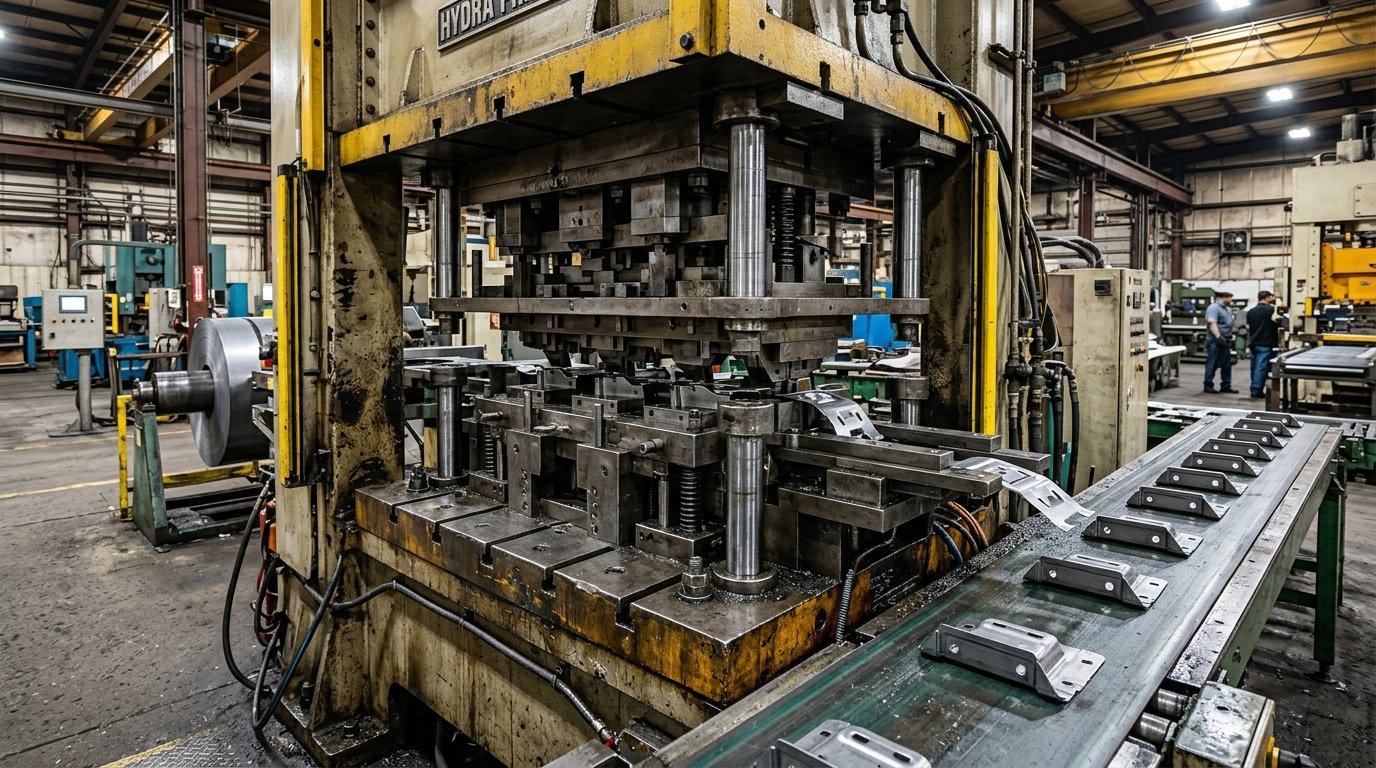
Coil is fed through a row of stations inside one die. Pilot pins locate the strip, and every press stroke performs a different operation at each station: piercing, forming, bending, then a final cutoff. The part stays attached to a carrier strip until the last station, so a finished part can drop out on every stroke.
This makes the progressive die the fastest option for brackets, terminals and clips. Its weak point is the carrier itself. A part that needs a deep draw or has to rotate between operations cannot stay tied to a flat strip.
Transfer Die
The blank is cut free first, either at station one or from pre-cut blanks, and mechanical fingers on transfer rails lift each part to the next station. Because the part is loose, it can be flipped, rotated and drawn deep. Stations sit in one large press or across a tandem line.
Transfer tooling handles housings, shells and large panels that a progressive die cannot carry, but it runs slower.
Compound Die
A compound die does several cuts in a single stroke at one station, typically blanking the outline and piercing the holes at the same moment. Every feature is cut in the same hit, so the hole-to-edge relationship and flatness are excellent. Washers, gaskets, shims and electrical laminations are classic compound parts.
It is a cutting tool. Forming is limited, although a combination die can add a simple form to the cutting stroke. Compound tools also demand high tonnage in one hit, because all the cutting happens at once.
Progressive vs Transfer vs Compound: Side by Side
| ファクター | Progressive die | Transfer die | Compound die |
| How the part moves | Attached to carrier strip | Loose, moved by fingers | Stays in one station |
| Operations per stroke | Many, one per station | Many, one per station | Several cuts at once |
| Typical parts | Brackets, terminals, clips | Housings, shells, drawn cups | Washers, gaskets, shims |
| Best volume | 高い | 中~高 | 低~中 |
| Relative tool price | 高い | 最高 | 最低 |
| スピード | Fastest | 中程度 | 中程度 |
| Tooling lead time | Longer | Longest | Shortest |
| Main limit | Draw depth, part size | Speed, cost | Little forming |
Which Die Stamping Process Fits Your Part?
Work through these questions in order:
- Does the part need a deep draw or turning between operations? Choose a transfer die.
- Is the part flat, with holes whose position to the edge is critical? Choose a compound die.
- Is it a small or medium formed part at high volume? Choose a progressive die.
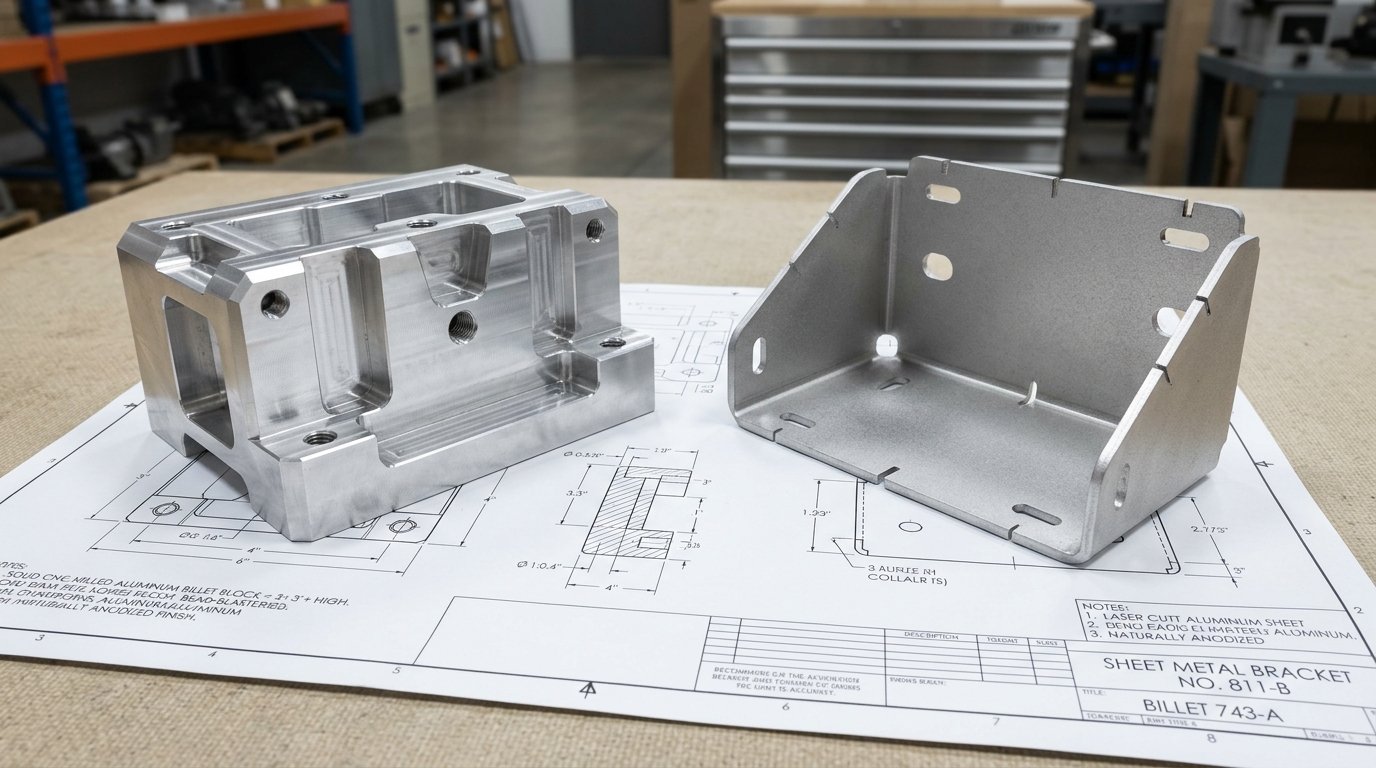
- Is volume low or the design still changing? Consider laser cutting and press-brake bending until it settles.
Our position is clear on step 3. Whenever a formed part fits the strip, the progressive die wins on piece price for high-volume production, and it is worth redesigning a tab or radius to make the part fit.
What Die Choice Changes on Your Drawing
The die type leaves marks that should be agreed before tooling starts.
A progressive part carries a small witness where it was cut off the carrier strip, and on a cosmetic or sealing edge that mark needs an agreed location. Pilot holes may be needed too. Burr direction should be marked on any edge that touches hands or wiring.
Compound parts have no carrier witness, and their flatness is usually better than a progressive part of the same shape. If you need flatness beyond general tolerance, call it out explicitly rather than relying on the general class in ISO 2768-2. Transfer parts may show small finger contact marks on soft or polished material.
Material Use and Scrap
A progressive strip has to be wide enough to carry the part plus its web, and that web becomes scrap. On low-carbon steel the loss is minor. On copper, brass or stainless it can decide the piece price.
Transfer and compound tools often nest blanks more tightly, since there is no carrier to feed. Ask your supplier for the strip layout and the material utilization figure. Two quotes with the same die type can differ by a few percent in yield, and that difference repeats on every part you buy.
Starting Small, Then Scaling Up
Committing to a large progressive die before the design is stable is a common and expensive mistake. Every change after the steel is cut means re-machining inserts or building new stations.
A staged route avoids that. Launch on laser-cut blanks and press-brake bends, or on simple single-station dies, while the design settles and volume is proven. Then build the progressive die for production. The early tooling is partly thrown away, but it costs far less than rebuilding a full progressive tool.
Hand-fed dies also put operators closer to the point of operation, which OSHA 29 CFR 1910.217 regulates in the United States. Automatic feeding is one more reason to move to a progressive or transfer tool once volume allows.
Die Stamping Costs Over the Life of the Tool
Tooling cost is only the first number. Piece price, scrap, maintenance and changeover time accumulate on every run.
- Progressive: expensive to build, lowest piece price, and regular sharpening across many stations
- Transfer: the most expensive build plus transfer automation, moderate piece price, and more setup time
- Compound: cheapest to build and simple to maintain, but a higher piece price at volume because it cannot form
For a formed part in high-volume production, the progressive die usually wins over a tool’s life. For a flat part at moderate volume, the compound die usually does.
よくある質問
What is the main difference between progressive and transfer die stamping?
In a progressive die, the part stays attached to a carrier strip as it moves through the stations. In a transfer die, the blank is cut free first and moved by mechanical fingers. That freedom lets transfer tools draw deep and rotate parts, while progressive tools run faster and cost less per piece.
When should compound die stamping be used?
Use a compound die for flat parts such as washers, gaskets and shims, especially when hole-to-edge position and flatness are critical. All cuts happen in one stroke, so features stay accurately related. It is not suited to parts that need bends or draws, unless a combination die adds a simple form.
Which stamping die is cheapest?
The compound die usually has the lowest tooling cost because it is a single station with no strip feeding or transfer automation. Transfer dies are usually the most expensive. The cheapest tool is not always the cheapest program, though, because piece price, scrap and maintenance add up over every order.
Can a progressive die make deep-drawn parts?
It can make shallow draws and some moderate cups, drawn in stages while the part stays on the strip. Deep draw parts that are much taller than their diameter, or that need rotating between operations, are better suited to a transfer die. The carrier strip limits how far the part can be pulled.
Can one die both cut and form?
Yes. Progressive and transfer dies cut and form at different stations as a matter of course. A compound die only cuts, but a combination die adds a simple forming action to the cutting stroke. For parts with several bends or draws, a multi-station tool remains the better choice.
Matching the Die to Your Part
Good die stamping decisions start with the part: flat and precise points to compound, deep or large points to transfer, and small formed parts at volume point to progressive. Elite Mold Tech’s DFM engineers review the part before choosing the tool, and our precision stamping services build and run all three die types. For prototypes and low volumes, 板金加工 bridges the gap. Every route sits within our 金属部品製造 capability, and エリート・モールド・テック quotes from a STEP file and drawing.