A gas turbine manufacturer needs 200 fuel injector tips with internal channels too complex to machine. The channels must be conformal to the combustion geometry, carry fuel at 300 degrees Celsius and 400 bar, and be made from Inconel 625 that can survive 15,000 thermal cycles without fatigue failure. CNC machining cannot reach the internal channels. Investment casting cannot hold the 0.05mm wall thickness between channels. DMLS produces all 200 parts in three builds, with every internal channel formed to specification and no secondary tooling cost.
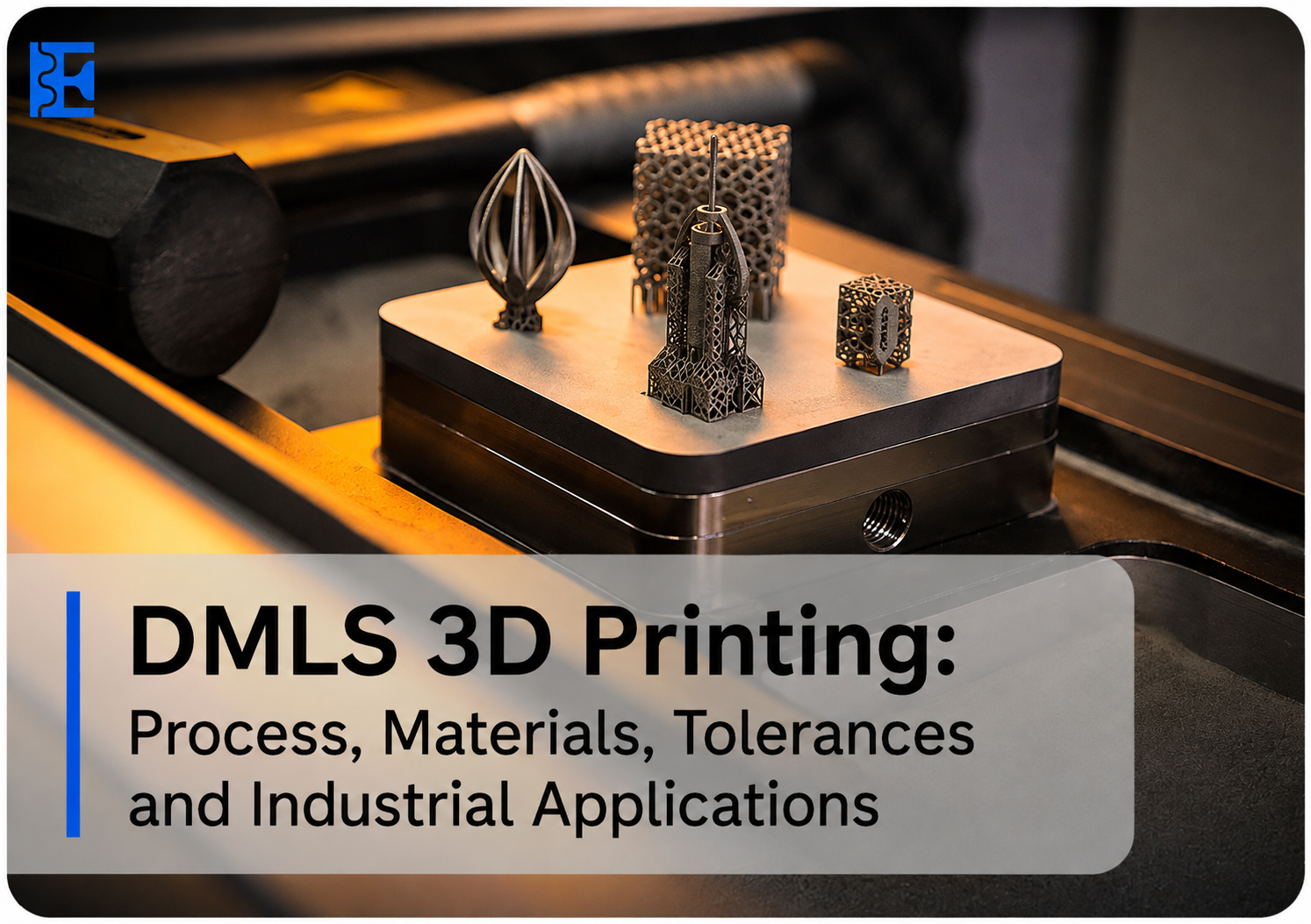
DMLS, Direct Metal Laser Sintering, is the metal additive manufacturing process that closes the gap between what engineers can design and what conventional manufacturing can produce. It builds fully dense metal parts directly from a digital file, layer by layer, in materials including titanium, Inconel, stainless steel, aluminum, and cobalt-chrome, with no tooling, no minimum order quantity, and no geometric constraints from tool access or mold pull direction.
This guide covers the DMLS process in technical detail: how it works, the major materials and their as-built mechanical properties, tolerance and surface finish capabilities, post-processing requirements, cost structure, and the specific application scenarios where DMLS is the right manufacturing process versus CNC machining, casting, or polymer 3D printing.
| Quick AnswerDMLS (Direct Metal Laser Sintering) is a powder bed fusion process that uses a fiber laser to sinter metal powder particles layer by layer in an inert atmosphere, producing fully dense metal parts with complex internal geometry that conventional manufacturing cannot achieve. As-built tolerances are 0.05 to 0.1mm, improving to 0.02mm or tighter on critical features after CNC post-machining. As-built surface roughness is Ra 5 to 20 µm, improving to Ra 0.8 µm or better after machining or polishing. Key materials include Ti-6Al-4V (tensile strength 1,050 MPa after HIP), Inconel 718 (1,240 MPa after heat treatment), 316L stainless steel, AlSi10Mg aluminum, and 17-4 PH stainless steel. DMLS is chosen when geometry is too complex to machine or cast, when tooling cost cannot be justified at low volumes, or when part consolidation eliminates assembly from a multi-component design. |
How Does the DMLS Process Actually Work?
DMLS is a powder bed fusion (PBF) process classified under ISO/ASTM 52900 as PBF-LB/M (Laser Beam, Metal). Understanding the process mechanics is essential for understanding why DMLS produces the part quality it does, and what limits its accuracy and surface finish in the as-built state.
The process begins with a build plate, a flat steel platform mounted inside an airtight build chamber. The chamber is purged with inert gas, typically argon or nitrogen, to reduce oxygen content below 0.1 percent. Oxygen at higher concentrations would oxidize the hot metal powder during sintering, creating inclusions that reduce mechanical properties and density.
A powder recoater spreads a thin layer of metal powder across the build plate, typically 20 to 100 µm thick depending on the material and quality requirement. A high-power fiber laser (typically 200 to 1,000 watts) scans the powder bed surface according to the cross-section of the part at that layer, sintering or partially melting the powder particles together. After each layer, the build platform drops by one layer thickness, the recoater spreads fresh powder, and the laser scans the next cross-section.
Support structures must be designed into the build for overhanging features beyond 45 degrees from vertical and for areas that need a heat conduction path to the build plate to prevent thermal distortion. Unlike SLS polymer printing, where unsintered powder provides self-support, DMLS supports are solid metal structures that must be removed by hand cutting, CNC machining, or wire EDM after the build is complete. Support removal is one of the most significant post-processing costs in DMLS and is a primary DFM consideration when orienting and designing parts for DMLS production.
After the build completes, the part is still attached to the build plate and surrounded by loose powder. The powder is vacuumed and sieved for reuse. The part is then removed from the build plate by wire EDM or band saw. Stress relief annealing is typically the first post-process step: residual thermal stress from the rapid heating and cooling during laser sintering can reach yield strength levels in the material, causing distortion when the part is removed from the plate without stress relief. Ti-6Al-4V is stress relieved at 650 to 750 degrees Celsius. Inconel 718 requires a full solution anneal and two-stage aging to develop its precipitation-hardened properties [1].
What Materials Are Available for DMLS, and What Mechanical Properties Do They Achieve?
DMLS material selection drives every other decision in a metal additive manufacturing program. The table below covers the six most widely specified DMLS materials, with mechanical properties reflecting post-processed condition (stress relief or full heat treatment) rather than as-built, since as-built properties carry higher variability and most structural applications require post-processing.
| Материал | Tensile Strength (post-processed) | Yield Strength | Elongation at Break | Плотность | Key Properties | Основные приложения |
|---|---|---|---|---|---|---|
| Ti-6Al-4V (Grade 5) | 1,050 to 1,100 MPa (after HIP) | 950 to 1,000 MPa | 8 to 14% | 4.43 g/cm3 | Highest strength-to-weight, biocompatible, corrosion-resistant | Aerospace brackets, medical implants, motorsport, lightweight structural |
| Инконель 718 | 1,240 MPa (after solution + age) | 1,100 MPa | 12 to 15% | 8.19 g/cm3 | Retains strength to 700 degrees C, oxidation resistant, fatigue resistant | Turbine components, rocket nozzles, exhaust systems, high-temp structural |
| Inconel 625 | 930 MPa (stress relief) | 517 MPa | 30 to 35% | 8.44 g/cm3 | Superior corrosion in chloride and seawater, high ductility | Subsea hardware, chemical processing, marine, cryogenic components |
| Нержавеющая сталь 316L | 540 to 600 MPa (stress relief) | 350 to 450 MPa | 40 to 50% | 7.99 g/cm3 | Biocompatible, excellent corrosion resistance, post-machineable | Medical instruments, food equipment, architectural, general industrial |
| AlSi10Mg | 350 to 450 MPa (T6 heat treated) | 200 to 250 MPa | 5 to 8% | 2.68 g/cm3 | Lightweight, good thermal conductivity, complex thin-wall geometry | Automotive brackets, UAV frames, heat exchangers, consumer electronics housings |
| Нержавеющая сталь 17-4 PH | 1,100 to 1,300 MPa (H900 condition) | 1,000 to 1,200 MPa | 5 to 12% | 7.78 g/cm3 | Precipitation hardened, high strength stainless, excellent corrosion | Aerospace fasteners, tooling inserts, surgical instruments, valve components |
As-built DMLS properties are lower and more variable than post-processed values. Ti-6Al-4V as-built typically shows tensile strength of 1,100 to 1,200 MPa with elongation at break of only 4 to 6 percent due to the martensite microstructure formed during rapid laser cooling. After stress relief annealing at 650 to 750 degrees Celsius and HIP (Hot Isostatic Pressing) at 920 degrees Celsius and 100 MPa argon pressure, elongation improves to 8 to 14 percent and the microstructure homogenizes, producing properties suitable for structural aerospace and medical implant applications [2].
What Tolerances and Surface Finish Can DMLS Achieve?
Tolerance capability in DMLS is one of the most misunderstood aspects of the process. Engineers familiar with CNC machining tolerances sometimes apply the same expectations to DMLS and are surprised to find that as-built DMLS is significantly less precise than a CNC operation on the same material.
As-Built Tolerances
As-built DMLS achieves dimensional tolerances of 0.05 to 0.1mm for features above 10mm in size, and 0.1 to 0.3mm for larger features where thermal gradient and shrinkage effects accumulate over longer dimensions. These values are consistent with ISO 2768 medium class for small features but do not approach the 0.005 to 0.02mm tolerances achievable with CNC machining. For most structural and non-mating features in aerospace and industrial applications, as-built tolerances are adequate.
For functional mating surfaces: bearing seats, seal grooves, thread features, precision fits, and any dimension where a mating part must interface reliably, CNC post-machining of the DMLS part is the standard practice. The DMLS build provides the near-net shape in the correct material with all complex internal geometry intact. CNC machining then brings critical external surfaces to the required tolerance without affecting the internal features that the machine tool cannot reach.
As-Built Surface Finish
As-built DMLS surface roughness is Ra 5 to 20 µm depending on build orientation. Upward-facing surfaces that receive the laser directly achieve Ra 5 to 8 µm. Downward-facing surfaces, which rest on support structures or face downward in the powder bed, achieve Ra 12 to 20 µm from the staircase effect of layer edges and the rough contact with supports. Side walls sit between these extremes at Ra 8 to 15 µm.
Post-processing dramatically improves surface quality. Shot blasting or bead blasting brings Ra to 3 to 6 µm and creates a uniform matte appearance. CNC machining on critical surfaces achieves Ra 0.8 to 3.2 µm. Electropolishing for medical and food-grade applications achieves Ra 0.1 to 0.4 µm. Hand polishing of implant surfaces for bone contact achieves Ra below 0.05 µm.
| Surface Condition | Ra Achievable | Tolerance Achievable | When Specified |
|---|---|---|---|
| As-built (upward face) | 5 to 8 µm | 0.05 to 0.1mm | Non-critical structural surfaces, internal channels |
| As-built (downward face / support contact) | 12 to 20 µm | 0.1 to 0.3mm | Hidden or non-functional surfaces only |
| After bead blasting | 3 to 6 µm | As-built (unchanged) | Industrial and aerospace exterior cosmetic surfaces |
| After CNC machining | 0.8 to 3.2 µm | 0.005 to 0.02mm | Mating surfaces, bearing seats, thread features, seals |
| After electropolishing | 0.1 to 0.4 µm | As-built (unchanged) | Medical devices, food equipment, corrosion-critical parts |
| After hand polishing | Below 0.05 µm | As-built (unchanged) | Implant bone contact surfaces, optical and aesthetic surfaces |
When Is DMLS the Right Manufacturing Process, and When Is It Not?
Applications Where DMLS Is the Only Viable Option
Certain part requirements make DMLS the only viable manufacturing route, regardless of cost. Internal conformal channels that follow the contour of a part surface for cooling, heating, or fluid flow cannot be produced by CNC machining (no tool access) or casting (no way to remove cores from highly complex internal paths). Topology-optimized structures, where material is removed from low-stress regions to minimize weight while maintaining structural performance in load paths, produce organic geometries with struts and lattices that no cutting tool can follow. Part consolidation, where a multi-component assembly is redesigned as a single printed part, can eliminate assembly labor, reduce fastener count, and remove potential leak paths between components that only DMLS can achieve.
Applications Where DMLS Competes Favorably With CNC Machining
At low volumes of 1 to 50 parts, DMLS frequently produces lower total cost than CNC machining for complex metal geometries, because DMLS has no setup time, no fixturing cost, and no programming time for complex 5-axis paths. The breakeven point varies by part complexity. A simple aluminum bracket always costs less in CNC than DMLS. A complex titanium component with multiple undercuts, internal features, and curved surfaces may cost less in DMLS at quantities under 10 to 20 parts, because the CNC setup and programming cost amortizes poorly across small runs.
Applications Where CNC Machining or Casting Is Superior
CNC machining produces superior tolerance, surface finish, and material consistency for simple to moderately complex parts at any production volume. The tight tolerances, long tool life, and low cycle times of CNC machining make it the cost-effective choice for the vast majority of metal components that do not require internal complexity or geometric optimization beyond what a cutting tool can reach. Die casting and investment casting produce metal parts at lower per-part cost than DMLS for any geometry that is moldable at volumes above 500 to 1,000 units. DMLS is most vulnerable to substitution by casting at volumes above a few hundred parts for any geometry that does not require the geometric freedom of additive manufacturing.
The additive manufacturing industry consistently identifies the crossover point between DMLS and conventional manufacturing as a function of part complexity and volume. For simple geometries, CNC machining is almost always more economical at any volume. For highly complex geometries with internal features, DMLS remains economical up to several hundred parts before die casting or MIM becomes cost-competitive [3].
| Need Metal 3D Printed Parts or a Process Comparison?Upload your STEP file to Elite Mold Tech and receive a free manufacturing process recommendation within 12 hours. Our engineering team will evaluate your geometry, material, tolerance requirement, and production volume and tell you whether DMLS, CNC machining, investment casting, or die casting produces your part at the lowest total cost. All uploads are secure and NDA protection is available on request.Visit elitemoldtech.com to explore metal 3D printing and CNC machining capabilities. |
Related Elite Mold Tech Guides and Sources
Related guides: complete manufacturing process selector guide, SLA vs SLS vs FDM comparison, DMLS metal 3D printing services.
Authoritative references: ISO/ASTM 52900 additive manufacturing standard, ASM International metal powder data.
Get a DFM Review from Elite Mold Tech
Ready to move from drawing to part? Upload your CAD file to Elite Mold Tech and receive a DFM review within 12 hours, with tolerance, material, and cost feedback from our engineering team before you commit to tooling.
Часто задаваемые вопросы
What is the difference between DMLS and SLM, and does it matter for buyers?
DMLS (Direct Metal Laser Sintering) and SLM (Selective Laser Melting) describe closely related, often overlapping metal powder bed fusion processes. The technical distinction is this: DMLS was developed by EOS GmbH and uses laser energy to sinter (partially melt and fuse) metal powder particles at temperatures below the full melting point, while SLM fully melts the powder particles using higher laser power density. In practice, most modern DMLS systems operating with optimized parameters achieve near-full melting and densities of 99.5 to 99.9 percent, making the distinction between sintering and melting negligible for most engineering applications. SLM is a trademarked term associated with SLM Solutions (now Nikon SLM Solutions). Other machine manufacturers use terms including LPBF (Laser Powder Bed Fusion, the ISO/ASTM standard term), LaserCUSING (Concept Laser/GE Additive), and simply metal AM or metal 3D printing. For buyers, the term used by a supplier matters less than the material certification, machine platform, process parameters, and post-processing capability they can document. Request material test certificates per ASTM E8 (tensile) and ASTM E466 (fatigue) rather than relying on terminology.
Does DMLS produce parts with the same mechanical properties as forged or wrought metal?
Post-processed DMLS parts approach but do not always equal wrought or forged properties, and the gap depends on the material, the post-processing applied, and the property being compared. For Ti-6Al-4V, DMLS parts after HIP and heat treatment achieve tensile strength of 1,050 to 1,100 MPa and elongation of 8 to 14 percent, which meets or exceeds ASTM F1472 requirements for forged titanium in aerospace and medical applications. For Inconel 718 after solution anneal and two-stage aging, DMLS achieves tensile strength of 1,240 MPa, comparable to wrought Inconel 718 per AMS 5664. The as-built condition is notably inferior: as-built Ti-6Al-4V has elongation of only 4 to 6 percent due to the martensitic microstructure formed during rapid laser cooling. As-built properties should not be used for structural design without confirming the post-processing that will be applied. The fatigue performance of DMLS parts is more variable than wrought equivalents because surface roughness and internal porosity, even at 99.7 percent density, create fatigue crack initiation sites that reduce high-cycle fatigue life below wrought values. HIP eliminates closed porosity and significantly improves fatigue performance.
What post-processing does a DMLS part typically require before use?
Post-processing requirements for DMLS parts depend on the application and the material. The minimum standard sequence for most structural applications is: support removal by hand cutting, grinding, or wire EDM; stress relief annealing to reduce residual thermal stress from the build; and bead blasting for uniform surface appearance. For parts requiring tight tolerances on mating features, CNC machining of critical surfaces follows stress relief. For load-critical aerospace and medical applications, HIP at elevated temperature and pressure closes internal porosity and improves fatigue life and elongation. For Inconel 718 and 17-4 PH stainless, full precipitation hardening heat treatment is required to develop the alloy’s design mechanical properties. For implant-grade titanium, electropolishing and passivation prepare the surface for biocompatibility testing. The cost of post-processing can add 30 to 80 percent to the build cost of a DMLS part and must be included in any total cost comparison with conventional manufacturing.
What design rules apply specifically to DMLS that do not apply to CNC machining?
DMLS imposes a different set of design constraints than CNC machining, and parts designed for machining often require redesign before DMLS is cost-effective. The key DMLS-specific rules are: support structures are required for all overhangs below 45 degrees from vertical, and support removal adds cost and can leave surface marks on supported faces. Wall thickness below 0.3 to 0.5mm is risky due to thermal distortion and incomplete sintering at very thin sections. Horizontal holes above 8mm in diameter require supports that are difficult to remove from the interior. Hollow closed volumes must include powder evacuation holes to allow unsintered powder to exit after the build. Sharp internal corners are acceptable in DMLS because there is no tool radius constraint, which is a design freedom advantage over CNC. Part orientation in the build must balance support minimization, surface quality on critical faces, and anisotropy of properties in the build direction. A DMLS DFM review from Elite Mold Tech before build submission identifies all four categories and can reduce post-processing cost by 20 to 40 percent.
How much does DMLS 3D printing cost per part, and what drives the price?
DMLS cost per part is driven by three variables that compound with each other: build volume, build time, and post-processing scope. Machine rate for industrial DMLS equipment runs USD 50 to USD 200 per hour depending on machine size and laser power. Build time is determined by the number of layers (total part height divided by layer thickness), the cross-sectional area to be scanned per layer, and the number of parts nested in the build. A single small bracket (50 x 50 x 30mm) in Ti-6Al-4V at 40 µm layer thickness may take 8 to 12 hours to build, costing USD 400 to USD 2,400 in machine time alone before material and post-processing. Nesting multiple parts in one build distributes the fixed machine overhead (setup, powder loading, atmosphere purge, plate heating) across all parts, reducing per-part machine cost significantly. Material cost adds USD 50 to USD 500 per kilogram consumed depending on the alloy (titanium and Inconel are at the high end, 316L stainless at the lower end). Post-processing adds 30 to 80 percent on top of build cost. Total cost for a medium-complexity DMLS part in titanium typically runs USD 300 to USD 2,000 per piece at prototype quantities, dropping to USD 100 to USD 500 when the build is fully nested with multiple parts sharing the build overhead.
Can DMLS parts be welded, machined, or surface treated after printing?
Yes, and multi-step processing of DMLS parts is standard practice for high-performance applications. CNC machining is the most common post-process: DMLS provides the near-net shape with complex internal geometry, and CNC brings critical external mating surfaces to tolerance. Titanium DMLS parts are routinely machined to 0.005mm tolerance on bearing seats and flange faces after stress relief. Welding DMLS parts to other components or to wrought material is possible for most alloys using standard TIG and electron beam welding procedures. The weld heat-affected zone behavior is similar to that of wrought equivalents after post-print heat treatment homogenizes the microstructure. Surface treatments including anodizing (for AlSi10Mg), passivation (for stainless steels), PVD coating, and thermal barrier coatings (for Inconel superalloy components) all apply to DMLS parts using the same specifications as wrought equivalents. The material is the same: what changes is the starting microstructure and porosity, which must be controlled through process parameters and post-processing before surface treatment can be reliably specified.