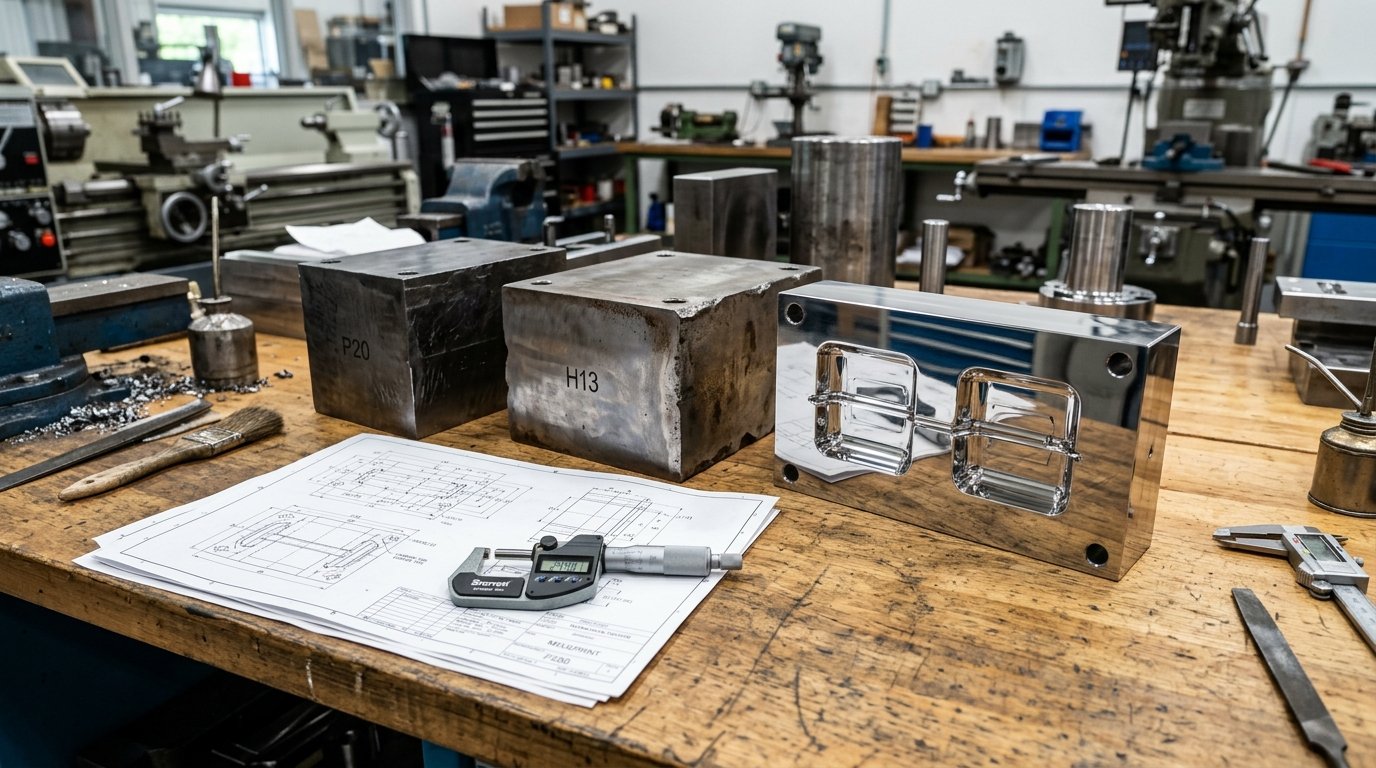
Most injection molds use one of four grades. P20 is the low-cost default for general resins, and H13 is hardened for long runs and glass-filled plastics. S136 is a stainless grade for corrosive resins and mirror finishes, while NAK80 polishes well without heat treatment. The right mold steel sets tool life, finish and much of the tooling cost.
How Mold Steel Affects Tool Life, Finish and Cost
The steel grade is chosen before the first cut and is expensive to change afterward. Three properties decide it:
- Hardness resists wear from filled resins and the constant closing of the parting line. Higher hardness usually means heat treatment after roughing, which adds time and a risk of distortion.
- Polishability caps the finish a cavity can reach. Clean, fine-grained steels polish to a mirror, while others show pits.
- Corrosion resistance matters when a resin releases acidic gas, as PVC and some flame-retardant grades do, or when molds sit in humid storage.
Steel is also a visible line on the quote, and our injection mold cost guide shows how it stacks up against cavity count and finish.
P20 vs H13 vs S136 vs NAK80 at a Glance
| Grade | 유형 | Working hardness | 힘 | Best fit |
| P20 (DIN 1.2311) | Pre-hardened low-alloy | Roughly 30 HRC as supplied | Low cost, fast to machine | PP, PE, ABS, PS at low to medium volume |
| 718 (DIN 1.2738) | P20 with added nickel | 290–330 HB as supplied | Even hardness in big blocks | Large P20-type molds |
| H13 (DIN 1.2344) | Hot-work, through-hardened | High 40s to low 50s HRC | Toughness, wear and heat resistance | Glass-filled nylon, long runs |
| S136 (AISI 420 mod., ~1.2083) | Stainless, hardened after machining | Around 50 HRC | Corrosion resistance, mirror polish | PVC, medical, clear parts |
| NAK80 | Precipitation-hardened, pre-hardened | 37–43 HRC as supplied | Polish, stable after EDM and welding | Cosmetic and textured parts |
The Four Grades in Detail
P20
P20 arrives pre-hardened, so it is machined straight to size with no furnace step, which keeps cost and lead time down. It wears quickly with glass-filled resins and will not take a true mirror finish, but for unfilled PP, ABS or PS housings it is the sensible default.
H13
H13 is a hot-work tool steel that is roughed soft, heat treated, then finished. It is tougher and far more wear resistant than P20. That is why it lasts with abrasive compounds. Heat treatment adds lead time, and thin cores can move, so leave stock for finishing.
S136
S136 is a modified 420 stainless, sold by Uddeholm as Stavax ESR. It is machined in the soft condition and hardened afterward. No other grade here matches its corrosion protection and mirror finish together, so it is standard for PVC, medical and optical lenses. A pre-hardened version, S136H, skips the heat treatment when extreme polish is not needed.
NAK80
NAK80 comes from Daido already aged to 37–43 HRC. Its datasheet shows uniform hardness through the block and no hardness rise after EDM or welding, which makes cavity repairs easy. It polishes very well and textures evenly, but it is not stainless.
On S136 vs NAK80, our view is simple. Choose NAK80 when you need a high-gloss or textured cosmetic surface and a fast tool; choose S136 when the resin or environment is corrosive, or when the part is an optical component.
Which Mold Steel Fits Your Resin and Volume?
Start with the resin, then check the volume. The Plastics Industry Association (formerly SPI) mold classes give a volume frame: Class 101 is built for 1 million cycles or more, Class 102 for up to 1 million, Class 103 for up to 500,000, Class 104 for up to 100,000, and Class 105 for prototypes of about 500 shots.
| Resin or requirement | Volume | Usual grade |
| Unfilled PP, PE, ABS, PS | Up to Class 103 | P20 or 718 |
| Unfilled resins | Class 101–102 | H13 or hardened stainless |
| Glass-filled nylon, PBT | Any | H13 |
| PVC or flame-retardant grades | Any | S136 |
| Clear PC or PMMA, lenses | Any | S136 |
| High-gloss or textured cosmetic | 낮음에서 중간 | NAK80 |
In the P20 vs H13 decision, glass fiber settles most cases. Filled resins scour P20 gates and parting lines, so the cheaper steel costs more once repairs start.
One Mold, Several Steels
A mold is rarely one steel. The cavity and core get the premium steel grade, while the mold base is usually a plain carbon steel and the retaining plates may be P20. Slides and lifters are often a hardened grade, and small cores that trap heat can switch to beryllium copper for its thermal conductivity. Parts that slide against each other need a hardness difference, or they gall. Nitriding or a PVD coating can also harden a P20 or H13 surface for extra wear life.
What to Put in Your Tooling Spec
Grade names get swapped in the supply chain, and a block stamped “S136” may not be the real steel. Cheaper mold steels are the usual substitutes. Specify these for all mold steels on the purchase order:
- Steel brand and DIN or AISI number for cavity, core, inserts and slides
- Final hardness for each component
- Mill certificate from the steel producer
- Hardness test report after heat treatment
- Required cavity finish, stated as an SPI polish grade
엘리트 몰드 테크의 플라스틱 사출 성형 team lists steel per component in every tooling quote, and inserts are cut on in-house wire EDM.
자주 묻는 질문
What is the best steel for injection molds?
No single grade wins. P20 is the most common because it is cheap and needs no heat treatment. H13 suits glass-filled resins and very long runs, S136 suits corrosive resins and optical parts, and NAK80 suits high-gloss cosmetic surfaces. Match the steel to the resin first, then to volume.
What is the difference between P20 and H13?
P20 is supplied pre-hardened at roughly 30 HRC and machined straight to size. H13 is machined soft, then through-hardened into the high 40s or low 50s HRC. That makes H13 far more wear resistant and tougher, at the cost of a heat-treat step, more lead time and a higher price.
Is NAK80 better than S136 for polishing?
Both reach a mirror finish. NAK80 gets there without heat treatment and stays stable after EDM and welding, so it is faster for cosmetic tools. S136 is hardened after machining and adds corrosion resistance, which matters for PVC, medical parts and humid storage. Pick by corrosion risk, not polish alone.
Can I use aluminum instead of steel for a mold?
Yes, for prototypes and short runs. Aluminum machines quickly and cools parts fast, which suits bridge tooling. It is softer than hardened steel, so it wears quickly with filled resins and dents easily at the parting line. For production volumes, steel remains the safer choice for tool life and dimensional stability.
Choosing the Right Steel for Your Next Tool
Pick mold steel by resin first, volume second and finish third, and write the grade and hardness for every component into the spec. When the choice is unclear, 엘리트 몰드 기술 reviews the part and resin before quoting, and its 생산 성형 line runs the tool once it is approved.