Vacuum casting is cheaper for the first few dozen parts, because a silicone mold costs a fraction of a machined tool. Injection molding wins beyond that, since each molded part costs far less. The break-even point in vacuum casting vs injection molding depends on size, complexity and resin. Calculate it per part.
각 프로세스의 작동 방식
Vacuum Casting
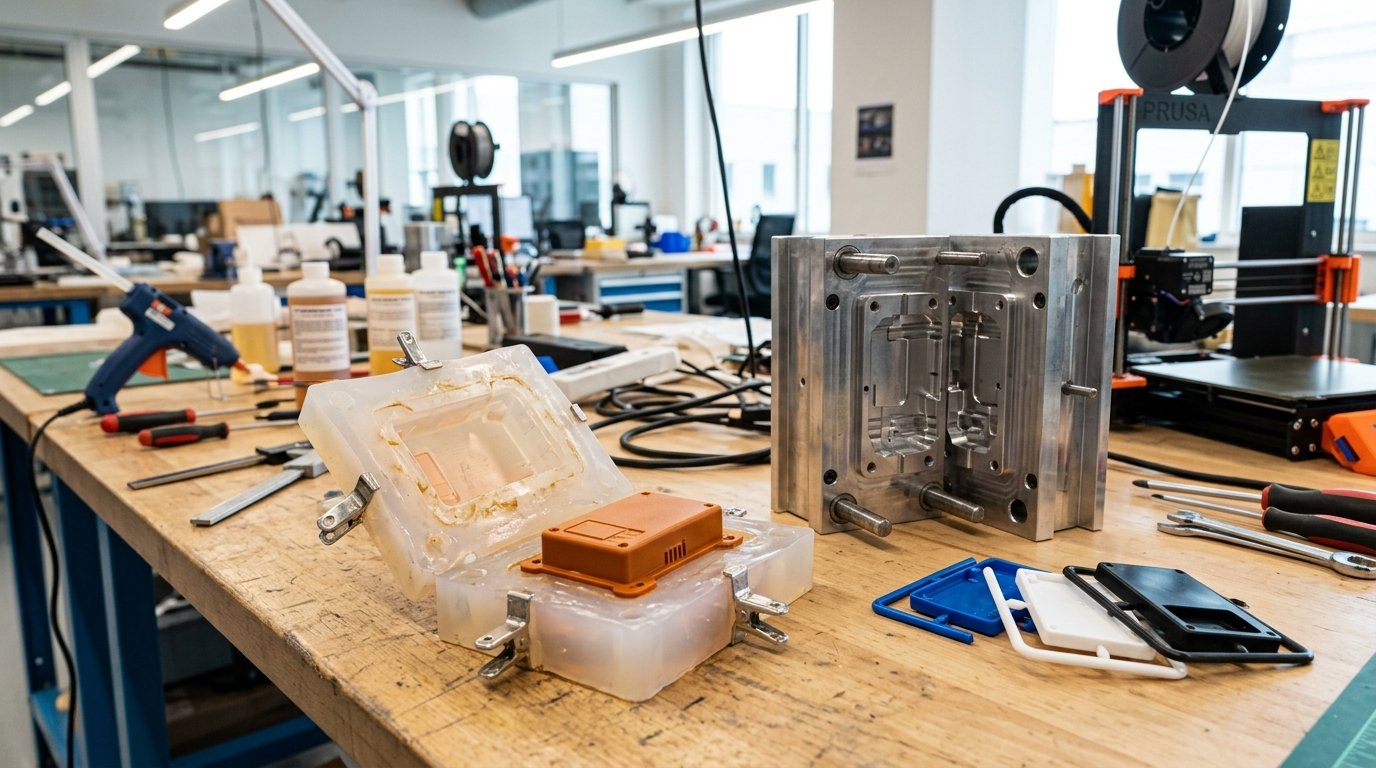
A master pattern, usually SLA-printed or CNC machined, is suspended in a box and covered in liquid silicone. Once cured, the silicone is cut open and the master removed, leaving a cavity. Two-part polyurethane (PU) resin is mixed, degassed and poured into the mold inside a vacuum chamber, then cured in an oven.
Each rubber tool wears out after a limited number of castings. Industry quotes range from about 10 to 30 parts, depending on geometry and resin, and then a new mold is made from the same master.
사출 성형
A machined metal tool, aluminum for short runs or steel for production, is mounted in a molding machine. Thermoplastic pellets are melted and injected under high pressure, cooled and ejected. Cycle times run in seconds, and a steel tool can last hundreds of thousands of shots or more.
Vacuum Casting vs Injection Molding Side by Side
The table sums up how casting and molding compare on the factors that drive a sourcing decision.
| 요인 | Vacuum casting | 사출 성형 |
| 툴링 | Silicone mold from a master | Machined aluminum or steel tool |
| 금형 비용 | 낮음 | 높음 |
| 단가 | 높음 | 낮음 |
| Tool life | About 10–30 castings per mold | Thousands to 1M+ shots |
| First parts | 일 | Weeks, after tool build |
| 재료 | PU resins that imitate ABS, PC, PP or rubber | The actual production thermoplastic |
| Repeatability | Drifts as the mold wears | Stable, process-controlled |
| 최상의 대상 | Prototypes, pilot runs, market tests | Production and repeat orders |
What Drives the Cost of Casting or Molding
The cost logic of casting vs molding is simple. Vacuum casting has little fixed cost: one master, then a fresh rubber tool for every batch of castings. Labor dominates, because every part is mixed, poured and cured by hand.
Injection molding reverses that. The tool is a large one-time cost, and every part after it costs little more than resin and machine time. Our injection mold cost guide breaks down what goes into that tool price.
How to Calculate Your Break-Even Quantity
Rubber tools wear out. Vacuum casting cost therefore rises in steps rather than along a straight line, and that shape matters. Use these two formulas:
- Vacuum casting total = master cost + (number of molds × mold cost) + (quantity × casting cost)
- Injection molding total = tool cost + (quantity × molded part cost)
Number of molds = quantity ÷ castings per mold, rounded up.
Worked example (hypothetical prices, for illustration only): a master costs $300, each rubber tool $400 and lasts 20 castings, and each casting costs $25. An aluminum tool costs $4,000 and each molded part $2.
| 수량 | Vacuum casting | 사출 성형 |
| 20 | $1,200 | $4,040 |
| 50 | $2,750 | $4,100 |
| 80 | $3,900 | $4,160 |
| 81 | $4,325 | $4,162 |
| 150 | $7,250 | $4,300 |
Here the break-even quantity falls at 81 parts, the point where a fifth rubber tool is needed. Your numbers will differ, so plug in real quotes for vacuum casting or injection molding on the same part. A break-even that lands right after a mold change is worth a second look, since shaving a few parts off the order may keep vacuum casting ahead.
Lead Time and Program Risk
Vacuum cast parts often ship within days of an approved master, which suits a trade show deadline or a user trial. An injection mold takes weeks to build and sample before the first approved part.
In the casting vs molding decision, speed is not the only risk. Committing to a production tool before the design is frozen means paying for tool changes later. We would rather see a customer run 30 cast parts through testing than cut steel on a design that is still moving.
Materials: Close, But Not the Same
Cast PU resins imitate thermoplastics. There are ABS-like, PC-like and PP-like grades, clear resins, and flexible grades from soft to firm on the Shore A scale. They are close enough for fit checks, looks and many functional tests. Shrinkage differs from the production resin, though, so tight tolerances measured on cast parts will shift once the part is molded, and later castings drift as the rubber tool wears.
They are not the production resin, and this is where injection molding vs vacuum casting differs most for regulated products. Flammability ratings such as UL 94, tested by bodies like UL Solutions, are tied to a specific resin grade. Food-contact compliance under 21 CFR Part 177 likewise applies to the actual material. For those tests you need molded parts in the production resin.
Designs That Cast but Will Not Mold
Flexible silicone forgives features that a rigid steel tool cannot release: zero draft, deep undercuts and trapped internal shapes. A part can pass every cast-prototype test and then need redesign before tooling.
The fix is simple. Design the master as if it were already a molded part: add draft, keep walls uniform, and flag every undercut for a side action or lifter so the toolmaker can price it early. That same review also settles tool material, which our guide to choosing mold steel covers.
When to Switch From Casting to Molding
The choice between vacuum casting and injection molding usually changes over a product’s life.
- Stay with vacuum casting while the design is changing, quantities are small, or you need parts for a demo in days. Most low-volume production programs start here.
- Move to an aluminum bridge tool when the design is frozen and you need hundreds to a few thousand parts in the real resin.
- Move to a hardened steel tool once demand is proven and volumes justify the investment.
Even so, low-volume production can justify a tool. When a part needs production resin, certification or tight repeatability, a simple aluminum tool can be the smarter first step even at modest quantities.
자주 묻는 질문
How many parts can one silicone mold make?
Industry quotes range from about 10 to 30 castings per mold. The count depends on part geometry, sharp details that tear the silicone, and the resin, since some grades attack silicone faster. Once a mold degrades, a fresh one is poured from the same master, which adds cost in steps.
Is vacuum casting cheaper than injection molding?
For small quantities, yes, because a rubber tool costs a fraction of a machined one. As quantity grows, the higher cost per casting and repeated mold replacement add up, and injection molding becomes cheaper. It depends on the part. Compare real quotes with the break-even formula.
How long does vacuum casting take compared to injection molding?
Vacuum cast parts can ship within days once the master is approved, because the rubber tooling is poured and cured quickly. Injection molding needs a machined tool first, which takes weeks to build, sample and approve. After that, molding produces parts far faster than casting.
Can vacuum cast parts be sold to customers?
Yes, for low quantities where the PU resin meets the product’s needs, such as pilot runs, market tests or specialist equipment. Check certification first. Flammability or food-contact approvals tied to a specific thermoplastic grade will not carry over to a cast polyurethane substitute, so regulated products usually need molded parts.
Are vacuum cast parts as strong as injection molded parts?
Usually not quite. PU resins imitate thermoplastics but do not match every property, particularly heat resistance, chemical resistance and long-term creep. For fit, appearance and many functional tests they are close enough. For load, heat or chemical testing, confirm results on parts molded in the production resin.
Vacuum Casting vs Injection Molding: Making the Call
Treat vacuum casting vs injection molding as a sequence, not a rivalry, with a bridge tool often sitting between them. Cast while the design moves, calculate the break-even with real quotes, and switch to a tool once the design is frozen and the volume is proven. Elite Mold Tech offers 우레탄 및 실리콘 주조 for early builds, 플라스틱 사출 성형 for production, and a full range of rapid prototyping services in between. Send a part file to 엘리트 몰드 기술 for a quote on both routes.