1. Introduction: What is the Main Difference Between 304 and 316 Stainless Steel?
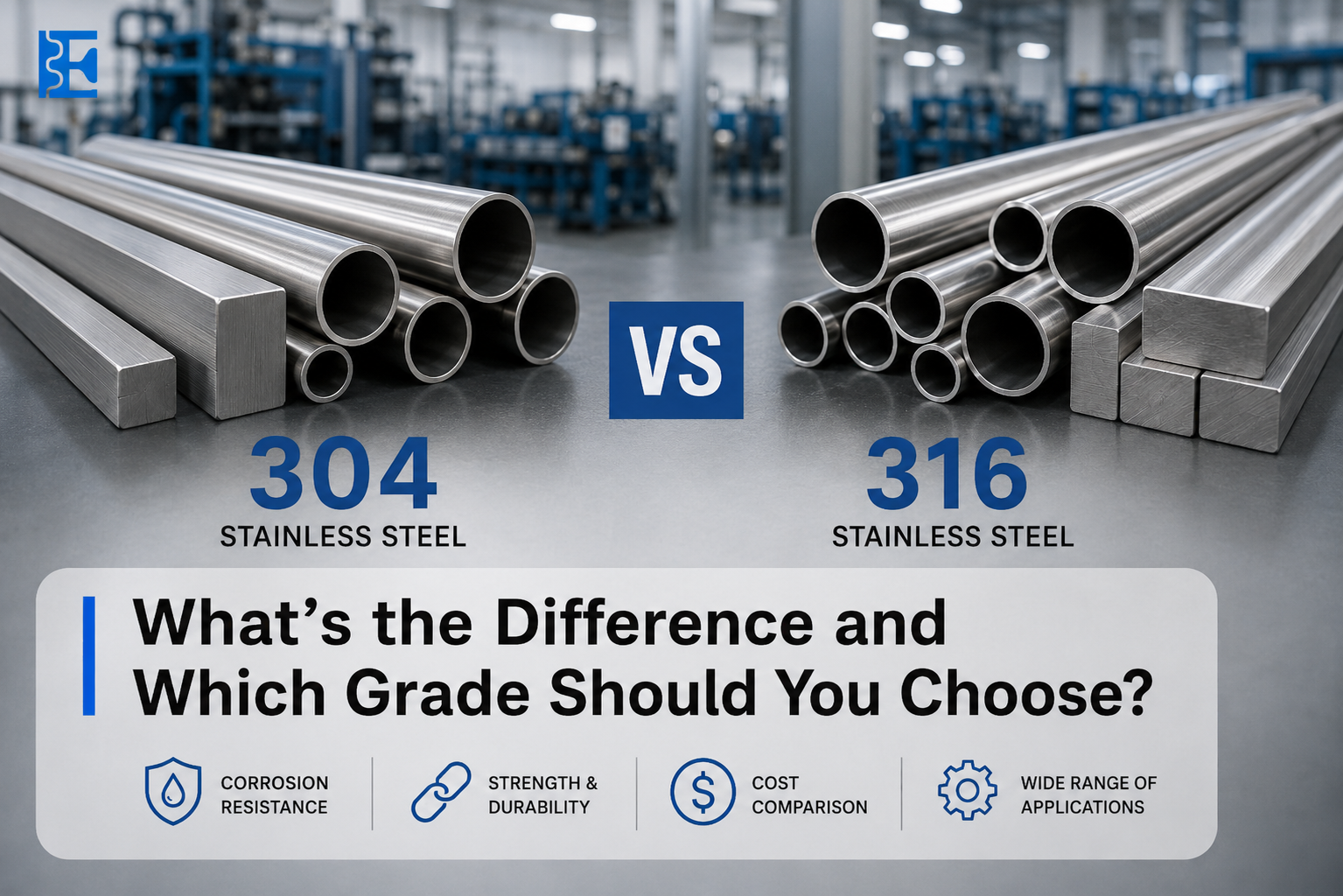
The primary metallurgical difference between 304 and 316 stainless steel is that Grade 316 contains 2% to 3% molybdenum (Mo), while Grade 304 contains none.4
This single chemical addition fundamentally transforms how each material behaves under environmental stress.6 While Grade 304 is the most widely used and cost-effective option for general-purpose applications, Grade 316 offers superior resistance to chloride-induced pitting, making it the undisputed standard for marine, chemical, and highly sterile pharmaceutical environments.
At (https://elitemoldtech.com/), we assist engineers, procurement managers, and product designers in evaluating and choosing the precise materials for custom injection mold design, precision CNC machining services, high-speed metal stamping services, and advanced metal injection molding (MIM) services.8 Choosing the incorrect grade can lead to premature mechanical failure, while over-specifying raw materials can unnecessarily inflate manufacturing costs.7
2. Technical Comparison Table: 304 vs 316 Stainless Steel
To assist with technical sourcing and procurement decisions, the table below outlines the core properties, costs, and limits of both grades :
| Performance Attribute | 304 Stainless Steel (UNS S30400) | 316 Stainless Steel (UNS S31600) | Engineering Sourcing Guideline |
| Chromium Content | 18.0% – 20.0% | 16.0% – 18.0% | Chromium reacts with oxygen to form a passive, protective oxide layer. |
| Nickel Content | 8.0% – 10.5% | 10.0% – 14.0% | Nickel stabilizes the face-centered cubic structure, enhancing toughness. |
| Molybdenum Content | None | 2.0% – 3.0% | Molybdenum boosts resistance to localized chloride pitting. |
| Pitting Resistance (PREN) | 18.0 – 20.0 | 23.0 – 29.0 | Higher values signify superior defense against localized corrosion. |
| AISI Machinability Rating | 70% (Baseline) | 60% (Baseline) | 304 cuts more easily; 316 is gummier and wears tooling faster. |
| Corrosion Performance | Excellent in mild media | Superior in saline and acidic media | Specify 316 if parts contact salt, acids, or harsh cleaners. |
| Upfront Raw Material Cost | Baseline | 20% to 40% Higher | The premium is driven by global molybdenum and nickel alloy costs. |
| Best Applications | Appliances, food equipment, brackets | Marine hardware, medical implants, chemical piping | Align material with actual environmental exposure, not over-specification. |
3. Chemical Composition and Technical Specifications
Both 304 and 316 belong to the austenitic family of stainless steels, defined by their non-magnetic nature, high ductility, and exceptional formability.7 Their chemical profiles are strictly defined under international standards such as ASTM A240 4:
Elemental Weight Percentages under ASTM A240 Standards
| Element | Grade 304 (UNS S30400) | Grade 304L (UNS S30403) | Grade 316 (UNS S31600) | Grade 316L (UNS S31603) |
| Carbon (C) | 0.08% max | 0.03% max | 0.08% max | 0.03% max |
| Chromium (Cr) | 18.00% – 20.00% | 18.00% – 20.00% | 16.00% – 18.00% | 16.00% – 18.00% |
| Nickel (Ni) | 8.00% – 10.50% | 8.00% – 12.00% | 10.00% – 14.00% | 10.00% – 14.00% |
| Molybdenum (Mo) | — | — | 2.00% – 3.00% | 2.00% – 3.00% |
| Manganese (Mn) | 2.00% max | 2.00% max | 2.00% max | 2.00% max |
| Silicon (Si) | 0.75% max | 0.75% max | 0.75% max | 0.75% max |
| Nitrogen (N) | 0.10% max | 0.10% max | 0.10% max | 0.10% max |
| Phosphorus (P) | 0.045% max | 0.045% max | 0.045% max | 0.045% max |
| Sulfur (S) | 0.030% max | 0.030% max | 0.030% max | 0.030% max |
| Iron (Fe) | Balance | Balance | Balance | Balance |
The Structural Role of Molybdenum
In standard Grade 304, chloride ions from saltwater or chemical cleaners can penetrate microscopic imperfections in the protective chromium oxide film, causing localized pitting and crevice corrosion.13
The addition of molybdenum in Grade 316 acts as a chemical shield.15 Molybdenum alters the atomic lattice, forming a highly stable, self-healing compound that stops chloride ions from breaking down the passivated surface.15
Low-Carbon Variants: Why Choose 304L and 316L?
During standard welding operations, temperatures in the heat-affected zone (HAZ) rise to between 425°C and 860°C.17 In this range, standard grades with higher carbon content experience sensitization—where carbon binds with chromium to form chromium carbides along the grain boundaries.17 This depletes the local chromium needed for corrosion protection, rendering the weld seam vulnerable to rapid rust (weld decay).17
To eliminate this failure mode, low-carbon variants 304L and 316L restrict carbon content to a maximum of 0.03%.4 This extremely low level prevents carbide precipitation, ensuring welded joints maintain the exact same rust resistance as the parent metal.15
4. Corrosion Resistance Profiles and PREN Calculations
To scientifically compare how different alloys resist localized chemical damage, engineers utilize the Pitting Resistance Equivalent Number (PREN) formula 19:
$$PREN=\%Cr+3.3\%Mo+16\%N$$
Because austenitic steels use nitrogen as an interstitial stabilizer, a multiplier of  is applied.19 Plugging the standard chemical ranges of ASTM A240 into this equation reveals a stark contrast 13:
- Grade 304 PREN:
 13
13 - Grade 316 PREN: 13
In the marine sector, a PREN value of 32 is widely recognized as the minimum threshold for permanent saltwater immersion without pitting risk.13 While Grade 316 (PREN ~25) does not meet this threshold for permanent submersion without a continuous cleaning regimen, it easily resists salt spray, coastal humidity, and regular splash zones where Grade 304 would oxidize rapidly.14
Comparative Corrosion Rates in Chloride and Marine Environments
In laboratory testing simulating aggressive marine environments (e.g., exposure to a 3.5% sodium chloride solution):
- Grade 304 exhibits a corrosion rate of 0.01 mm/year.21
- Grade 316 exhibits a corrosion rate of only 0.001 mm/year—representing a tenfold () improvement in durability.21
When the concentration of chloride ions exceeds 200 ppm, standard 304 stainless steel experiences rapid crevice corrosion and pitting, with corrosion rates climbing to 0.02-0.05 mm/year.22 Under the exact same conditions, Grade 316 remains chemically passive, ensuring tight seals and structural integrity.22
5. Mechanical and Physical Properties Evaluation
Sourcing managers often make the mistake of choosing Grade 316 because they believe it is physically stronger than Grade 304.23 In reality, their mechanical and load-bearing properties are almost identical in standard annealed conditions 24:
| Mechanical Property | Grade 304 Stainless Steel | Grade 316 Stainless Steel | Technical Application Impact |
| Ultimate Tensile Strength | 515 MPa (75,000 psi) |  515 MPa (75,000 psi) 515 MPa (75,000 psi) | Identical limits under ultimate static or structural loads. |
| Yield Strength (0.2% Offset) | 205 MPa (30,000 psi) | 205 MPa (30,000 psi) | Identical deflection limits under standard working loads. |
| Elongation (in 50mm) | 40% | 40% | Excellent ductility; supports complex deep stamping. |
| Rockwell B Hardness | 70 HRB (92 HRB max) | 79 HRB (95 HRB max) | 316 is slightly harder, increasing wear resistance but also tool wear. |
| Density | 7.93 g/cm³ – 8.00 g/cm³ | 7.98 g/cm³ – 8.00 g/cm³ | Weight profiles are practically identical. |
| Max Continuous Temp Limit | 870°C | 925°C | 316 offers superior yield strength at elevated temperatures. |
Magnetism and Cold-Working Material Behavior
Both 304 and 316 are fully non-magnetic in their annealed states.25 However, cold-working processes—such as CNC machining, bending, stamping, or rotary draw drawing—introduce localized shear stresses that transform a portion of the non-magnetic austenite into magnetic martensite.25
Because Grade 316 has a higher nickel content (10% to 14%), its austenitic structure is significantly more stable.28 Consequently, Grade 316 remains highly resistant to magnetic transformation, making it the preferred choice for surgical implants, MRI equipment, and sensitive aerospace guidance systems.27
6. CNC Machining & Fabrication Characteristics
Austenitic stainless steels are notoriously difficult to machine due to their low thermal conductivity, high toughness, and strong tendency to work-harden.23
Machinability Index and Feed/Speed Optimization
According to AISI standards, Grade 304 has a machinability rating of 70% (relative to free-machining carbon steels), while Grade 316 has a rating of 60%.30 The molybdenum in 316 makes it “gummier” during cutting, requiring a 15% reduction in cutting speed to control thermal load at the tool’s edge.24
At (https://elitemoldtech.com/3-4-axis-cnc-machining/) our CNC programmers use specific spindle and chip load parameters to ensure precise dimensional accuracy:
| Machining Parameter | Grade 304 Stainless Steel | Grade 316 Stainless Steel | Recommended Tooling & Toolpath Strategy |
| Milling Cutting Speed () | 70 – 120 m/min | 60 – 100 m/min | TiAlN or AlTiN-coated solid carbide end mills. |
| Milling Feed Rate () | 0.03 – 0.06 mm/tooth | 0.02 – 0.05 mm/tooth | Constant, positive feed prevents work hardening. |
| Turning Cutting Speed () | 80 – 160 m/min | 65 – 140 m/min | Positive-geometry indexable coated carbide inserts. |
| Coolant Requirements | Standard Flood Coolant | High-Pressure Coolant (+20% Flow) | Extreme pressure additives reduce micro-roughness. |
The Golden Rule for Machining Stainless: Never let the tool rub!29 If the feed rate is too light or the spindle dwells, the tool friction creates a work-hardened outer skin that immediately ruins carbide cutting edges.24 Elite Mold Tech employs high-rigidity CNC setups and positive tool paths to ensure the cutter stays beneath the work-hardened zone.29
Bending, Stamping, and Advanced Fabrication Services
- (https://elitemoldtech.com/tube-bending/): Grade 304 is often selected for complex, multi-planar structural frames because its superior ductility allows it to bend smoothly with less springback.33 For marine or hydraulic lines, we utilize CNC rotary draw mandrel bending on Grade 316L to achieve perfect, un-collapsed radii.34
- (https://elitemoldtech.com/metal-stamping/): We manufacture custom progressive stamping dies to form high-volume brackets, EMI shielding, and clips.8 While both 304 and 316 can be stamped, 316’s slightly higher strength requires robust press systems to prevent die wear.27
- Metal Injection Molding (MIM): For complex three-dimensional geometries that are impossible or too expensive to mill, our custom MIM services combine the design flexibility of plastic molding with sintered 316L stainless steel to deliver dense, high-strength end-use parts.10
7. Sourcing Recommendations by Industry Application
Choosing between 304 and 316 is heavily dictated by the operating environment and industry-specific regulations 35:
Food & Beverage Equipment
Both 304 and 316 are certified food-safe materials under FDA and NSF standards.7 Grade 304 is the default choice for milk processing, brewing pipelines, and kitchen appliances.26 However, in systems handling highly acidic or salty foods (e.g., tomato paste, citrus fruits, brine mixtures) or facilities utilizing aggressive chlorine-based Clean-in-Place (CIP) sanitization, Grade 316 is mandatory to prevent bacterial growth inside microscopic corrosion pits.7
Marine Hardware & Coastal Infrastructure
For any part installed within 5 miles of a coastline, Grade 316 is the absolute baseline.35 Using Grade 304 in marine splash zones or saltwater immersion results in structural failure and cosmetic “tea staining” within a matter of months.36 Boat winches, offshore oil rig enclosures, and coastal architectural elements rely heavily on Grade 316L.35
Medical and Pharmaceutical Processing
Medical cleanrooms, drug formulation tanks, and orthopedic implants demand complete chemical purity.18 Grade 316L is the industry standard here.39 Its non-reactive nature ensures that organic acids and chemical sanitizers do not cause metal leaching.36 For implantable devices, specialized 316L meeting ASTM F138 standards guarantees high biocompatibility and zero patient risk.21
8. Cost Analysis and Total Cost of Ownership (TCO)
Sourcing decisions should never be based solely on upfront material costs.41 A thorough life-cycle assessment proves that paying a premium for Grade 316 often yields substantial savings over time.41
Upfront Sourcing Premium
Grade 304 typically trades between $2.50 and $5.00 per kilogram, whereas Grade 316 ranges from $3.50 to $6.50 per kilogram.35 This price gap—representing a 20% to 40% raw material premium—is driven by the high cost of molybdenum (averaging $20–$24 per pound in 2026) and the higher nickel content in Grade 316.35
20-Year Lifecycle Cost Comparison
In corrosive environments (such as chemical processing or coastal installations), Grade 304 has a realistic lifespan of only 5 years before structural pitting requires replacement.21 By contrast, Grade 316 can easily withstand 20+ years of continuous service.21
Below is a realistic TCO financial model based on a typical 100kg industrial component 21:
| TCO Cost Element (20-Year Horizon) | Grade 304 Stainless Steel | Grade 316 Stainless Steel | Technical & Financial Justification |
| Initial Material & Machining | $1,000 (Baseline) | $1,400 (+$400) | 316 costs more upfront due to alloying elements and tougher cutting.21 |
| Expected Component Lifespan | 5 Years | 20 Years | 304 degrades due to stress corrosion; 316 resists chloride attack.21 |
| Required Replacements (20 Yrs) | 3 Times | 0 Times | Repeated equipment degradation forces system rebuilds.21 |
| Cumulative Material Sourcing | $5,000 | $1,400 | Choosing 316 eliminates repeated procurement cycles.21 |
| Cumulative Maintenance Labor | $2,000 (4x $500) | $500 (1x $500) | Labor hours are saved by avoiding weld repairs and tear-downs.21 |
| Production Downtime Costs | $4,000 | $1,000 | Fewer line shutdowns prevent expensive lost productivity.21 |
| Total Cumulative TCO Cost | $11,000 | $2,900 | Grade 316 delivers a 74% cost reduction over 20 years 21. |
9. Frequently Asked Questions (FAQs)
Is 316 stainless steel better than 304?
Grade 316 is superior for environments containing saltwater, chlorides, and strong industrial acids.7 However, Grade 304 is the more economical, practical choice for indoor products and standard atmospheric conditions where aggressive chemical exposure is absent.7
Does 304 stainless steel rust?
Yes.5 Although 304 is highly corrosion-resistant, it will rust and pit if subjected to prolonged exposure to saltwater, salt air, bleach, or pool chemicals.15
Is 316 stainless steel magnetic?
In its annealed state, Grade 316 is fully non-magnetic.25 However, heavy CNC milling, turning, or cold-working can cause slight magnetic properties due to a localized phase change to martensite.25 It remains significantly less magnetic than 304 under the same stresses.27
Which stainless steel is best for food processing?
Grade 304 is the standard for general dry-good handling, dairy, and brewing.7 Grade 316 should be selected for high-salt foods, acidic ingredients (such as citrus or tomato products), or equipment regularly washed with chlorine-based sanitizers.7
Why is 316 called marine grade stainless steel?
It contains 2% to 3% molybdenum, which increases its resistance to chloride-induced pitting, allowing it to withstand coastal air and saltwater spray far better than standard grades.30
What is the difference between 304L and 316L?
The “L” stands for low carbon ( 0.03%).15 These variants are designed for welding applications to prevent chromium carbide precipitation, ensuring the welded joints retain full corrosion resistance.18
10. Partner with Elite Mold Tech for Precision Manufacturing
Selecting the correct grade of stainless steel is only half the battle; achieving dimensional accuracy on tough, work-hardening alloys requires expert manufacturing execution.24
At Elite Mold Tech, we operate state-of-the-art 3-axis, 4-axis, and 5-axis CNC mills and turning centers, allowing us to hold standard tolerances of 0.05 mm and high-precision tolerances down to 0.005 mm.9 We specialize in:
- High-Precision CNC Machining: Streamlined machining of stainless steels, titanium, aluminum, and engineering plastics.9
- (https://elitemoldtech.com/quick-turn-injection-molding/): Advanced tooling and molding with conformal cooling systems to optimize cycle times and eliminate part warping.39
- Comprehensive DFM Consultation: Professional engineering feedback to optimize your designs for cost-effectiveness and manufacturability before production begins.44
Ready to start your next project? Contact our engineering team today to submit your CAD files and receive a detailed, competitive RFQ quote within 24 hours.44