By Phil Huang, Elite Mold Tech. Updated November 2, 2026.
Type II anodizing is the standard decorative and protective coating for aluminum. Type III, also called hardcoat, is thicker, harder, and costs more. Type II takes a full range of dye colors. Type III is mostly dark gray, bronze, or black. The choice comes down to wear, color, fit, and budget. This guide compares the two on the points that matter for CNC machined aluminum parts.
Choose Type II for looks and light protection. Choose Type III for wear surfaces such as gears, sliding parts, and bores.
Key takeaways
- Type II is typically 0.0002 to 0.0012 in thick. Type III is typically 0.002 in, and up to 0.004 in.
- Type III is harder and far more wear resistant, but costs more.
- Type II comes in a full range of dye colors. Type III is usually left natural or dyed black.
- Both coatings change part size. Type III changes it about ten times more, so plan the fit.
- Type III can lower fatigue strength on certain high-strength alloys.
What is the difference between anodizing Type 2 and Type 3?
Type II is regular sulfuric acid anodizing, and Type III is sulfuric acid hardcoat anodizing that runs at a lower temperature, costs more, and is slightly harder (OMW, 2026). Both grow a hard oxide layer on the aluminum, and the layer is part of the metal, not paint. The main differences are thickness, hardness, color range, and cost.
Item | Type II | Type III (hardcoat) |
Typical thickness | 0.0002 to 0.0012 in (about 5 to 30 μm) | About 0.002 in (about 50 μm), up to 0.004 in |
Hardness | Moderate | About 400 to 530 HV |
Wear resistance | Handles scuffing and handling | About ten times better in Taber abrasion tests |
Color | Full dye range | Natural dark gray to bronze, or black dye |
Size change per surface | About 0.0001 to 0.0004 in | About 0.001 in |
Cost | Lower | Higher |
Best for | Housings, panels, cosmetic parts | Gears, pistons, bores, sliding parts |
Sources: OMW “Understanding and Specifying Anodizing” and Gleco Plating (2026). Values are typical and vary by shop and spec. We have not run our own tests.
What do we offer for Type II and Type III?
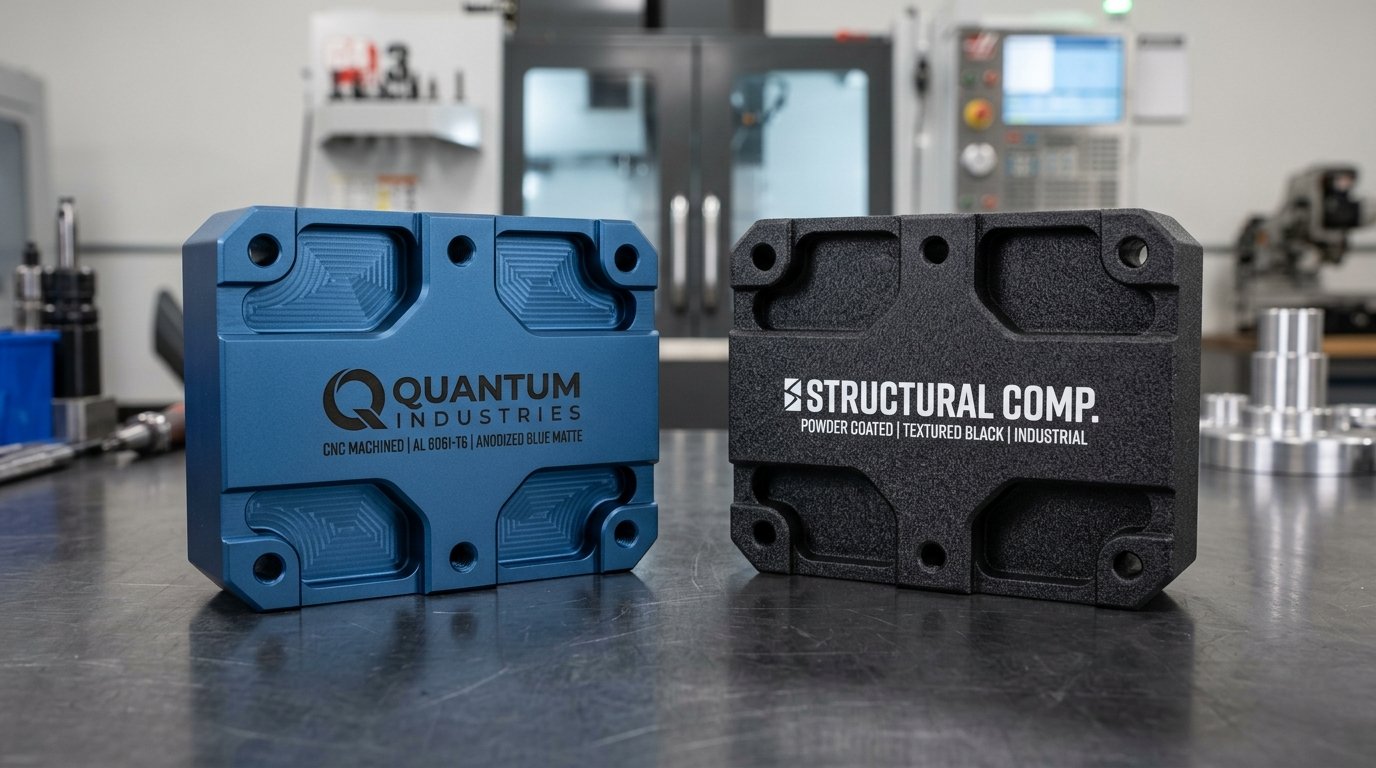
Our Type II page lists clear, black, red, blue, orange, and gold, and our anodizing page says you can choose Type II (decorative) or Type III (hard coat) (Elite Mold Tech, 2026). We also do anodizing, powder coating, and polishing for aluminum parts.
- Type II: decorative color options, ideal for consumer products. See our Type II anodizing page.
- Type III: hard coat for wear. Ask us for thickness and hardness on your part.
Our pages do not publish a hardness value, a specification number, or a thickness for Type III. Ask for these at quote, and tell us the spec on your drawing. Read our aluminum anodizing services page for the full process.
Anodizing type 2 vs type 3: how thick is each coating, and how does it change part size?
Anodizing grows into the metal and out of it, so part size changes. A common rule says about half the coating builds up and half penetrates, though Type II is closer to two thirds in and one third out (OMW, 2026). Type III builds up about half its thickness per surface.
Feature | Type II (about 0.0008 in coating) | Type III (0.002 in coating) |
Growth per surface | About 0.0002 to 0.0003 in | About 0.001 in |
Effect on a hole diameter | Shrinks about 0.0004 to 0.0006 in | Shrinks about 0.002 in |
Effect on a shaft diameter | Grows about 0.0004 to 0.0006 in | Grows about 0.002 in |
Worked arithmetic from the growth figures above, for two surfaces on a diameter. Not a guarantee. Confirm the real number for your spec.
For a 0.500 in bore, Type III can pull the diameter down by about 0.002 in. That is twice the ±0.001 in we hold on critical features, so a tight fit fails unless you account for it. The fix is to tell us the finish and whether each tolerance applies before or after coating. See our guide to anodizing tolerance on CNC parts, and our guide to aluminum CNC machining tolerances.
Which anodizing is harder and more wear resistant?
Type III is harder and far more wear resistant. Published data shows about 400 to 530 HV for hardcoat and about ten times better wear in Taber abrasion testing than Type II (Gleco Plating, 2026). Use it where parts slide, rub, or take repeated contact.
- Choose Type III for: gears, cams, pistons, cylinder bores, sliding guides.
- Choose Type II for: enclosures, brackets, panels, cosmetic faces.
Hardcoat has a trade-off. It can reduce fatigue strength, with a debit of 30 to 50% reported on certain high-strength alloys (Gleco Plating, 2026). If the part is fatigue critical, such as a 7075 aerospace fitting, ask your engineer before you specify Type III. Our guide to 7075 aluminum CNC machining covers that alloy.
What colors can you get with each type?
Type II takes dye well in black, red, blue, gold, orange, and clear. Type III is usually left natural or dyed black. Natural hardcoat is already dark, ranging from dark gray to dark olive or bronze, and thicker layers look darker (OMW and Elite Mold Tech, 2026).
Alloy affects color too. Copper and zinc do not anodize the same way, so 7075 and 2024 give different colors than 6061. 7075 shows a yellow tint in clear anodizing, and its black is less deep (OMW, 2026). 6061 and the 3000 and 5000 series look more consistent. If color match matters, ask for a sample. Our guide to aluminum CNC surface finishes compares every finish.
How does cost compare?
Type III costs more. It runs at a lower temperature but needs higher current and voltage, so it uses more energy, and it is usually considerably more expensive than Type II (OMW, 2026). Masking adds cost too, since it is largely hand work.
- Process: hardcoat needs more energy and longer bath time.
- Masking: Type III usually needs masking on threads and tight bores.
- Inspection: thickness checks add time.
We do not publish anodizing prices because they depend on size, color, and quantity. Send a drawing for a quote. See our guide to aluminum CNC machining cost for the wider picture.
How do you choose between Type II and Type III?
Choose by the job the surface does. Use this short check:
- Does the surface slide, rub, or wear? Yes points to Type III.
- Does it need a bright or specific color? Yes points to Type II.
- Is the fit tight? Plan extra allowance for Type III, and mask critical bores or threads.
- Is the part fatigue critical? Check the fatigue debit before you pick Type III.
- Is budget tight? Type II costs less.
Many parts use both ideas: mask the wear face for hardcoat, and leave the rest as machined or Type II. Say so on the drawing, with each face marked.
What should you put on the drawing?
State the type, the class, the color, the thickness, and where it applies. For example: “Anodize per MIL-A-8625 Type III, Class 1, 0.002 in on face A. Mask bore B.” Name the specification you need, because our site does not name one.
- Type and class (II or III, dyed or undyed).
- Thickness target and whether it includes the growth.
- Masking notes for threads and tight bores.
- Before or after coating for each critical tolerance.
- Alloy and temper, since they change color.
Get your anodized aluminum parts quoted
Send your 3D file and 2D drawing, and tell us the anodizing type, color, and where it applies. Our engineers will check the fit, flag cost drivers, and quote the part. We guarantee a response within 12 hours.
Ready to start? Request a quote, read about our aluminum CNC machining service, or visit the Elite Mold Tech home page.
Frequently asked questions
Q: What is the main difference between Type II and Type III anodizing?
A: Type III is thicker, harder, and more wear resistant, and it costs more. Type II is thinner, takes a full range of dye colors, and suits decorative and light-duty protection.
Q: How thick is Type II anodizing?
A: Typically 0.0002 to 0.0012 in (about 5 to 30 μm). Ask us to confirm the target for your part, because shops and specs differ.
Q: How thick is Type III hard anodizing?
A: Typically about 0.002 in (about 50 μm), and up to 0.004 in. About half of it builds above the original surface, so plan for size change.
Q: Does anodizing change dimensions?
A: Yes. Type II grows about 0.0001 to 0.0004 in per surface, and Type III grows about 0.001 in per surface. Tell us the finish and whether tolerances apply before or after coating.
Q: Can Type III hardcoat be dyed any color?
A: Usually not. It is typically left natural, which is dark gray to bronze, or dyed black. Type II is the choice for a wide color range.
Q: Does hardcoat anodizing weaken aluminum?
A: It can reduce fatigue strength. A 30 to 50% debit is reported on certain high-strength alloys. Ask your engineer before you use it on fatigue-critical parts.
Sources
- OMW Corp, Understanding and Specifying Anodizing: omwcorp.com
- Gleco Plating, Type II vs Type III Anodizing: glecoplating.com
- Elite Mold Tech, Anodizing Type II page (2026): elitemoldtech.com/surface-finish/anodizing-type-ii
- Elite Mold Tech, Aluminum Anodizing Services page (2026): elitemoldtech.com/surface-finish/aluminum-anodizing-services