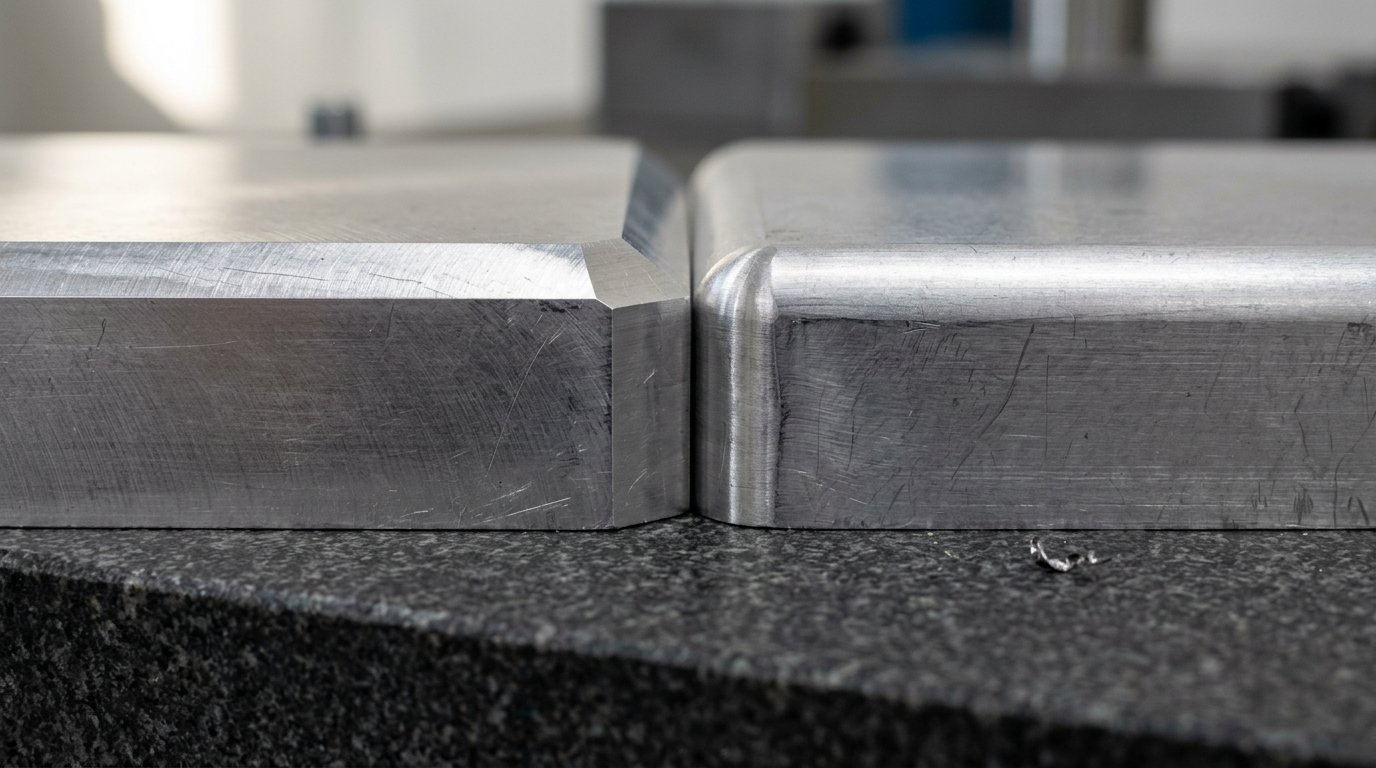
Put a fillet on every edge of a machined part and the quote goes up for features nobody needed. Put a chamfer in a loaded inside corner and the part can crack there first. The chamfer vs fillet choice looks cosmetic in a CAD model, but it changes tooling, cycle time and strength.
This guide compares chamfers and fillets on strength, cost, process and drawing callouts.
What is the difference between a chamfer and a fillet?
A chamfer is a flat, angled cut that replaces a sharp edge, most often at 45 degrees. A fillet is a rounded transition of a set radius between two surfaces. Chamfers are usually faster to cut and guide parts together during assembly. Fillets spread load around a corner, so they belong where a part carries stress.
A round is a fillet on an outside edge. A bevel usually slopes the full thickness; a chamfer only trims the corner.
Chamfer vs fillet: comparison table
| Factor | Chamfer | Fillet |
| Shape | Flat angled face, defined by leg length and angle | Curved face, defined by radius |
| Strength under load | Leaves two smaller corners | Smooth load path, lower peak stress |
| CNC tooling | Chamfer mill, spot drill or countersink; one tool covers many sizes | Corner-rounding end mill sized to the radius, or ball end mill |
| Internal vertical corners | Not possible with a rotating cutter alone | Always present, set by tool radius |
| Assembly | Lead-in for pins, shafts, fasteners and O-rings | Weak lead-in |
| Handling and appearance | Removes the sharp edge, reads as technical | Softest to the hand, consumer look |
| Coating and paint | Acceptable | Coats more evenly than a sharp or angled edge |
| Molded and cast parts | Leaves corners in the tool | Preferred for flow and ejection |
Which edge is stronger under load?
In a loaded inside corner, the fillet wins a chamfer versus fillet comparison almost every time. Stress piles up where geometry changes sharply, and a smaller root radius means a higher peak.
MIT’s Roylance notes on closed-form stress solutions give the classic Inglis result for a notch in a wide plate. Peak stress equals the applied stress times 1 + 2√(a/ρ), where a is the notch depth and ρ is the radius at its tip. The same notes show that a circular hole triples the local stress whatever its size, and that sharp voids are worse than rounded ones.
Run the numbers for a 2 mm deep notch:
- Tip radius 0.125 mm: a/ρ = 16, so the stress concentration factor (Kt) is 1 + 2 x 4 = 9
- Tip radius 2 mm: a/ρ = 1, so Kt is 1 + 2 x 1 = 3
That is an idealized plate, not a real bracket. It shows the trend; real parts need published stress concentration charts or FEA. Fatigue is where this bites. The same MIT course’s fatigue module describes fatigue as starting at a surface or internal flaw where stresses are concentrated.
A chamfer replaces one sharp corner with two blunter ones, and each still behaves like a small notch. On a static part the fillet or chamfer choice rarely matters for strength. On a shaft shoulder, a bracket under vibration or a pressure housing, specify a fillet radius and make it as large as the design allows.
What makes a fillet cost more to machine?
In a fillet vs chamfer quote, the curve itself is rarely the cost. External chamfers and rounds both take one contour pass with the right tool. The cost comes from how many different tools, setups and small cutters the edges demand.
- Tool count. One chamfer mill can cut many chamfer sizes by changing depth. A corner-rounding end mill cuts one radius. Five different radii on one part can mean five tools and five tool changes.
- No matching tool. A radius with no stock corner-rounding cutter, or one on a curved edge, gets surfaced with a ball end mill in many small passes.
- Setups. Edges on every face need re-fixturing or 5-axis access. A general note can be cheaper than modeling every edge.
- Small radii. Tiny cutters run slower, deflect more and break more often.
Our position: default to a chamfer or a light break on external edges that carry no load, and pay for a fillet only where stress, handling or appearance needs it. Our CNC machining cost drivers guide covers the other design choices that move a quote.
Internal corners are set by the cutter
An end mill is round, so every internal vertical corner of a pocket has a radius at least equal to the tool radius. A sharp inside corner needs EDM or a secondary operation. Specify an internal fillet radius slightly larger than the cutter radius so the tool can sweep through the corner. Deep pockets need longer tools, and long thin tools deflect, so check the radius against pocket depth before release. Suppliers publish different depth limits, so ask yours. For precision pockets and profiles, see our CNC milling services.
Chamfers on holes and threads
Holes almost always get a chamfer, not a fillet. A spot drill or countersink cuts it in the same setup, and it removes the burr, starts the tap and seats flat-head screws. Our guide to types of holes in engineering covers countersinks, counterbores and spotfaces.
Chamfers and fillets on molded, cast and sheet metal parts
On molded and cast parts, fillets and chamfers are cut once into the tool and repeated in every shot. Piece cost barely changes. What changes is how material flows and how the part releases.
Injection molded parts. Sharp inside corners concentrate stress and disturb flow, so molders prefer radii. For even wall thickness, make the outside radius equal the inside radius plus the wall. Our wall thickness rules for plastic parts explain why uniform walls matter, and our plastic injection molding service team reviews edges during DFM.
Die cast parts. Generous fillets help molten metal fill and reduce sharp steel edges in the die, which are prone to cracking. Chamfers work on outer cosmetic edges.
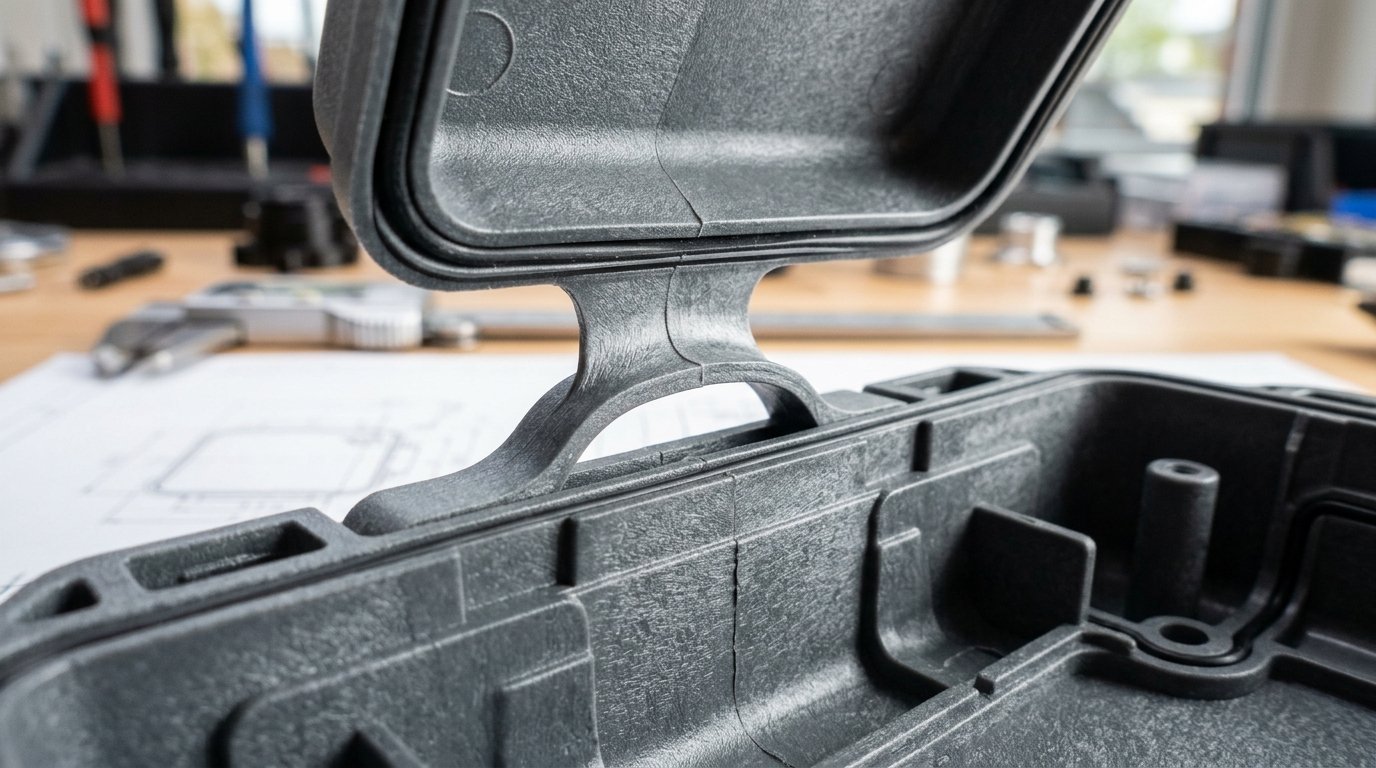
Both processes. Keep an edge radius entirely in one mold half. A fillet split by the parting line shows a step wherever the halves mismatch.
Sheet metal. Bends are radiused by nature. Outline corners on laser-cut blanks can be rounded in the cutting program at little cost, while chamfers on sheet edges are usually a secondary deburring or countersinking step.
3D printed parts. Here the chamfer or fillet logic flips: chamfers on downward-facing edges print without support, while fillets there overhang.
How to write a chamfer, fillet or edge break drawing callout
Chamfer and fillet disputes usually start with an unclear drawing callout. The current US standard is ASME Y14.5-2018, which replaced the 2009 edition. Check which edition your title block cites, since some customers still work to 2009. Common forms:
| Feature | Typical callout | Watch for |
| 45-degree chamfer | 1 X 45° | The 1 is the leg length along the face, not the angled face width |
| Other chamfer angle | Two linear dimensions, or leg and angle | State which face the leg is measured on |
| Hole chamfer | Diameter and included angle | Included angle, not half angle |
| Fillet | R2 | Flats and reversals allowed within tolerance |
| Controlled radius | CR 2 | Fair curve, no flats or reversals; costs more to inspect |
| Edge break | General note with a minimum and maximum size | Say whether chamfer or radius is acceptable |
ISO drawings handle unspecified edges with the ISO 13715 edge symbol, which defines passing, such as a burr, and undercut, such as a break. Our GD&T guide for machined parts covers the tolerancing side.
Mistakes that show up at first article inspection
Most rejected chamfers or fillets are drawing problems. The shop cut what the drawing said, and the drawing said something the designer did not mean.
- Leg vs face width. Cut a 1 X 45° chamfer to a 1 mm face width instead of a 1 mm leg and the legs come out about 29% short.
- R0.5 in a deep pocket. The supplier quotes EDM or a fragile long cutter, or asks for a bigger radius, and the RFQ stalls until someone decides.
- No break note. Each batch gets whatever the operator deburrs, so edges vary between lots.
- Chamfer or fillet left optional. Mating parts built by different suppliers then fit differently.
Frequently asked questions
Does a chamfer cost less than a fillet?
Usually, on external edges. One chamfer mill cuts many sizes, while each fillet radius needs its own corner-rounding cutter or slower ball-end passes. The gap shrinks when the fillet matches a standard tool. Internal pocket corners are the exception, because the end mill leaves a radius there anyway.
Does a chamfer have to be 45 degrees?
No. 45 degrees is the default because it is easy to cut, inspect and dimension with one leg length. Other angles are common: shallower lead-ins on shafts and seal bores, or the included angle a countersunk screw needs. Dimension any non-45 chamfer with two lengths, or a leg length and an angle.
Is a chamfer the same as a bevel?
Not quite. Both are angled flat faces. A chamfer trims only the corner between two surfaces, for handling, assembly or deburring. A bevel usually slopes the whole edge or thickness, as on weld preparations or cutting blades. Many shops use the words loosely, so dimension the geometry rather than relying on the name.
When should I use a chamfer on a hole?
Use one on almost every hole that takes a pin, shaft, tap or fastener. The chamfer removes the drilling burr, gives the mating part a lead-in, helps a tap start straight and lets countersunk heads sit flush. Dimension it by diameter and included angle so the inspector measures the right thing.
Why can’t a CNC mill cut a sharp inside corner?
End mills are round, so an internal vertical corner always keeps at least the tool radius. Smaller radii need smaller, slower tools that deflect in deep pockets. A truly sharp corner needs EDM or another secondary process. Specify the largest radius the design tolerates, slightly above a standard cutter size.
Choosing chamfer vs fillet on your next drawing
Treat every edge as one of three cases. Loaded inside corners get a fillet, sized as large as the design allows. Mating features and holes get a chamfer for lead-in. Everything else gets a general edge break note with a stated range.
Elite Mold Tech machines, molds and casts parts. Send the drawing and model and ask for an edge review during DFM, before any fillet vs chamfer choice is locked into a quote. The full range of processes is on the Elite Mold Tech homepage.