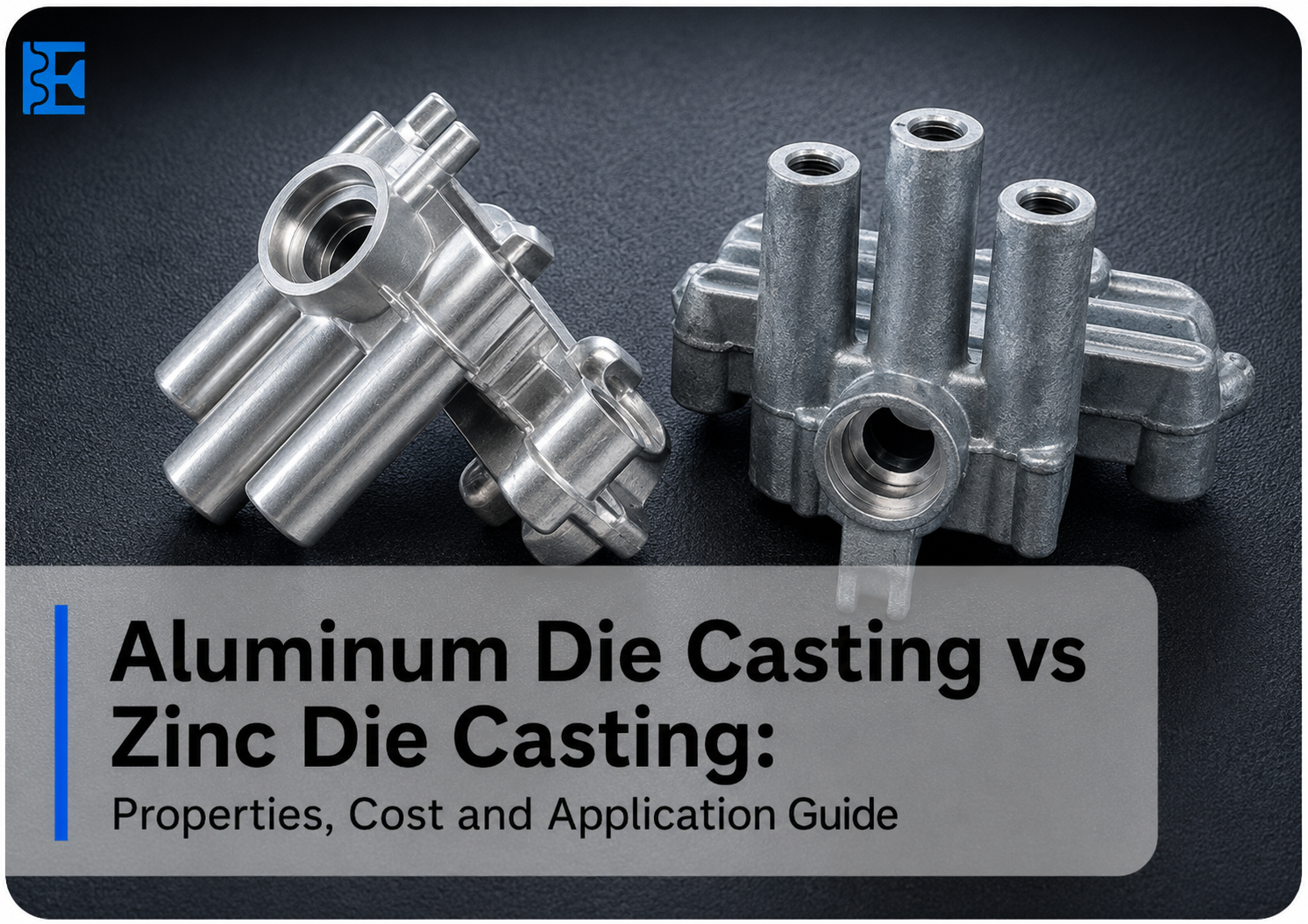
Two engineers at the same company are quoting the same part. One specifies aluminum A380. The other specifies Zamak 3. The quotes come back with a 40 percent cost difference, a 60 percent weight difference, and a 10x difference in expected die life. Neither engineer is wrong in principle. Both made a material selection decision without running the full comparison, and one of them is going to discover the mistake after the die is cut.
Aluminum die casting and zinc die casting are the two most widely used pressure die casting processes in global manufacturing. They share the same fundamental process: molten metal forced under pressure into a hardened steel die cavity. Beyond that, they diverge significantly on every property that matters to a product engineer: density, strength-to-weight ratio, melting point, casting process type, minimum wall thickness, die life, corrosion resistance, surface finish capability, and per-part economics.
This guide compares A380 aluminum against Zamak 3 and Zamak 5 zinc alloys on every dimension that drives material selection decisions. By the end, you will have the data to make the right call before the tooling budget is committed.
| Quick AnswerAluminum die casting (A380 is the most common alloy) produces lightweight, thermally conductive parts with high strength-to-weight ratio. It uses the cold chamber process due to aluminum’s 660 degrees Celsius melting point and suits automotive, aerospace, electronics, and EV applications where weight is critical. Zinc die casting (Zamak 3 and Zamak 5 are the most common alloys) produces denser, heavier parts with higher as-cast dimensional accuracy, longer die life (up to 10x aluminum), lower melting point (385 degrees Celsius), and superior plating quality. It uses the hot chamber process and suits small, complex, high-volume hardware, connectors, and decorative components. Choose aluminum when weight and temperature matter. Choose zinc when wall thinness, plating quality, die life, and small-part dimensional precision matter. |
What Is the Fundamental Difference Between Aluminum and Zinc Die Casting?
The most important difference between aluminum and zinc die casting is not a property of the alloy. It is the casting process each material requires, and that process difference drives downstream differences in cycle time, die life, part wall thickness, and total program cost.
Aluminum Die Casting: Cold Chamber Process
Aluminum has a melting point of approximately 660 degrees Celsius. At this temperature, it would rapidly degrade the injection mechanism if it were kept in contact with the molten metal during every cycle, which is how hot chamber machines operate. Aluminum therefore uses the cold chamber process, where the molten metal is ladled into a separate shot chamber for each cycle before being injected into the die. The cold chamber process adds a step to each cycle, increases cycle time by 20 to 30 percent compared to hot chamber, and exposes the shot sleeve to thermal shock with each cycle. The result is higher cycle time and higher machine wear than zinc, but the mechanical properties and weight advantage of aluminum justify this cost for the applications where they are needed.
Zinc Die Casting: Hot Chamber Process
Zinc alloys melt at 385 to 420 degrees Celsius depending on the specific Zamak grade, a temperature low enough to keep the injection mechanism submerged in the molten metal bath continuously. The hot chamber machine maintains the metal in a molten state in the machine body and injects directly from that reservoir into the die with each cycle. Hot chamber casting eliminates the ladling step, reduces cycle time to 30 to 50 percent faster than cold chamber for equivalent part size, reduces thermal shock on the injection system, and produces less porosity since the injection pressure is applied more consistently. The lower process temperature also extends die life dramatically: zinc dies typically produce 500,000 to 1,000,000 shots before replacement, compared to 100,000 to 300,000 shots for aluminum dies of equivalent complexity.
Published comparisons from die casting industry sources confirm that zinc alloy dies routinely last up to 10 times longer than aluminum dies for the same part geometry, a cost advantage that compounds significantly in high-volume programs [1].
How Do A380 Aluminum and Zamak 3 and Zamak 5 Zinc Compare on Mechanical Properties?
The table below compares the three most widely specified die casting alloys: A380 (the dominant aluminum die casting alloy in North America and Europe), Zamak 3 (the standard zinc alloy for most commercial applications), and Zamak 5 (the higher-strength zinc alloy used when greater hardness and wear resistance are required). All values represent as-cast condition unless noted.
| Propriété | A380 Aluminum | Zamak 3 Zinc | Zamak 5 Zinc |
|---|---|---|---|
| Résistance à la traction | 325 MPa | 215 to 250 MPa | 270 to 310 MPa |
| Yield Strength | 160 MPa | 140 to 170 MPa | 210 MPa |
| Densité | 2.71 g/cm3 | 6.60 g/cm3 | 6.60 g/cm3 |
| Melting Point | 540 to 660 degrees C | 381 to 387 degrees C | 380 to 386 degrees C |
| Thermal Conductivity | 96 W/m·K | 113 W/m·K | 109 W/m·K |
| Brinell Hardness | 80 HB | 82 HB | 91 HB |
| Elongation at Break | 3.5 percent | 10 percent | 7 percent |
| Minimum Wall Thickness | 2.3 to 2.5mm | 0.8 to 1.0mm | 0.8 to 1.0mm |
| Die Life (typical shots) | 100,000 to 300,000 | 500,000 to 1,000,000+ | 500,000 to 1,000,000+ |
| Casting Process | Cold chamber | Hot chamber | Hot chamber |
| As-Cast Dimensional Tolerance | 0.1mm to 0.2mm | 0.05mm to 0.1mm | 0.05mm to 0.1mm |
| Résistance à la corrosion | Good (anodize or paint) | Good (stable oxide layer) | Good (stable oxide layer) |
| Plating Quality | Moderate (requires pretreatment) | Excellent (plates directly) | Excellent (plates directly) |
| Relative Raw Material Cost | 1.0x (baseline) | 0.7x to 0.85x | 0.75x to 0.90x |
The density difference between A380 (2.71 g/cm3) and Zamak 3 (6.60 g/cm3) is the single most decisive property in material selection for most applications. Zinc is 2.4 times denser than aluminum. A zinc part that weighs 100 grams weighs 41.5 grams in aluminum with equivalent geometry. For any application where shipping cost, vehicle fuel economy, or structural weight budget matters, aluminum’s weight advantage is a program-level decision that overrides most other considerations [2].
Where Does Aluminum Win, and Where Does Zinc Win?
Neither alloy is universally superior. Each wins decisively in specific application categories, and those categories are defined by measurable part requirements, not by general preferences.
Where Aluminum A380 Is the Clear Choice
Aluminum wins in every application where part weight drives a functional or economic outcome. Automotive structural components, EV battery housings and motor end covers, aerospace enclosures, large consumer electronics chassis, and industrial equipment housings all require aluminum because zinc’s 2.4x weight penalty is unacceptable at the part size and quantity involved.
Thermal management is the second aluminum advantage. A380’s thermal conductivity of 96 W/m·K, combined with its low density, makes it the standard material for heat sinks, LED lighting housings, inverter enclosures, and any component that must transfer heat from an internal source to the surrounding environment. Zinc’s higher thermal conductivity (113 W/m·K) does not compensate for its 2.4x weight penalty in thermal applications where the heat sink mass must be minimized.
Aluminum also anodizes. Anodizing Type II and Type III builds a hard aluminum oxide layer directly on the surface, providing corrosion protection, wear resistance, and color in a single operation. Zinc cannot be anodized. It can be powder coated or painted, but it does not form the hard oxide layer that anodizing produces on aluminum. For applications requiring anodized cosmetic finishes, aluminum is the only die casting option.
Where Zinc Zamak 3 and Zamak 5 Are the Clear Choice
Zinc wins on small, intricate, high-volume parts where thin walls, complex internal geometry, and tight as-cast tolerances are the primary requirements. Zamak 3 achieves minimum wall thicknesses of 0.8 to 1.0mm in hot chamber casting, compared to aluminum’s 2.3 to 2.5mm minimum. For small hardware components, connectors, lock cylinders, hinges, and decorative fittings where the geometry demands thin walls and fine detail, zinc’s casting capability cannot be matched by aluminum.
Die life is zinc’s most significant economic advantage at high production volumes. A zinc die producing 800,000 shots before replacement versus an aluminum die producing 150,000 shots means the tooling cost per part is 5 to 10 times lower for zinc in a sustained production program. For a consumer hardware product at 500,000 units per year, a zinc die runs two years before replacement. An equivalent aluminum die requires replacement every four to five months.
Zinc plates directly without the aggressive pretreatment required for aluminum. Chrome plating, nickel plating, and copper plating all adhere to Zamak 3 and Zamak 5 with standard electroplating chemistry, producing mirror-quality decorative surfaces used in bathroom hardware, door handles, belt buckles, and automotive interior trim. Aluminum requires an intermediate chemical conversion coating before plating will adhere, which adds a process step and increases rejection rates in plating lines.
Electromagnetic interference (EMI) shielding is a zinc-specific advantage. Zinc’s higher density and electrical conductivity make it more effective than aluminum at attenuating high-frequency electromagnetic radiation, making it the preferred material for connector housings, RF shielding enclosures, and small electronic hardware where EMI compliance is required.
How Do You Choose the Right Die Casting Alloy for Your Application?
The decision framework below maps real application categories to the correct alloy based on the functional requirement that drives the decision. Work through the priority hierarchy: weight first, then temperature, then geometry, then finish, then volume economics.
| Application Type | Primary Requirement | Correct Alloy | Reason |
|---|---|---|---|
| Automotive structural housing (door handle, bracket) | Low weight, moderate strength | A380 Aluminum | Zinc weight penalty unacceptable at this part size and automotive weight budgets |
| EV battery housing or motor end cover | Low weight, thermal management | A380 Aluminum | Density and thermal conductivity both favor aluminum for electrification components |
| LED lighting heatsink or inverter housing | Heat dissipation, low weight | A380 Aluminum | Aluminum anodizes for corrosion resistance and dissipates heat at low mass |
| Small lock cylinder or cam mechanism | Thin walls, tight tolerance, wear resistance | Zamak 5 Zinc | Sub-1mm wall capability, 0.05mm as-cast tolerance, superior hardness for wear |
| Chrome-plated bathroom hardware (faucet, handle) | Mirror surface, plating quality | Zamak 3 Zinc | Direct chrome plating on zinc, no pretreatment, mirror surface from polished die |
| High-volume connector housing (500,000+ units/year) | Low per-part cost, complex geometry | Zamak 3 Zinc | 10x die life vs aluminum, hot chamber cycle speed, thin wall capability for connectors |
| Consumer electronics enclosure (mid-size, painted) | Weight, cosmetics, cost | A380 Aluminum | Weight advantage critical for portable electronics, paint or powder coat viable finish |
| EMI shielding enclosure for RF electronics | Electromagnetic shielding | Zamak 3 Zinc | Higher density and conductivity provide better attenuation than aluminum at same wall thickness |
| Aerospace bracket or structural fitting | Strength-to-weight ratio, weight | A380 Aluminum | Zinc’s 2.4x weight penalty eliminates it from weight-critical aerospace applications |
| Decorative hardware at high volume (belt buckle, zipper) | Surface quality, detail, cost | Zamak 3 Zinc | Finest thin-wall detail, direct plating, long die life reduces cost at high volume |
| Not Sure Whether Your Part Should Be Aluminum or Zinc Die Cast?Upload your STEP or IGES file to Elite Mold Tech and receive a free material recommendation within 12 hours. Our engineering team evaluates your part geometry, wall thickness requirements, weight constraints, surface finish specification, and annual volume to identify whether A380 aluminum, Zamak 3, or Zamak 5 zinc delivers the best combination of performance and total program cost. All uploads are secure and NDA protection is available on request.Visit elitemoldtech.com to explore die casting capabilities and upload your CAD file. |
Related Elite Mold Tech Guides and Sources
Related guides: complete manufacturing process selector guide, die casting surface finish options, die casting services.
Authoritative references: North American Die Casting Association (NADCA), ASTM International die casting alloy standards.
Get a DFM Review from Elite Mold Tech
Ready to move from drawing to part? Upload your CAD file to Elite Mold Tech and receive a DFM review within 12 hours, with tolerance, material, and cost feedback from our engineering team before you commit to tooling.
Questions fréquemment posées
Why is zinc die casting less expensive than aluminum for small parts at high volume?
The cost advantage of zinc for small, high-volume parts comes from three compounding factors. First, zinc die life: a zinc die produces 500,000 to 1,000,000 shots before replacement, compared to 100,000 to 300,000 shots for aluminum. At 500,000 units per year, a zinc die runs two full years before the USD 15,000 to USD 40,000 replacement cost is incurred. An equivalent aluminum die requires replacement every 2 to 7 months, multiplying the annualized tooling cost. Second, cycle time: zinc hot chamber casting is 30 to 50 percent faster per cycle than aluminum cold chamber casting, increasing machine output per hour and reducing machine time cost per part. Third, secondary operations: zinc’s superior as-cast surface quality and direct plating capability reduce or eliminate finishing steps that aluminum requires. The combination of longer die life, shorter cycle time, and fewer secondary operations makes zinc consistently more economical than aluminum for small parts at production volumes above 50,000 units per year.
Can zinc die castings be used in high-temperature environments?
Zinc alloys retain their mechanical properties reasonably well at room temperature and in mild service environments, but they have meaningful limitations above 100 degrees Celsius. The creep resistance of Zamak alloys decreases significantly above 70 to 80 degrees Celsius under sustained load. Under-hood automotive applications, components adjacent to heat sources, and parts that experience thermal cycling between ambient and elevated temperatures should be evaluated carefully against published elevated-temperature property data for the specific Zamak grade. Zamak 5 offers better creep resistance than Zamak 3 at elevated temperatures due to its higher copper content. For sustained service above 100 degrees Celsius, aluminum A380 is the correct material: it retains useful structural properties up to 200 degrees Celsius and is specifically designed for elevated-temperature applications such as engine housings, transmission cases, and inverter enclosures where zinc would deform under load over time.
What is the difference between Zamak 3 and Zamak 5 zinc alloys?
Zamak 3 and Zamak 5 are both zinc-aluminum-magnesium alloys in the Zamak family, and they differ primarily in copper content. Zamak 3 contains approximately 0.02 percent copper, while Zamak 5 contains approximately 0.75 to 1.25 percent copper. That copper addition increases Zamak 5’s tensile strength from 215 to 250 MPa to 270 to 310 MPa, raises its Brinell hardness from 82 HB to 91 HB, and improves wear resistance and creep resistance at elevated temperatures. The trade-off is reduced ductility: Zamak 5 elongation drops to 7 percent from Zamak 3’s 10 percent, making it slightly more brittle under impact. Zamak 3 is the global default for most commercial zinc die casting applications where surface finish and castability are the primary concerns. Zamak 5 is specified when the part experiences higher mechanical loads, wear contact, or service temperatures above 70 degrees Celsius. Zamak 7 is a third option that reduces magnesium content to improve ductility and flow for the finest thin-wall features, used primarily in small, intricate hardware where dimensional precision at minimum wall thickness is the critical requirement.
Can aluminum die castings be chrome plated like zinc?
Chrome plating aluminum die castings is possible but significantly more complex and expensive than plating zinc. Aluminum naturally forms a stable oxide layer that prevents standard electroplating chemistry from adhering. Before plating, aluminum must be chemically etched to remove the oxide layer, then zincate treated to deposit a thin zinc layer that bridges the aluminum surface to the plating chemistry, then copper struck before the final chrome or nickel plating layer is applied. This multi-step pretreatment sequence adds process steps, chemical cost, and rejection risk compared to plating zinc directly. For applications requiring chrome-plated decorative surfaces on die cast components, zinc Zamak 3 or Zamak 5 is almost always the more cost-effective material choice. Aluminum die castings are finished more commonly with anodizing, powder coating, painting, or shot blasting, processes that work directly with the aluminum surface without extensive pretreatment.
What minimum wall thickness can each die casting alloy achieve?
Minimum wall thickness in die casting is controlled by the alloy’s fluidity at casting temperature and the pressure capability of the machine. Zinc Zamak alloys, cast in hot chamber machines at lower temperatures with high fluidity, achieve minimum wall thicknesses of 0.8 to 1.0mm on small parts with properly designed gating and venting. This capability makes zinc the standard choice for small, intricately detailed parts such as miniature connectors, fine hardware fittings, and precision lock components. Aluminum A380, cast in cold chamber machines at higher temperatures with lower fluidity, achieves minimum wall thicknesses of 2.3 to 2.5mm reliably. Walls below 2mm in aluminum die casting require careful gating design, higher injection velocities, and tight process control to avoid cold shuts and incomplete fill. The 2.5x difference in minimum wall thickness between zinc and aluminum is frequently the deciding factor for small parts where geometry demands thin sections that aluminum cannot fill reliably.
How does porosity differ between aluminum and zinc die casting, and does it affect structural performance?
Porosity is a concern in both aluminum and zinc die casting but differs in severity and origin. Aluminum die casting is more susceptible to gas porosity because aluminum absorbs hydrogen from moisture in the atmosphere and from lubricants at its higher processing temperature. Hydrogen porosity creates small spherical voids distributed through the casting cross-section that reduce fatigue strength and can cause cosmetic surface defects after machining or anodizing. Vacuum-assisted die casting, optimized venting, and degassing of the melt reduce but do not eliminate aluminum porosity. Zinc die casting, processed at lower temperatures with less atmospheric reactivity, produces lower porosity levels in standard hot chamber production. The result is that zinc die castings are generally more structurally consistent and better suited to applications requiring pressure tightness. For structural applications where porosity could create a failure point, zinc’s lower inherent porosity is a genuine advantage. For large structural aluminum parts where porosity is a concern, squeeze casting and vacuum die casting process variants can reduce porosity to acceptable levels.
About the Author:
Alex Morgan specializes in technical content for precision manufacturing, with a focus on CNC machining, injection molding, die casting, 3D printing, sheet metal fabrication, and custom mold manufacturing. With more than a decade of experience in B2B manufacturing content and SEO, he creates technically accurate content designed for engineers, product developers, procurement teams, and manufacturing decision-makers. His work helps global manufacturers clearly communicate complex production capabilities, material options, tolerances, tooling processes, and quality standards to customers across the US, Europe, and Asia-Pacific. He writes for manufacturing companies where technical expertise, precision, and reliability matter.