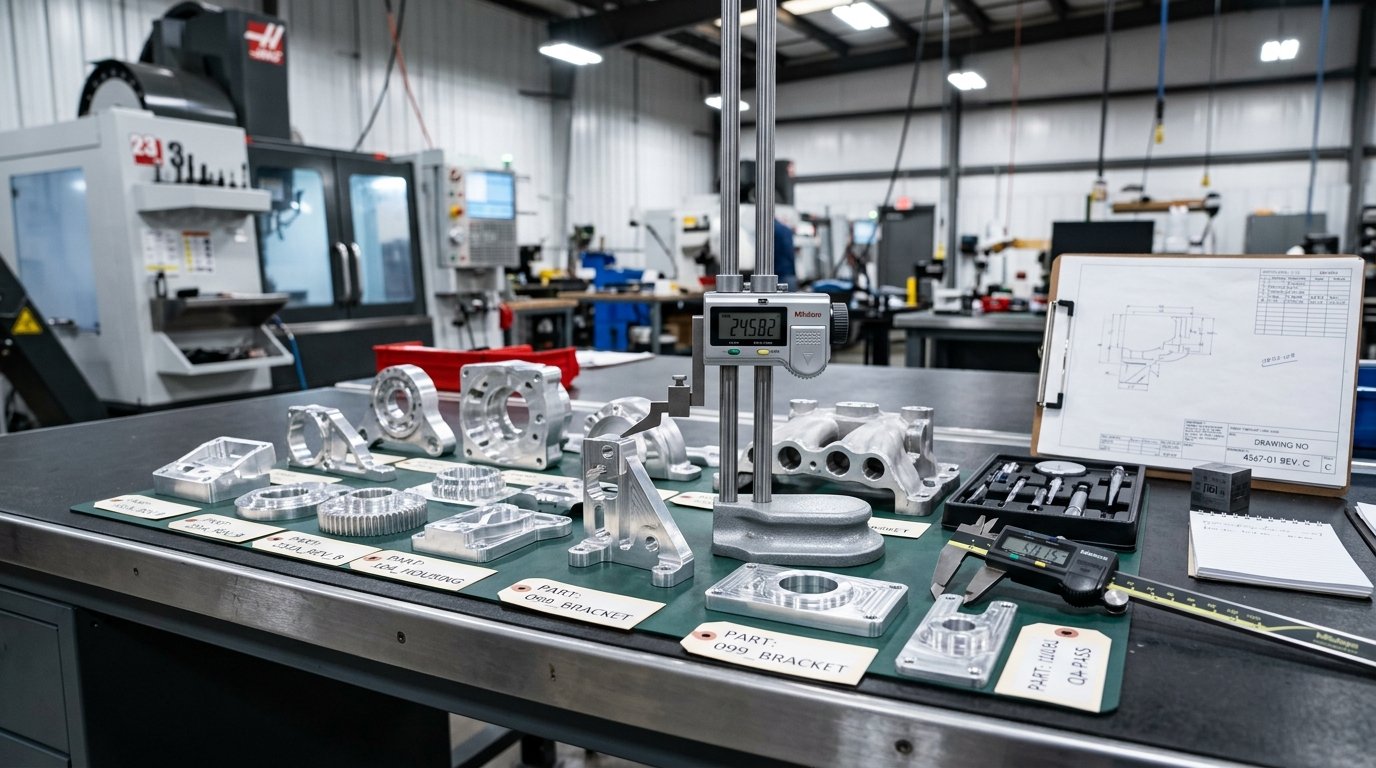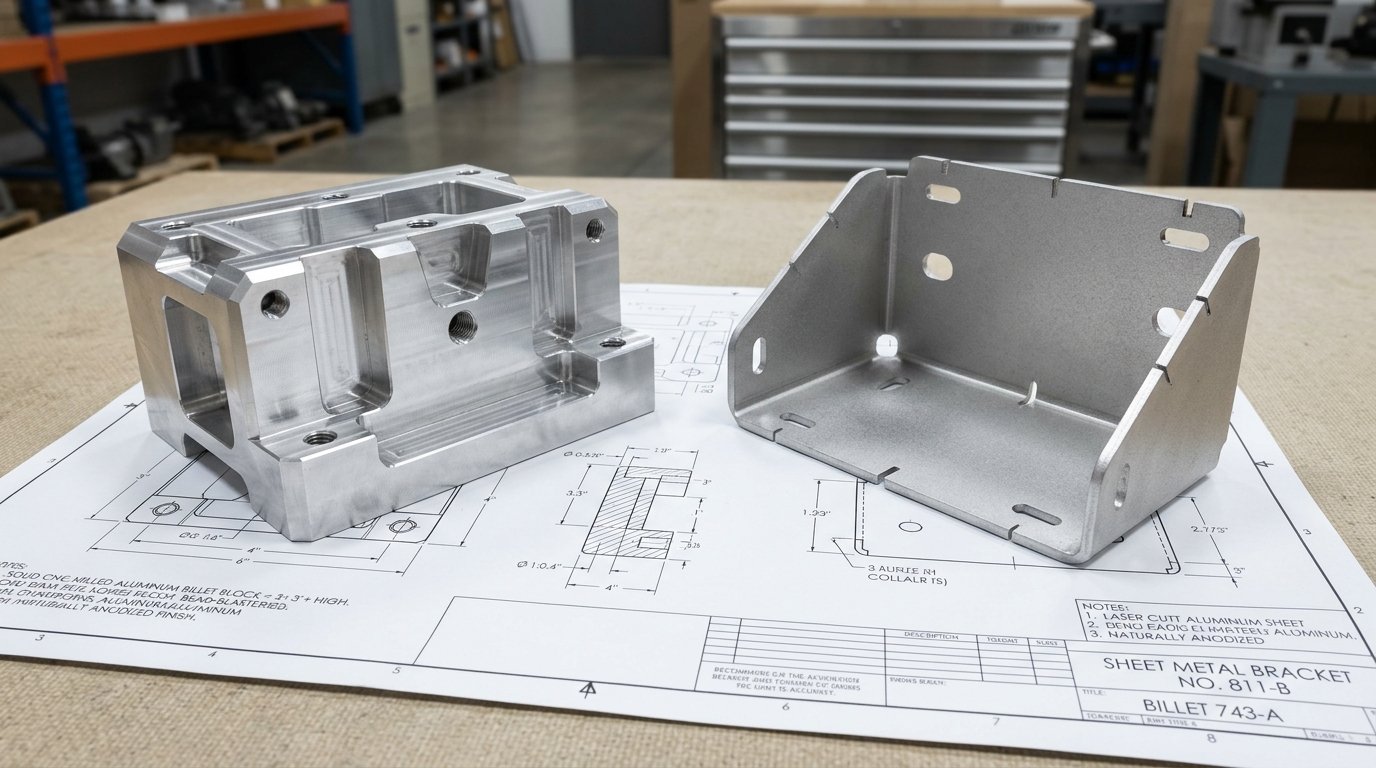
Choosing between CNC machining vs sheet metal fabrication comes down to wall thickness, precision and quantity. Sheet metal is usually cheaper and faster for aluminum enclosures and brackets with uniform walls, especially past a few dozen units. CNC machining is the better choice when a part needs varying wall thickness, sealing surfaces, tight bores or deep pockets that can’t be bent from flat stock.
Short answer: Bend it if you can, machine it if you must, and combine the two when one area of a sheet metal part needs machined precision. Most electronics enclosures and simple L- or U-brackets suit sheet metal. Heat-sinking housings, sealed enclosures and load-bearing brackets with precise hole patterns usually suit machining.
CNC Machining vs Sheet Metal Fabrication: Quick Comparison
| Factor | CNC machining | Sheet metal fabrication |
| Starting material | Solid plate or bar | Flat sheet, typically 0.5–6 mm |
| Wall thickness | Can vary within one part | Uniform across the part |
| Precision | Tight tolerances on any machined feature | Good on cut features; bends are less precise |
| Material use | Most of the block can become chips | Most of the sheet ends up in the part |
| Setup for a prototype | CAM program and fixture | Flat pattern, cutting program, bend setup |
| Cost trend with volume | Falls slowly | Falls quickly |
| Typical aluminum grade | 6061-T6, 7075-T6 | 5052-H32 |
| Best for | Precise, thick or complex parts | Light enclosures, covers, brackets |
These are general patterns, not fixed limits. A capable sheet metal shop can hold very good positional accuracy on laser-cut holes, and a machine shop can make thin walls. But each process has a natural sweet spot, and designing for it is where the savings come from.
How Each Process Makes an Aluminum Part
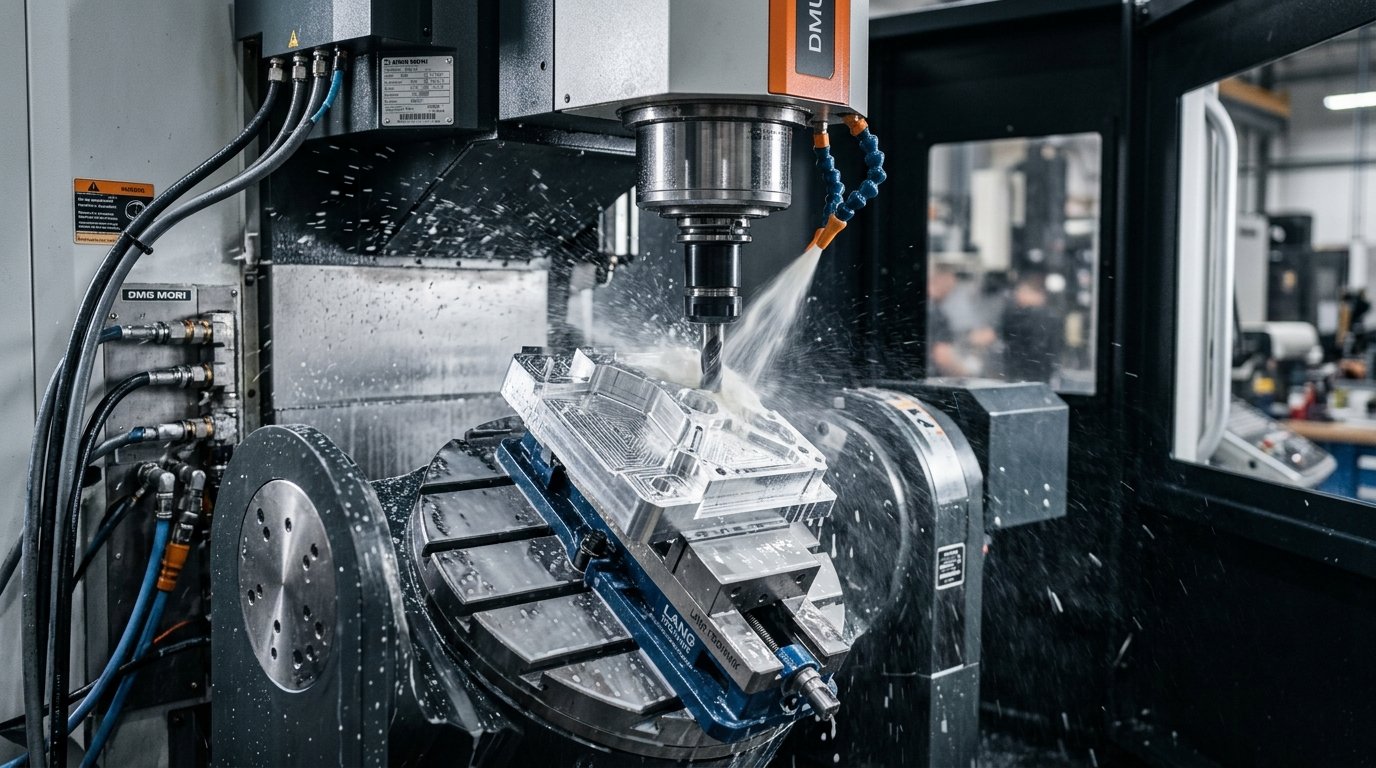
CNC machining removes material from a solid block. A milling machine follows a programmed toolpath to cut pockets, bores, threads and surfaces. Because the part is carved, wall thickness can change from 6 mm to 1.5 mm within one housing, and any face can be held flat and precise. The downside is waste: for a hollow enclosure, most of the block ends up as chips. Elite Mold Tech’s CNC milling services cover 3-, 4- and multi-axis work for this kind of part.
Sheet metal fabrication starts from flat sheet. The outline and holes are cut by laser, punch or waterjet. The flat blank is then bent on a press brake to form walls, flanges and tabs. Hardware such as threaded inserts and standoffs is pressed in, and seams are welded, riveted or left open. Because the part is formed rather than carved, almost all of the material ends up in the finished part, and an enclosure weighs a fraction of a machined equivalent. Our sheet metal fabrication service handles cutting, bending, hardware insertion and finishing in one flow.
That basic difference, carved versus folded, drives almost every other comparison in this guide.
When Is CNC Machining the Better Choice for Enclosures?
Machine the enclosure when the design needs something a bent sheet can’t provide. In our experience the deciding feature is usually one of these:
- A sealing face or O-ring groove. IP-rated housings need flat, smooth mating surfaces and accurately sized grooves. Machining delivers both directly.
- Variable wall thickness. Thick bosses for screws, thin walls for weight, ribs for stiffness. Sheet metal gives you one thickness everywhere.
- Heat dissipation. Machined housings can carry fins, thick heat-spreading floors and flat mounting pads for components.
- Precise bores and pockets. Bearing seats, connector cutouts with tight positional tolerance, and recesses for PCBs or displays.
- Premium appearance. A one-piece machined shell with no seams anodizes evenly and looks solid. That’s why many consumer and instrument housings are milled from billet.
- Very low quantity with complex shape. For one or two units, machining avoids designing bend sequences and can be faster to get right.
The trade-off is cost per part and weight. A hollow machined box uses a lot of material and machine time compared with the same box folded from sheet.
When Does Sheet Metal Fabrication Win?
Sheet metal is the better route when the part is essentially a shell or a bent plate:
- Electronics enclosures and chassis with uniform walls, vents, cutouts for connectors and PEM fasteners for mounting boards.
- Covers, panels and doors that need to be light and stiff enough, not thick.
- Brackets with one or more bends, especially L-, U- and Z-shapes.
- Larger parts. A 400 mm enclosure machined from solid plate is expensive. The same part from sheet is a fraction of the material.
- Medium and higher volumes. Once the flat pattern and bend program exist, each additional part is quick to make.
Sheet metal also handles design changes cheaply at the prototype stage, as long as you avoid dedicated forming tools. A changed hole pattern is a program edit, not new tooling.
The limitations are real, though. Bends add tolerance stack-up, inside corners have a bend radius, and features can’t sit too close to a bend line without distorting. Those rules are covered in the redesign section below.
Brackets: Machined Block or Bent Sheet?
Brackets get their own section because they are where the choice is most often made by habit rather than by function.
A bent sheet metal bracket is the default for mounting, stiffening and supporting. It’s light, cheap and fast. For most brackets that hold a sensor, a board or a cable tray, a 2 to 3 mm 5052 bracket with two bends does the job.
A machined bracket makes sense when:
- It carries real load and needs thick sections or ribs in specific places.
- Mounting holes on two faces must line up precisely with each other, for example a motor mount or a robot joint.
- It needs a precise pilot diameter, a bearing bore or a dowel pin hole.
- The bracket is part of a datum chain in a precision assembly.
Our position: if the bracket’s job is “hold this here”, bend it. If its job is “hold this here, in exactly this position, under load”, machine it. For brackets in between, a bent bracket with laser-cut holes, located by tabs and slots, often gets surprisingly close.
Strength and Weight: Which Part Performs Better?
Neither process is “stronger” in general. Strength comes from the alloy, the temper and the geometry.
A machined part can put material exactly where the load is. Thick ribs, gussets and bosses can be machined into one piece with no joints, which suits brackets that carry torque or impact. It also means no welds, and welds in heat-treated alloys such as 6061-T6 locally lose strength because the heat affects the temper.
A sheet metal part gets its stiffness from shape. A flat 2 mm sheet flexes easily, but add two flanges and it becomes a stiff channel. That’s why sheet metal enclosures use folded edges, hems and beads instead of thicker material.
On weight, sheet metal usually wins for enclosures. A folded box has walls only where it needs them. A machined box can be pocketed thin, but thin machined walls take longer to cut and risk chatter and distortion, which adds cost. Our guide to machining thin walls explains where the practical limits sit.
For brackets the answer flips more often. A compact machined bracket with targeted ribs can be lighter than a bent bracket made from thicker sheet to reach the same stiffness.
Lead Times for Prototypes and Short Runs
Both processes are quick for prototypes because neither needs hard tooling, provided the sheet metal design uses standard bends.
For a machined part, lead time is driven by programming, fixturing and machine time. Simple parts move fast. Complex multi-sided parts take longer because each setup adds time.
For a sheet metal part, cutting and bending are fast, but there are more separate steps: cut, deburr, bend, insert hardware, weld if needed, then finish. Each step is short, but they add up, and welding plus finishing can easily be the longest part of the job.
In practice, for a first prototype the two often land within a few days of each other. The bigger time difference shows up on reorders: a sheet metal part with programs on file can be cut and bent very quickly, while a machined part still takes the same machine time per piece.
One thing slows both processes equally: an incomplete drawing. Missing bend radii, unclear hardware callouts or no finish specification are the most common reasons a quote comes back with questions instead of a price. For a wider look at prototype suppliers and lead times, see our comparison of aluminum CNC machining services.
Which Aluminum Alloy Works for Each Process?
The process largely chooses the alloy for you.
5052-H32 is the standard aluminum for sheet metal. It bends well with tight radii, has good corrosion resistance and welds easily. It is less pleasant to machine: it’s gummy, and chips tend to stick to the tool.
6061-T6 is the standard for machining. It cuts cleanly, holds threads well and anodizes evenly. As a sheet, 6061-T6 bends poorly. Tight bends can crack along the outside of the bend, so it needs generous bend radii or a softer temper.
7075-T6 is used for high-strength machined parts such as aerospace and robotics brackets. It isn’t suitable for bending in the T6 temper.
5083 appears in marine and structural sheet parts where corrosion resistance and weldability matter more than cosmetic finish.
One practical consequence: a product that combines a 5052 sheet chassis with a 6061 machined cover will not anodize to exactly the same shade. If the two parts sit next to each other, choose a finish that hides the difference, such as powder coat, or accept it in the design.
Alloy and temper designations follow the international registration system maintained by the Aluminum Association. Always state both alloy and temper on the drawing.
How Do Costs Compare From Prototype to Production?
Published per-part price comparisons between the two processes vary widely, and competitors quote numbers that contradict each other. That’s because cost depends on the part far more than on the process name. So rather than a price table, here’s how the cost structure differs.
CNC machining cost is driven by material, machine time and setup. Machine time stays roughly the same for every part, so the price per part falls slowly as quantity rises. Hollow shapes are expensive because most of the cutting time goes into removing material that becomes chips.
Sheet metal cost is driven by cutting time, bending operations, hardware and finishing. Cutting and bending are fast per part. Once the programs are set up, each extra part adds relatively little, so the price falls steeply with quantity.
What that means in practice:
- For one or two simple parts, the two processes are often close in price.
- For a hollow enclosure, sheet metal usually becomes clearly cheaper within the first few dozen units.
- For a solid, compact bracket with precise features, machining can remain competitive well into the hundreds.
- Finishing can change the answer. Anodizing, powder coating and silk-screen printing cost roughly the same per part either way, so they narrow the percentage gap.
The reliable way to decide is to quote both versions of the same part at 1, 10 and 100 pieces. Many suppliers, including Elite Mold Tech, can quote machining and sheet metal side by side from one drawing set.
Tolerances and Flatness in CNC Machining vs Sheet Metal Fabrication
Tolerance is where many teams over-specify sheet metal and under-specify machining.
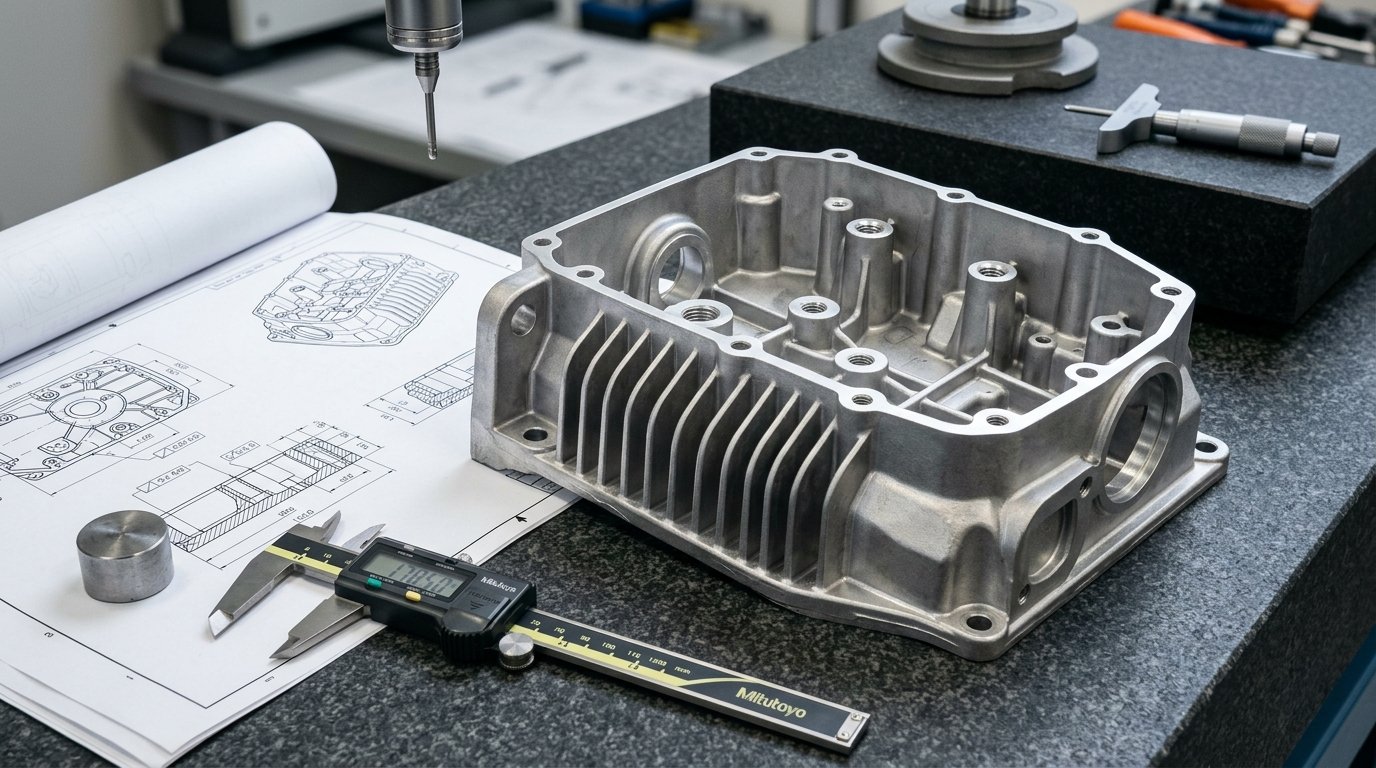
Machined features such as bores, slots and flat faces can be held to tight tolerances because each is cut directly by the tool. The limiting factors are part rigidity, thin walls and temperature, not the process itself.
Sheet metal features fall into two groups. Features cut in the flat, such as holes and outlines, are positioned accurately by the laser or punch. Features that depend on bends are less precise, because each bend adds variation from material thickness, springback and the brake setup. Dimensions measured across two or three bends stack those variations.
The practical rule: on a sheet metal drawing, tolerance features relative to the same face where possible, avoid tight tolerances that cross bend lines, and use tabs, slots and PEM hardware to locate parts instead of relying on bent flange positions.
For general tolerances, the ISO 2768-1 standard covers both machined parts and sheet metal forming. Stating a class such as ISO 2768-m on the drawing removes guesswork for any supplier.
Flatness deserves a separate note. Large flat sheet panels can bow slightly after cutting and bending. If a face must be flat for sealing or mounting a heat-generating component, either machine that surface or add a machined plate to the sheet metal part.
Finishing Differences Between Machined and Sheet Metal Parts
Both processes accept the same finishes, but results differ.
- Anodizing looks best on 6061 machined parts. On 5052 sheet it’s fine but can look slightly different in color. Welded seams on sheet metal anodize to a visibly different shade because the weld filler is a different alloy.
- Powder coating is the common finish for sheet metal enclosures. It hides weld seams and alloy differences, and it adds thickness, so threads and mating faces need masking.
- Bead blasting before anodizing hides tool marks on machined parts and handling marks on sheet parts.
- Brushed finishes are easy on sheet panels and harder on complex machined shapes.
If the product has visible parts from both processes, decide the finish early. It’s one of the few things that is hard to fix after the first batch.
The Hybrid Approach: Sheet Metal Body, Machined Interfaces
Many of the best enclosure designs aren’t pure machining or pure sheet metal. They use each process only where it earns its place.
Common hybrid patterns include:
- A bent sheet metal chassis with a machined front panel carrying precise connector cutouts and a gasket groove.
- A sheet metal enclosure with a machined heat-sink plate bolted to the floor under a hot component.
- A bent bracket with a machined boss or bushing pressed or welded in where a shaft locates.
- Sheet metal covers on a machined base in instruments and robotics, where the base carries the precision and the covers just keep dust out.
The advantage is cost: you only pay machining prices for the small area that needs precision. The challenge is tolerance stack-up between the two parts, so define the datums clearly and locate parts with dowel pins or fitted holes rather than slotted clearance holes.
A supplier that does both processes, plus assembly, takes that stack-up responsibility in-house instead of leaving you to referee between two vendors.
Redesigning a Machined Enclosure for Sheet Metal
If a machined prototype is now too expensive for production, converting it to sheet metal is often worth it. These are the changes that usually need to happen:
- Choose one wall thickness. Pick the thinnest that gives enough stiffness, often 1.5 to 2 mm for small electronics enclosures. Add stiffness with flanges and bends rather than thicker walls.
- Replace thick bosses with hardware. Self-clinching nuts, studs and standoffs replace machined threaded bosses.
- Add bend radii. Every inside corner along a bend gets a radius, commonly at least equal to the sheet thickness.
- Move features away from bends. Keep holes and slots a few material thicknesses from bend lines so they don’t distort.
- Add bend reliefs. Small notches where bends meet edges prevent tearing.
- Rethink seams. Decide whether corners are welded, overlapped and riveted, or left as open gaps. Welding adds cost and affects anodizing.
- Keep machining where it matters. If one face still needs a seal groove, plan it as a separate machined part.
Expect the first sheet metal version to need a revision. Bend sequences and springback are easier to get right on a second pass, and a supplier’s DFM review before cutting saves most of that loop.
Common Mistakes When Choosing Between the Two
These come up again and again on enclosure and bracket projects:
- Machining an enclosure that is just a box. If walls are uniform and there are no sealing faces, it’s probably costing far more than it needs to.
- Specifying 6061-T6 sheet for tight bends. It can crack. Use 5052-H32 or ask the shop about bend radius.
- Tight tolerances across bends. They drive inspection costs and rejects. Tolerance critical features from a single face.
- Forgetting finish thickness. Powder coating adds noticeable thickness on mating edges and in threads.
- Assuming both processes can share one 3D model. A sheet metal part needs a flat pattern and bend allowances. Model it as sheet metal in CAD from the start.
- Splitting suppliers without defining datums. A machined panel from one shop and a sheet chassis from another rarely fit on the first try unless the interface is fully defined.
Frequently Asked Questions
Is sheet metal cheaper than CNC machining?
For enclosures and brackets with uniform walls, sheet metal is usually cheaper, and the gap widens as quantity grows because each extra part is fast to cut and bend. For one or two parts the difference is often small, and for compact, precise parts machining can stay competitive. Quote both versions to confirm.
What is the best aluminum for sheet metal enclosures?
5052-H32 is the usual choice for sheet metal enclosures. It bends to tight radii without cracking, resists corrosion and welds well. 6061-T6 machines better but can crack on tight bends. If the enclosure will be anodized, discuss alloy and finish together with your supplier.
Can you anodize sheet metal enclosures?
Yes. Sheet metal enclosures in 5052 or 6061 can be anodized in clear or dyed colors. Welded seams and mixed alloys may anodize to a slightly different shade, so many welded enclosures are powder coated instead. Mask threads and mating faces where coating thickness would affect fit.
When should a bracket be machined instead of bent?
Machine a bracket when it carries significant load, needs thick sections in specific places, or has holes on different faces that must align precisely, such as motor mounts and robot joints. For general mounting and support, a bent sheet metal bracket is lighter, faster and usually much cheaper.
Can one part combine sheet metal and CNC machining?
Yes, and it’s often the most cost-effective design. A common example is a bent sheet metal chassis with a machined panel or heat-sink plate fastened to it. Define datums and locating features clearly so the machined and formed parts assemble without adjustment.
Choosing Between Aluminum CNC Machining and Sheet Metal Fabrication
If your enclosure or bracket has uniform walls and no precision interfaces, sheet metal fabrication will almost always be lighter and cheaper. If it needs sealing faces, variable thickness, heat dissipation or tightly aligned features, aluminum CNC machining is the right call. When only part of the design needs precision, combine the two.
Elite Mold Tech machines, cuts, bends, finishes and assembles aluminum parts under one roof, so you can compare both routes on the same drawing. Send us your design and we’ll quote the machined and sheet metal versions side by side.