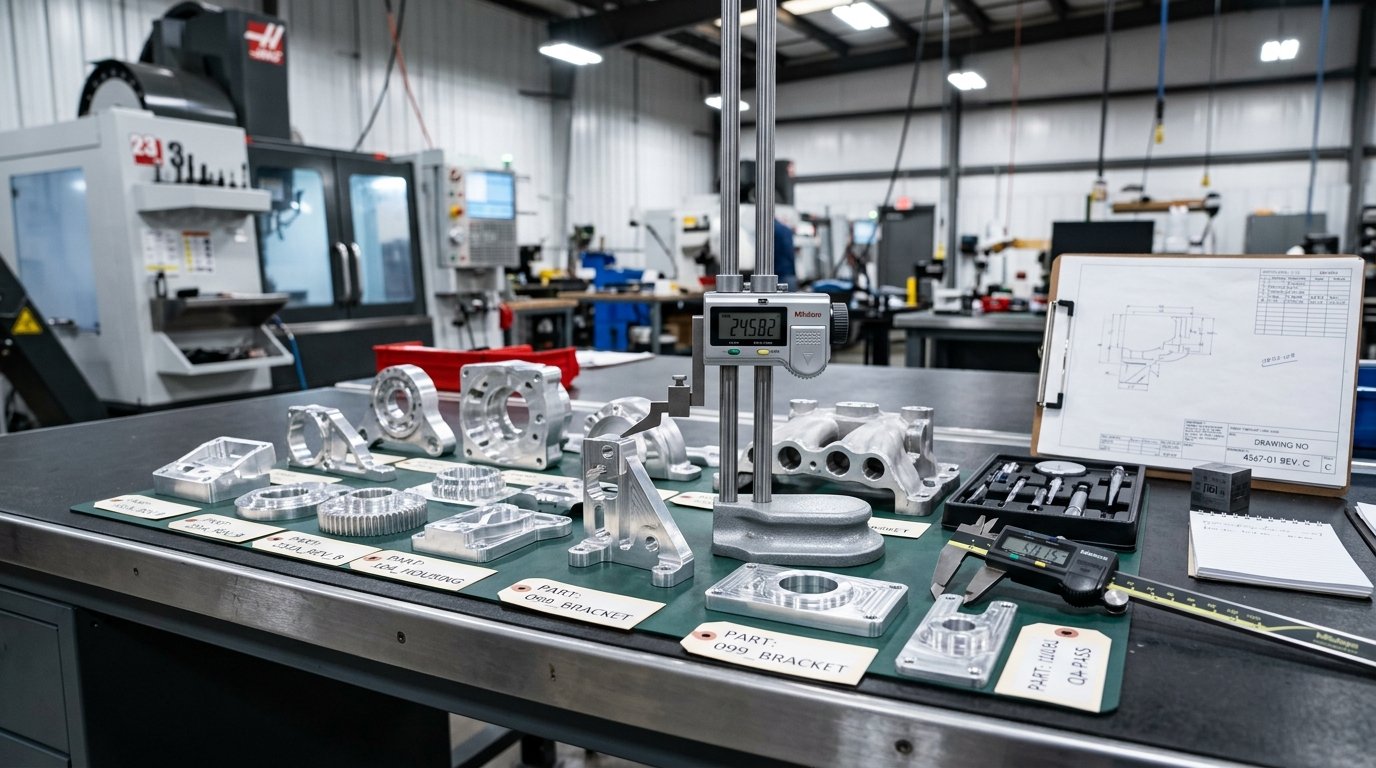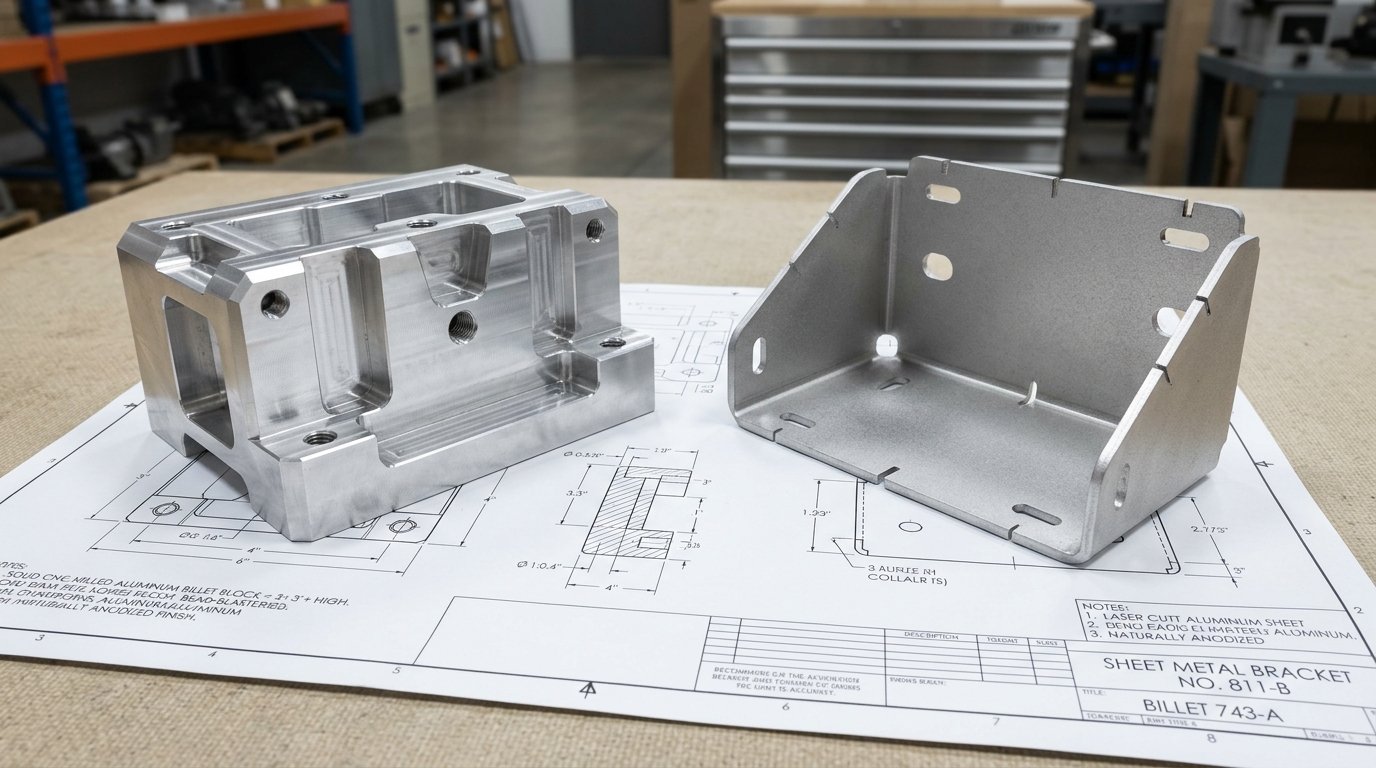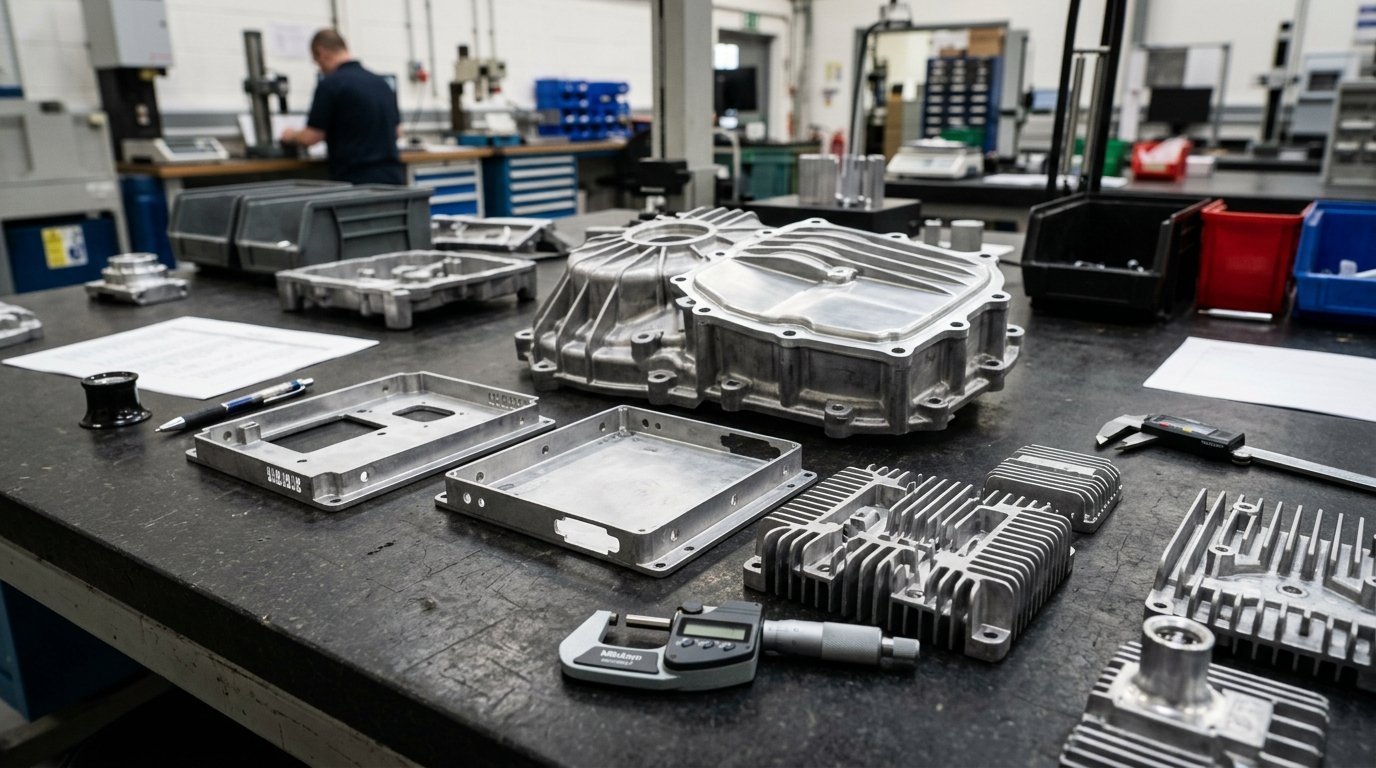
A380 is the default aluminum die casting alloy for general parts because it balances strength, castability and cost. ADC12, the Japanese standard grade that sits close to US alloy 383, fills thin walls more easily. A360 gives up some castability for better corrosion behavior and strength at high temperature. Wall thickness, environment and service temperature decide between them.
What Sets Each Alloy Apart
Two elements explain most of the differences: silicon and copper.
Silicon makes molten aluminum flow, so higher silicon fills thinner walls and resists hot cracking. Copper adds strength and hardness but makes the alloy more prone to corrosion. A360 keeps copper very low and adds magnesium, which is why it behaves differently from the other two.
| Element (%) | A380 | ADC12 | A360 |
| Silicium | 7.5–9.5 | 9.6–12.0 | 9.0–10.0 |
| Cuivre | 3.0–4.0 | 1.5–3.5 | 0.6 max |
| Magnésium | trace | 0.3 max | 0.4–0.6 |
| Governing standard | ASTM B85 | JIS H 5302 | ASTM B85 |
A380 and A360 are specified under ASTM B85, while ADC12 comes from JIS H 5302, the Japanese standard used across most Asian foundries.
Mechanical and Thermal Properties
The figures below are NADCA typical values for separately cast test bars. Production parts usually come in lower because of porosity and section size, so treat them as a comparison, not a design allowable. NADCA does not list ADC12, so its closest US counterpart, 383, stands in.
| Propriété | A380 | 383 (≈ ADC12) | A360 |
| Tensile strength | 324 MPa | 310 MPa | 317 MPa |
| Limite d'élasticité | 159 MPa | 152 MPa | 165 MPa |
| Elongation | 3.5% | 3.5% | 3.5% |
| Dureté | 80 HB | 75 HB | 75 HB |
| Conductivité thermique | 96.2 W/m·K | 96.2 W/m·K | 113 W/m·K |
| Conductivité électrique | 23% IACS | 23% IACS | 29% IACS |
On paper the strength gap is small. The real differences show up in how each alloy casts and how it survives service.
Castability, Corrosion and Heat Ratings
NADCA rates die casting alloys from 1 (most desirable) to 5 (least desirable). These ratings matter more to a buyer than the tensile numbers.
| Characteristic | A380 | 383 (≈ ADC12) | A360 |
| Die filling (thin walls) | 2 | 1 | 3 |
| Resistance to hot cracking | 2 | 1 | 1 |
| Anti-soldering to the die | 1 | 2 | 2 |
| Pressure tightness | 2 | 2 | 2 |
| Résistance à la corrosion | 4 | 3 | 2 |
| Strength at high temperature | 3 | 2 | 1 |
| Usinage | 3 | 2 | 3 |
| Placage électrolytique | 1 | 1 | 2 |
Read across the rows and the pattern is clear. ADC12-type alloys cast most easily, A360 survives corrosion and heat best, and A380 sits in the middle while being the least likely to solder to the die, which helps tool life.
A380: The General-Purpose Default
NADCA describes A380 as by far the most widely cast aluminum alloy, used for brackets, housings, gear cases, power-tool bodies and electronics enclosures. It fills moderate walls well. It machines acceptably and takes plating better than either rival.
Its weakness is corrosion. The copper content makes bare A380 a poor choice for salt spray, marine or outdoor exposure unless the part is coated.
ADC12: Thin Walls and Complex Shapes
ADC12 carries more silicon than A380, so it flows further before freezing. That suits thin-walled covers, lighting housings and parts with fine ribs. On the A380 vs ADC12 question for a complex, thin part, ADC12 usually casts with fewer cold shuts and less scrap.
ADC12 is not identical to A380, and a drawing that treats them as interchangeable invites disputes. Lower copper and higher silicon put it closer to 383.
A360: Corrosion Performance and High-Temperature Strength
With copper held below 0.6%, A360 resists corrosion far better than A380 and keeps its strength at elevated temperature. NADCA also notes somewhat better ductility. Its thermal conductivity is the highest of the three, which helps heat sinks and LED housings.
The catch is castability. A360 is harder to fill and more prone to soldering, so expect a slightly higher scrap rate and piece price. In A360 vs A380 decisions, we recommend A360 only when corrosion or heat is a genuine service requirement, since a coating on A380 is often the cheaper route to acceptable corrosion performance.
Which Aluminum Die Casting Alloy Should You Choose?
- General housings and brackets, indoors: A380
- Thin walls, fine ribs or complex cores: ADC12 or 383
- Outdoor, marine or salt exposure without heavy coating: A360
- Parts running hot, or heat sinks: A360
- Pressure-tight fluid parts: discuss A413 as well, which NADCA rates highest for pressure tightness
If two alloys fit, pick the one your supplier casts every day, which also settles most A360 vs A380 debates in favor of availability. A foundry running A380 in volume will often hold tighter process control on it than on an alloy it melts twice a year.
JIS and US Equivalents at a Glance
Buyers working across both systems need a quick cross-reference. The pairs below are close equivalents, not exact matches.
| US alloy (ASTM B85) | Nearest JIS alloy (JIS H 5302) | Shared traits |
| A380 | ADC10 | Si 7.5–9.5%, copper around 2–4% |
| 383 | ADC12 | Higher silicon, better die filling |
| A360 | ADC3 | Copper 0.6% max, magnesium added |
When a Japanese or Chinese drawing lists ADC10 and a US drawing lists A380, the parts can usually share a supplier, but the chemistry ranges still need a line-by-line check.
Finishing and Heat Treatment Limits
Conventional high-pressure die castings trap small amounts of gas, so they are generally not solution heat treated; the gas expands and blisters the surface. Parts that need heat treatment call for vacuum-assisted casting or structural alloys designed for it, such as AA365, which NADCA lists among the heat-treatable specialty grades.
Finishing also varies with the alloy. A380 and 383 take electroplating best. Powder coating and e-coating work on all three and are the usual route to corrosion protection on A380. Decorative anodizing is where all three disappoint.
Sourcing From China: ADC12 vs A380
ADC12 is the standard melt at many Chinese foundries, because the Japanese system dominates Asian ingot supply. A380 is available too, but ingot sourcing may take longer or cost more at some shops.
That creates a common trap for overseas buyers. A drawing calls out A380, the quote comes back on ADC12 without comment, and the difference only surfaces during a failure investigation. Ask up front which alloy the quote assumes.
How to Write the Alloy Callout
A clear callout prevents substitution disputes. Include:
- Alloy and standard, for example “A380 per ASTM B85”
- Allowed equivalents, if any, stated explicitly
- A certificate of analysis per melt lot, showing chemistry against the standard
- Mechanical test requirements, if the part is load-bearing
- Finish requirements, since alloy choice affects plating and anodizing results
Elite Mold Tech’s services de moulage sous pression cover aluminum, zinc and magnesium, and cast parts that need tight features are finished on in-house Usinage CNC centers.
Questions fréquemment posées
Is ADC12 the same as A380?
No. ADC12 has more silicon (9.6–12.0%) and less copper (1.5–3.5%) than A380, which contains 7.5–9.5% silicon and 3.0–4.0% copper. That makes ADC12 flow better into thin walls. Their strengths are similar, but the chemistry differs enough that a drawing should state whether substitution is allowed.
What is the US equivalent of ADC12?
Alloy 383 is the closest US counterpart. Both have higher silicon and lower copper than A380, and both are chosen for intricate, thin-walled castings. They are not chemically identical, so confirm the ranges against JIS H 5302 and ASTM B85 before accepting one in place of the other.
Which alloy is best for corrosion resistance?
A360 is the best of the three. NADCA rates its corrosion resistance 2 on a 1–5 scale, against 3 for 383 and 4 for A380. The low copper content is the reason. For outdoor parts in A380, a powder coat or conversion coating is usually required instead.
Can die cast aluminum be anodized?
It can, but the result is rarely decorative. High silicon content produces a gray, uneven anodized layer, and NADCA rates A380, 383 and A360 only 3 out of 5 for anodized appearance. Powder coating, painting or plating give more consistent cosmetic results on die cast aluminum parts.
Which alloy is best for heat sinks?
A360 conducts heat best of the three, at 113 W/m·K against 96.2 W/m·K for A380 and 383 in NADCA’s data. Where thin fins are the priority, ADC12 or 383 may still win on fill, so heat sink designs often trade a little conductivity for castability.
Matching the Aluminum Die Casting Alloy to the Part
The right aluminum die casting alloy follows the part’s walls, environment and temperature, not habit. Default to A380, move to ADC12 for thin and complex shapes, and pay for A360 when corrosion or heat demands it. Ask Elite Mold Tech to confirm the alloy and standard in writing at quote stage. For parts too small or detailed to cast, see our comparison of MIM and die casting, and explore the full range of production de pièces métalliques options.