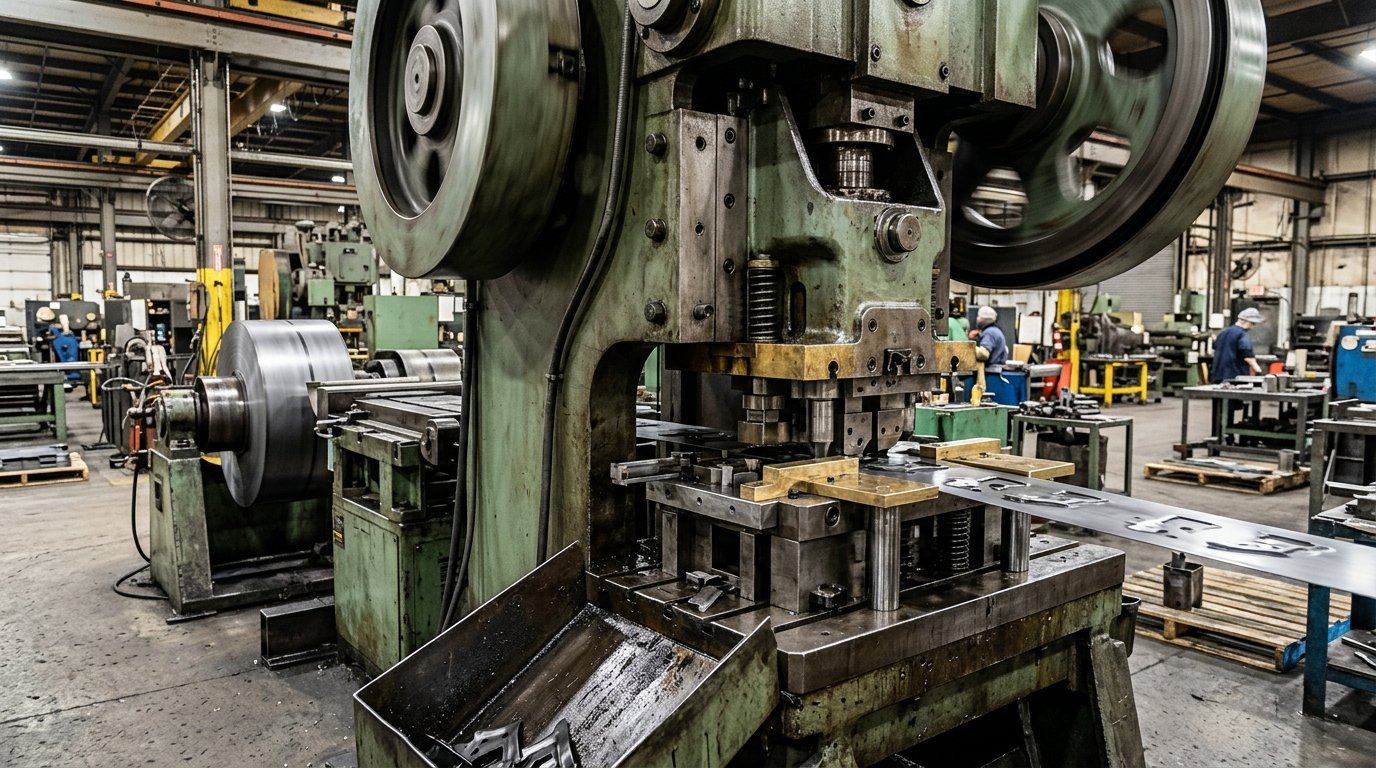
Metal stamping is a cold-forming process that cuts and shapes flat sheet or coil into finished parts by closing a hardened punch and die on it inside a press. One stroke can blank, pierce, bend or draw a part in under a second. That speed is why brackets, terminals, shields and enclosures are stamped rather than machined once volumes climb.
What Is Metal Stamping?
A press closes a matched pair of tools on the workpiece. The upper half (the punch) and the lower half (the die block) are ground to the part’s profile, so every hit reproduces the same geometry. Most work is done cold on steel, stainless steel, aluminum, copper and brass supplied as coil or blanks.
Stamping is also called pressing.
The economics are simple: tooling is expensive and slow to make, while each part afterward costs very little.
How Does the Metal Stamping Process Work?
Every production run follows six stages.
- DFM review. Engineers check the 3D CAD model for features the die cannot make cleanly.
- Strip layout. The tool designer plans how parts nest on the coil and the carrier strip that links them between stations.
- Die build. Tool steel inserts are CNC machined, cut on wire EDM, heat treated, ground and assembled.
- Tryout. Samples are measured and the steel adjusted until parts hold the print, including springback correction.
- Production. Coil runs through a straightener and servo feeder, and pilot pins locate the strip before every hit.
- Secondary operations. Deburring, heat treatment, plating, powder coating or assembly.
Stages 3 and 4 set the schedule. A simple blanking die can be ready in a few weeks, while a multi-station progressive die with forming stations and tryout more often needs 6 to 10 weeks. Production itself is fast.
Core Operations: Cutting and Forming
Every die combines cutting stations, which separate metal, and forming stations, which move it without separating it.
| Operation | Group | What it does |
| Blanking | Cutting | Cuts the outer profile from the strip |
| Piercing / punching | Cutting | Cuts internal holes; the slug is scrap |
| Lancing | Cutting | Slits the sheet to form tabs or louvers |
| Trimming | Cutting | Removes excess flange after drawing |
| Bending | Forming | Creates an angle along a straight line |
| Flanging | Forming | Bends a small tab or edge |
| Drawing | Forming | Stretches a blank into a cup or box |
| Coining | Forming | Squeezes metal under very high pressure |
| Embossing | Forming | Raises or sinks a pattern such as a rib or logo |
Coining strikes hard enough to make the metal flow, so it can flatten a burr or set a bend so firmly that springback almost disappears.
Types of Stamping Processes
Those operations are packaged into different die arrangements, and the choice affects piece price more than almost anything else.
Progressive Die Stamping
A coil strip advances through a row of stations inside one die; every stroke works all stations at once, and the last station cuts the finished part free. Progressive die stamping is the fastest route for small and medium parts at high volume, though the carrier strip makes deep draws awkward.
Transfer Die Stamping
The blank is cut free first, and mechanical fingers carry it between stations. Loose parts can be rotated and drawn deep, so this is the usual route for large housings.
Compound Die Stamping
Several cuts happen in one stroke at a single station, such as blanking and piercing a washer together. Flatness is excellent. Forming is not its strength.
Fourslide and Multi-Slide Stamping
Four or more tools strike horizontally from different directions. It suits small clips and flat springs with many bends, usually on cheaper tooling than a progressive die.
Deep Draw Stamping
A punch pulls the blank into a cavity, forming sensor cans and other parts deeper than their diameter, and deep draw stamping often needs several draw stages with annealing between them on harder alloys.
Fine blanking, the final row in the table, uses triple-action tooling to leave a smooth, fully sheared edge on gears and other parts whose edges do real work.
| Process | Best volume | Part size | Relative tooling cost |
| Progressive die | High | Small to medium | High |
| Transfer die | Medium to high | Medium to large | High |
| Compound die | Medium | Small, flat | Low to medium |
| Fourslide | Medium to high | Small | Low to medium |
| Deep draw | Medium to high | Cups and cans | High |
| Fine blanking | Medium to high | Small to medium | Very high |
Our view is clear. If a part can run in a progressive die, choose it over transfer, because the part stays located on the strip and costs less per piece; move to transfer only when depth or size forces it.
Stamping Dies: How They Are Built and How Long They Last
A stamping die is a precision assembly rather than one block of steel:
- Punch and die block: the male and female working halves
- Stripper plate: pulls the strip off the punches
- Pilot pins: locate the strip in each station
- Guide pins: keep the halves aligned inside the die set
Inserts are hardened tool steel. D2, a high-chromium cold-work steel sold as SKD11 under Japan’s JIS system, is the workhorse for steel and stainless, while carbide inserts suit very long runs and abrasive materials because they hold an edge far longer at a much higher price.
Die life depends on material, clearance and maintenance more than on steel grade. Punch-to-die clearance, set as a percentage of material thickness, controls both burr height and punch wear, so it is the first thing checked when burrs grow. An unsharpened die drifts out of tolerance long before it breaks.
Maintenance is part of the price. Ask who owns the tool, who pays for sharpening and replacement inserts, and how many hits the quote assumes.
Stamping Presses and How to Estimate Tonnage
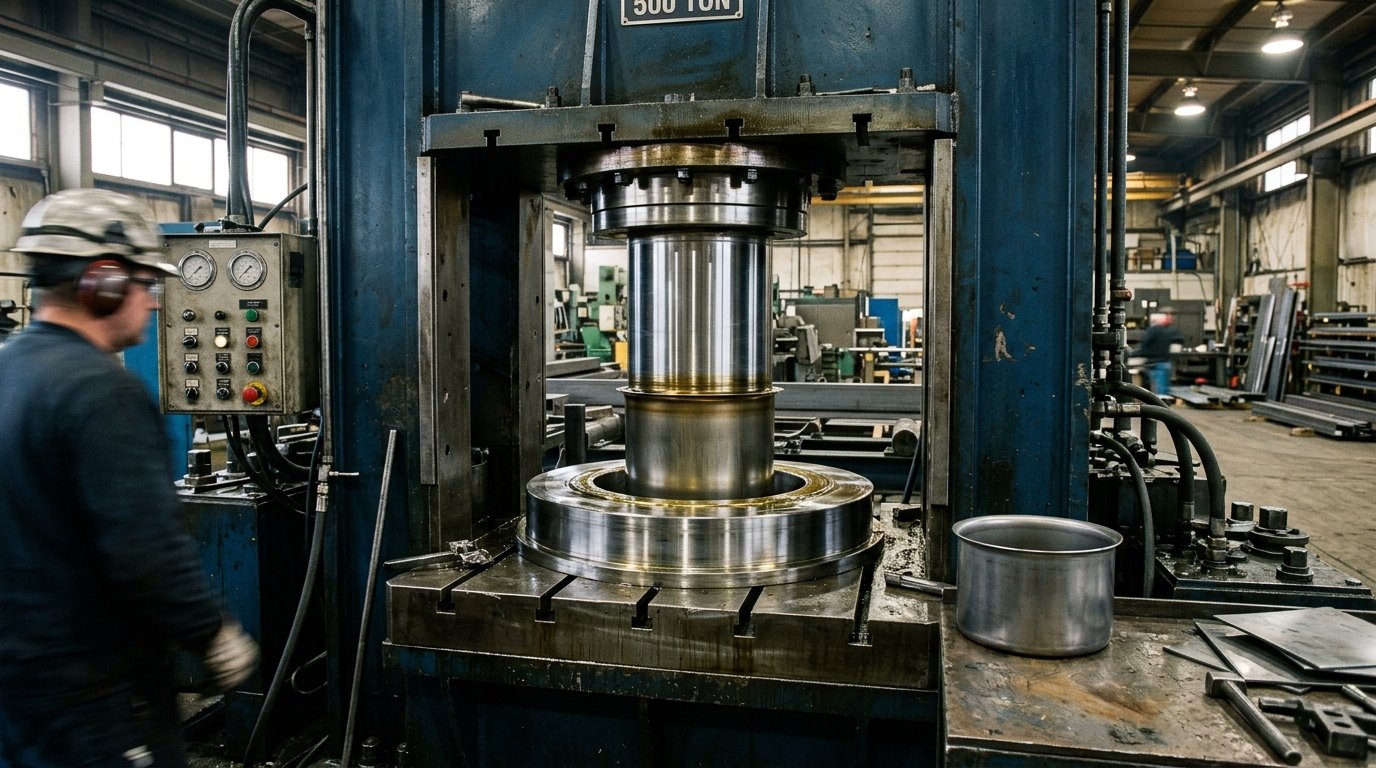
- Mechanical presses store energy in a flywheel and hit full force near the bottom of the stroke, ideal for fast blanking.
- Hydraulic presses deliver full force anywhere in the stroke, which suits deep drawing and thick material.
- Servo presses use a programmable motor so the ram can slow through a draw. They cost more but help with high-strength steel.
A first estimate for a cutting station comes from one formula:
Force = cut perimeter × material thickness × shear strength
Take a steel bracket with a 200 mm blanked perimeter, 2 mm thick, and an assumed shear strength of 300 MPa. That gives 200 × 2 × 300 = 120,000 N, roughly 12.2 metric tons of stamping press force for blanking alone. Use the real shear strength from the mill certificate, add every piercing and forming station, and leave headroom, because a stamping press should not run at its rated limit all day.
In the United States, mechanical power presses fall under OSHA 29 CFR 1910.217, which sets rules for guarding, inspection and die setting.
Which Materials Work Best for Stamped Parts?
Formability comes first: a strong but brittle material cracks at bends, and a very soft one dents in handling. Elite Mold Tech stamps all five material families below.
| Material | Common grades | Why it is chosen | Watch-outs |
| Cold-rolled low-carbon steel | 1008, 1010, 1018 | Low cost, excellent formability | Needs plating or coating against rust |
| Stainless steel | 301, 304, 316/316L | Corrosion resistance; 301 for springs | Work hardens, more springback |
| Copper | C110 | High electrical conductivity | Soft and marks easily |
| Brass | C260 and similar | Conductive, forms well | Higher material cost |
| Aluminum | 5052, 6061 | Low weight | Galls on tools; 6061-T6 cracks on tight bends |
Grain direction matters as much as grade. Bends parallel to the rolling direction crack more easily, especially on stainless, so ask for the blank to be rotated on the coil when a bend is critical.
Design Rules That Keep Stamped Parts Cheap
Most cost problems are designed in. Confirm these starting points with your supplier for the actual material and temper (T = thickness):
- Hole diameter: no smaller than T, and larger for stainless or high-strength steel
- Hole to edge: at least 2T, or the web bulges
- Holes near bends: keep them out of the bend zone, or they stretch into ovals
- Tabs, slots and notches: at least 1.5T wide
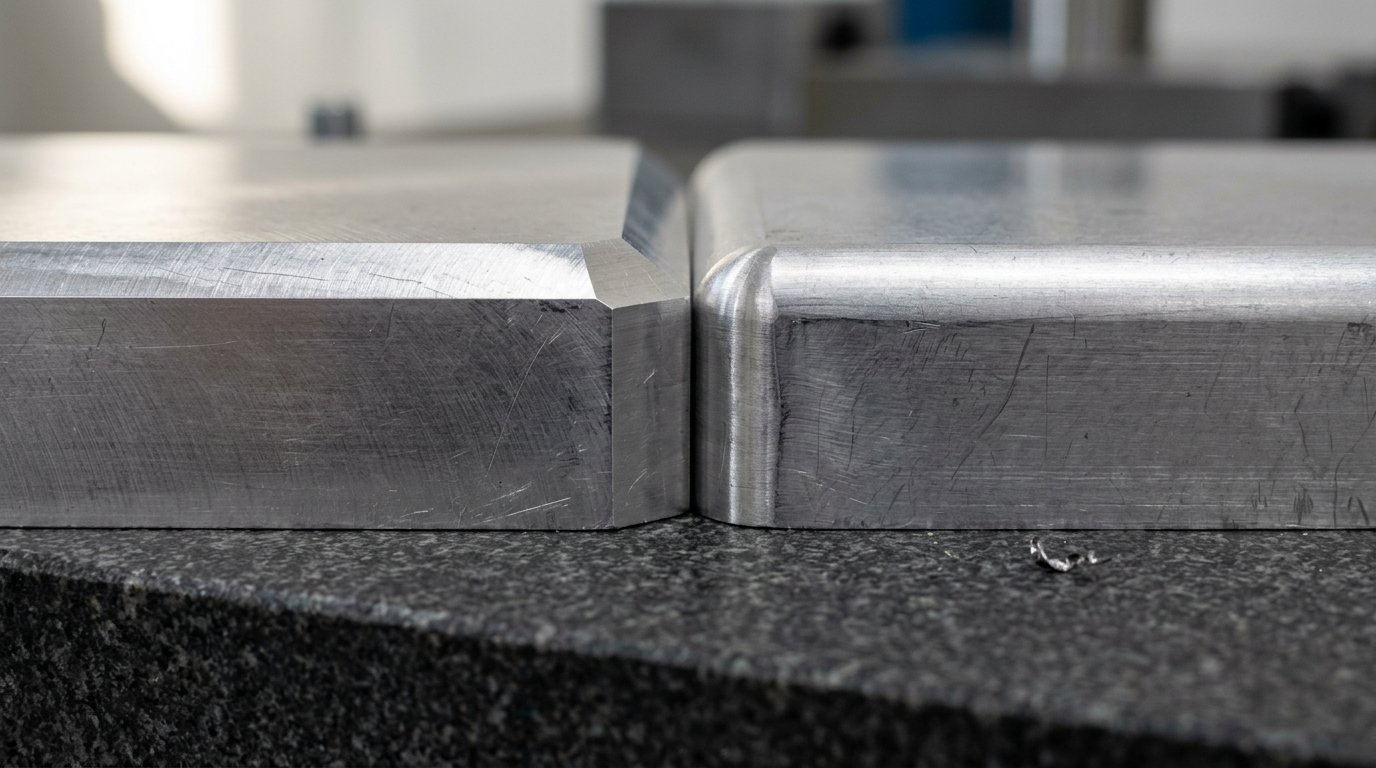
- Blank corner radii: at least 0.5T
- Bend relief: small notches where a bend meets an edge stop tearing
- Burr direction: mark which side may carry burr
- Tolerances: keep tight values for functional features only
That last rule is one of the biggest cost drivers on stamping drawings. Calling ±0.05 mm on every feature, when only two holes locate the part, can add a restrike station or secondary machining for no functional gain. Elite Mold Tech holds ±0.05 mm where it matters, and general dimensions can usually sit in the medium class of ISO 2768-1.
When Is Stamping Cheaper Than Laser Cutting and Bending?
It comes down to volume. Laser cutting and press-brake bending need no dedicated tooling, so the first part costs about the same as the thousandth. A die front-loads the cost, then makes each part for a fraction of that price.
Break-even quantity = die cost ÷ (fabricated unit price − stamped unit price)
Run it with two real quotes. Below that quantity, fabricate; above it, especially for parts reordered over several years, stamp. The crossover depends on size, bend count, material and die type, so no single threshold holds for every part.
On Elite Mold Tech’s sheet metal fabrication line, laser-cut features hold ±0.010 in and bends ±0.020 in under ISO 2768-mK, while a hard-tooled die repeats features within ±0.05 mm (about ±0.002 in). Many programs fabricate prototypes, freeze the design, then move to a die.
Stamping is the wrong answer for thick, three-dimensional parts with bosses and changing walls. Casting or metal injection molding fits them better, as our comparison of MIM and die casting explains, and all three routes sit within Elite Mold Tech’s metal part production options.
From RFQ to First Article: Running a Stamping Project
Send these with your request for quote:
- STEP model and 2D drawing with tolerances and datums
- Material grade, temper and thickness
- Annual volume and typical order size
- Finish, plating or heat treatment
- Critical-to-function features, marked
- Inspection needs: first article report, PPAP level or check fixture
Projects usually slip after tooling starts. Moving a hole once the die steel is cut means welding and re-machining inserts, a cost that rarely sits inside the original quote, so freeze the design with prototypes first.
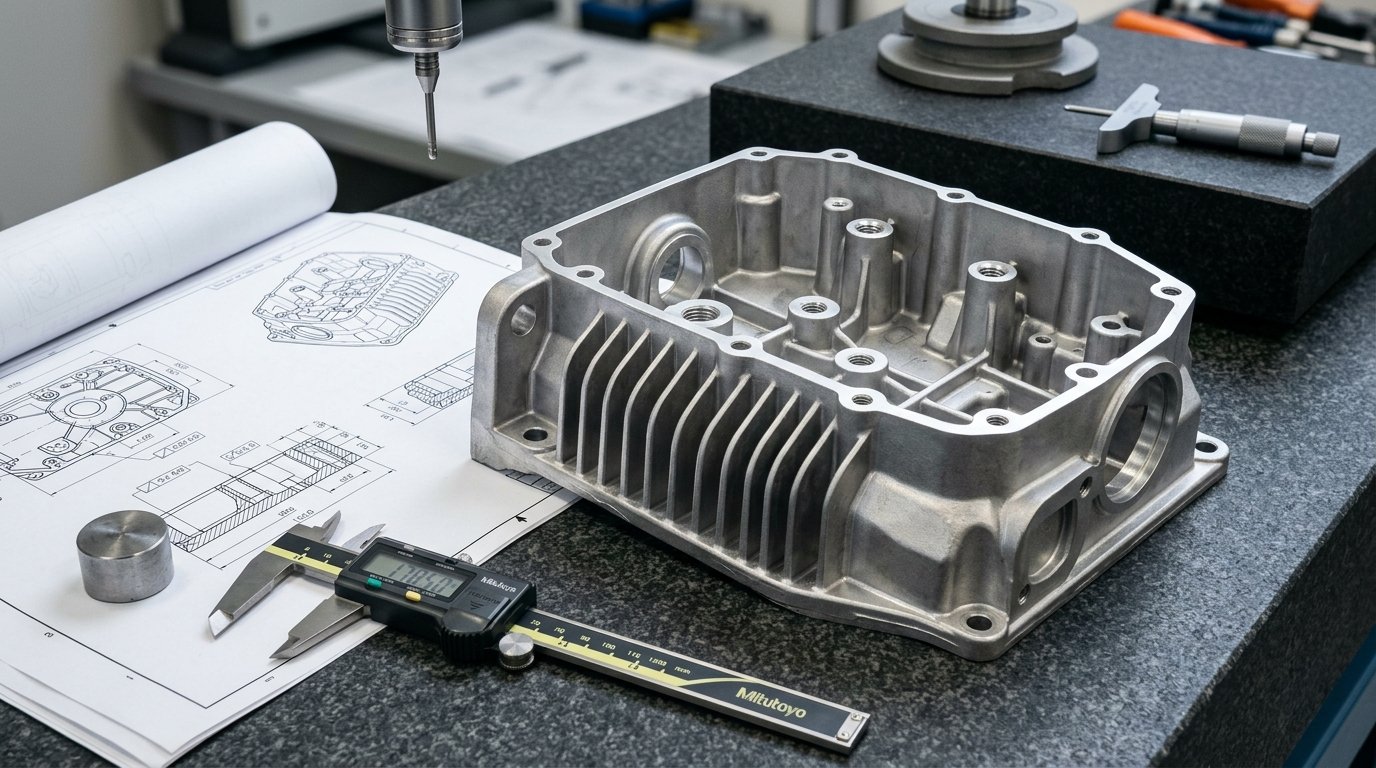
Samples from the production die are then measured against every dimension on a CMM, and the buyer signs off before the full run; automotive programs formalize this as PPAP. Elite Mold Tech’s DFM review team checks parts before quoting, and its custom stamping services cover tooling, production and finishing.
Frequently Asked Questions
What tolerances can stamped parts hold?
Elite Mold Tech holds ±0.05 mm on stamped features. Tighter results are possible with fine blanking, restrike stations or secondary machining, but each adds cost. Formed dimensions such as bend angles vary more than pierced holes because of springback, so tolerance them separately and only as tightly as the assembly needs.
How much does a stamping tool cost?
It depends on part size, number of stations, material and the die life you need. A single-station blanking die is the cheapest option, while a multi-station progressive die for a complex bracket costs many times more. Ask for the tooling price separately from the piece price so you can calculate your break-even volume.
When does stamping become cheaper than laser cutting?
Once total quantity exceeds tooling cost divided by per-part saving. Laser cutting and bending win for prototypes and short runs, since there is no die and a design change only needs a new cutting program. Stamping wins on repeat, high-volume orders, where the die cost is spread across thousands of identical parts.
Is stamping the same as pressing?
Yes. Stamping and pressing describe the same process: a press closes a punch and die on sheet metal to cut or form it. Some regions say pressed parts and others say stamped parts, and both terms appear on drawings and RFQs. Hot stamping of boron steel car parts is a separate, heated variant.
Can aluminum be stamped?
Yes. Softer grades such as 5052 stamp and bend well, while 6061 in the T6 temper tends to crack on tight bends and usually needs larger radii or forming in a softer temper. Aluminum also galls on tool surfaces, so dies need polished steel, coatings or a suitable lubricant.
Getting Your Stamped Part Into Production
Metal stamping pays off when the design is stable, the volume is real and the tolerances follow function. Start with a DFM review, compare a fabricated quote against a die-based one, and choose the die type that fits your part. Elite Mold Tech quotes from a STEP file and drawing, with tooling, stamping and finishing managed under one roof.