China produces a large share of the world’s precision machined components, and the concentration of suppliers in Guangdong province alone runs into the thousands. For a design engineer or procurement manager, that abundance is the problem rather than the solution. Directory listings return hundreds of near-identical company profiles, most of them written to sound the same, and very few of them tell you what actually distinguishes one supplier from the next.
This guide compares 15 CNC machining manufacturers in China against a consistent set of criteria: where they are located, what processes they run in house, which certifications they hold, what order volumes they accept, and the type of project each one suits best. The aim is to shorten your shortlist, not to crown a single winner. The right supplier for a 20-piece medical prototype is rarely the right supplier for a 50,000-piece automotive run.
Why So Many CNC Suppliers Cluster in Guangdong
Most Chinese machining capacity sits inside a small geographic area. Shenzhen, Dongguan, Foshan and Zhongshan form a manufacturing corridor in the Pearl River Delta where a machined part can be cut, anodized, silk screened and assembled within a 40 kilometre radius.
That density matters commercially. When a supplier needs heat treatment or a specialist surface finish it does not run in house, the subcontractor is often a short drive away rather than a province away. Lead times compress. Freight costs between operations approach zero. A supplier in this corridor can quote a multi-process part more competitively than one operating in isolation, simply because the ecosystem around it absorbs the work it cannot do itself.
The corridor also sits close to Shenzhen and Hong Kong ports, which shortens the gap between a finished part and an outbound container. For buyers working to tight launch dates, that logistics proximity is worth as much as the machining rate.
How This List Was Built
Each company below is assessed on the same six points:
- Location and the manufacturing cluster it belongs to
- Core processes available in house rather than subcontracted
- Certifications held, since these determine which industries a supplier can legally serve
- Typical order volume the supplier is set up for
- Materials commonly handled
- Best suited to a specific project profile
No supplier is ranked first or last on overall quality, because that judgement depends entirely on what you are making. The list is ordered loosely by scale, from broad full-service manufacturers through to specialists.
The 15 Manufacturers
1. RapidDirect
Founded in 2009 and based in Shenzhen, RapidDirect operates as an on-demand manufacturing platform with instant quoting and a broad process range covering CNC machining, sheet metal, injection molding and 3D printing. The platform model suits engineers who want a fast price against a CAD file without a lengthy sales exchange.
Best for: rapid quoting, prototyping and low to mid volume production where speed of response matters more than deep process customisation.
2. Elite Mold Tech
Based in Tangxia, Dongguan, Elite Mold Tech works across CNC machining, plastic and metal part production, additive manufacturing and value-added finishing, with a distinct focus on full mechanical BOM sourcing rather than single-part supply. That positioning matters for buyers who are managing an assembly rather than a component, since it consolidates machined parts, molded parts, finishing and assembly under one supplier and one point of accountability.
Best for: projects that span multiple processes, and buyers transitioning a prototype into mass production without changing supplier.
3. WayKen Rapid Manufacturing
Operating from Shenzhen since 2002, WayKen specialises in prototype manufacturing and low-volume production with strong capability in complex geometries and finishing. The company has a long track record with automotive and consumer product development teams.
Best for: appearance prototypes, functional testing parts, and design validation work.
4. Gensun Precision Machining
Located in Dongguan and operating since 2006, Gensun covers CNC milling and turning alongside 3D printing and injection molding, holding ISO 9001 certification.
Best for: custom prototypes and low-volume production runs with mixed process requirements.
5. Junying Metal Manufacturing
Established in 2005 in Dongguan, Junying delivers online CNC machining services with roughly two decades of industrial parts and product design experience behind it.
Best for: industrial components where design support alongside machining is useful.
6. Yijin Hardware
Shenzhen based and operating since 2003, Yijin runs 3 to 5 axis CNC machining and holds both ISO 9001 and IATF 16949, the latter being the automotive quality standard.
Best for: automotive and electronics components where IATF certification is a procurement requirement.
7. HLH Prototypes
With facilities across Shenzhen and Dongguan and more than 15 years of operation, HLH runs one of the larger dedicated prototyping floors among mid-tier Chinese suppliers.
Best for: prototyping programmes that need machine capacity and quick turnaround at volume.
8. Richconn Technology
Founded in 2012 with machining bases in both Shenzhen and Dongguan, Richconn operates a substantial fleet of 3, 4 and 5 axis centres alongside dedicated inspection equipment, serving medical, automation and electronics customers.
Best for: precision parts requiring multi-axis machining and documented inspection.
9. Hongsinn Precision
A Shenzhen company established in 2010, Hongsinn covers 4 and 5 axis milling, turning, turn-mill, grinding and wire cutting, certified to ISO 9001:2015 and equipped with Zeiss and Mitutoyo coordinate measuring machines.
Best for: complex structural parts and non-standard components requiring full inspection reports.
10. KinTec Machining
Dongguan based with over 13 years of operation and a large facility running more than 60 CNC systems, KinTec focuses on precision metal components for automotive, aerospace, robotics and medical applications.
Best for: regulated-industry metal parts at production volume.
11. Mingshengfa Intelligent Technology
Operating from Dongguan since 2010, Mingshengfa runs a large bank of machining centres including four and five axis machines, working in aluminium, stainless steel and thermoplastics.
Best for: tight-tolerance parts across both prototype and larger production quantities.
12. Xinwanda Metal Materials
A newer Shenzhen operation founded in 2018, running CNC lathes, vertical machining centres and gantry systems for consumer electronics, semiconductor and healthcare equipment components, certified to ISO 9001.
Best for: electronics and semiconductor components where scalable capacity is needed.
13. UIDEARP
Shenzhen based, focused on rapid prototyping and low-volume production with 3, 4 and 5 axis milling and turning, aimed specifically at overseas engineers and product development teams.
Best for: early-stage development work where communication with overseas engineering teams is the priority.
14. Junyu CNC Machining
A Dongguan precision machining supplier handling precision parts, mold components, turned and milled parts and wire EDM work, with multi-process surface treatment support.
Best for: mold components and parts needing several secondary operations.
15. RpProto
Operating from Xiamen in Fujian province rather than the Guangdong cluster, RpProto holds ISO 9001 and positions around competitive pricing and short lead times for custom prototypes and low-volume runs.
Best for: cost-sensitive prototype work, and buyers wanting a supplier outside the Guangdong concentration for supply chain diversification.
Comparing Suppliers on the Points That Matter
Company profiles tell you very little on their own. Four criteria separate suppliers in practice.
Certification Determines Which Industries a Supplier Can Serve
ISO 9001 is the baseline quality management standard and most credible Chinese machining suppliers hold it. It confirms documented processes exist, not that parts are good.
Beyond that baseline, certification becomes industry-specific. IATF 16949 is required by most automotive OEM supply chains. ISO 13485 governs medical device manufacturing. AS9100 covers aerospace. A supplier without the relevant certification may still machine an excellent part, but your customer’s quality department may refuse the paperwork regardless.
Ask for the certificate itself with its issuing body and expiry date, not a logo on a website.
In-House Capability Versus Subcontracting
Many suppliers advertise processes they broker rather than run. This is not automatically a problem, since subcontracting is normal and often efficient. It becomes a problem when nobody tells you, because a subcontracted operation adds a handoff, a transport leg and a party who has never seen your drawing.
Ask directly which operations happen under the supplier’s own roof. Machining, surface finishing and assembly under one roof shortens the chain and reduces the number of places quality can drift.
Volume Fit
A prototype shop optimised for one-off parts is set up for fast changeovers, flexible programming and rapid quoting. A production shop is optimised for repeatability, fixturing and cost per unit at quantity. Sending a 10,000-piece order to a prototype shop, or a 5-piece order to a production shop, produces a poor outcome in both directions.
Ask what a typical order looks like. If the answer does not resemble your project, the fit is wrong regardless of how capable the supplier is.
Inspection and Documentation
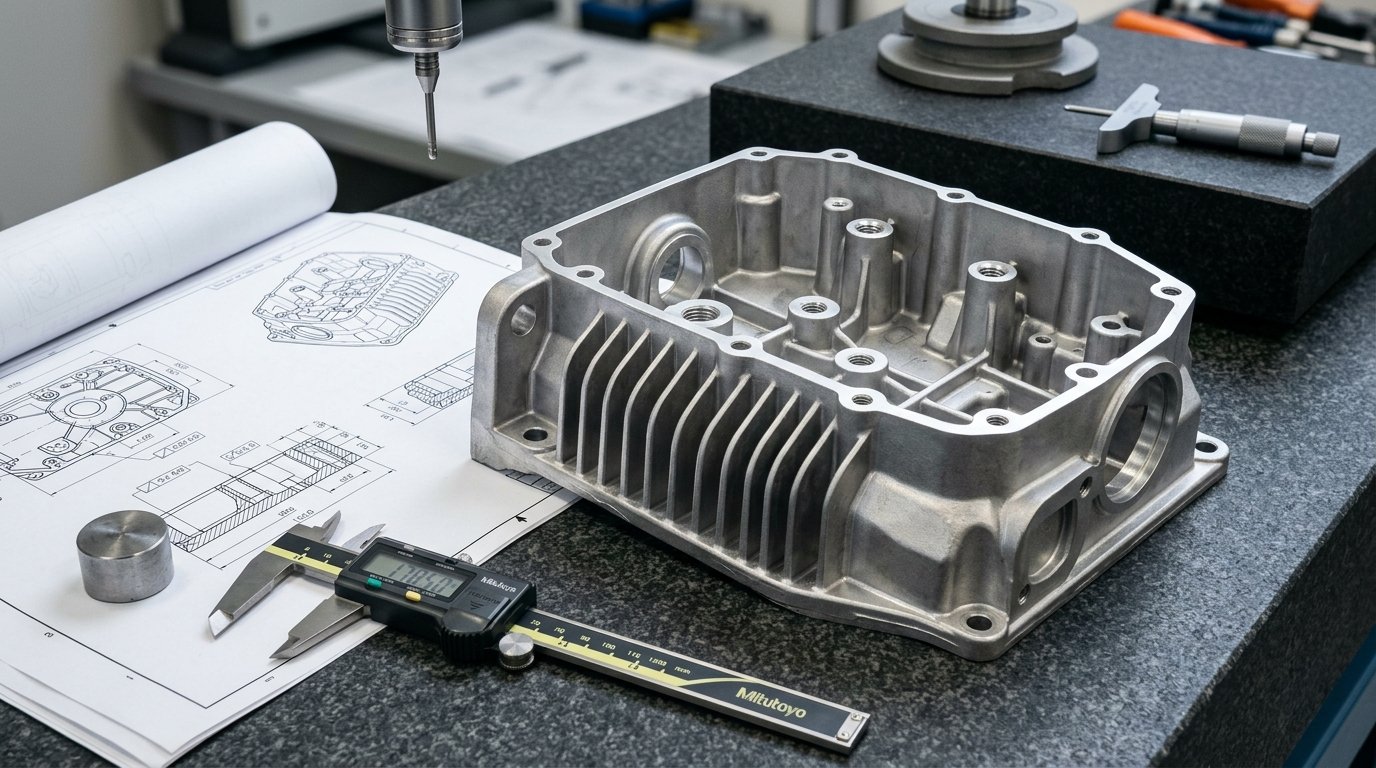
Precision claims mean little without measurement to back them. A supplier claiming ±0.01 mm should be able to name the coordinate measuring machine it uses and provide a dimensional report against your drawing.
Establish before you order what inspection documentation comes as standard and what costs extra. First article inspection reports, material certificates and dimensional reports should be agreed at quotation stage rather than requested after delivery.
Practical Questions to Ask Before You Commit
| Question | What a good answer looks like |
| Which operations run in your own facility? | A specific list, with subcontracted operations named openly |
| What certifications do you hold and when do they expire? | Certificate documents with issuing body and dates |
| What inspection equipment do you use? | Named CMM brands and models, not “advanced equipment” |
| What is your typical order quantity? | A range that overlaps with your project |
| Who owns the tooling and fixtures? | A clear written position agreed before payment |
| What is your standard lead time and what drives variation? | Realistic ranges with named bottlenecks |
| Can you provide DFM feedback on my drawing? | Specific comments on your part, offered before quoting |
That last point is a useful filter on its own. A supplier that reviews your drawing and comes back with observations about draft, tolerance stack or feature accessibility is engaging with the part. A supplier that returns only a price has treated your file as a quoting input rather than an engineering problem.
Understanding Cost Differences Between Quotes
Wide variation between quotes for the same part is common and usually explainable. The main drivers are material grade and whether it is certified, the number of setups required, tolerance callouts, surface finish specification, inspection level, and batch quantity.
A quote that comes in far below the others usually differs on one of these rather than on efficiency. Before treating it as a saving, confirm it covers the same material certification, the same inspection documentation and the same finish. Comparing quotes only on headline price is how buyers end up paying twice.
Tight tolerances deserve particular scrutiny. Specifying ±0.01 mm across every dimension when only two features need it can add substantially to cost without improving the part. Reserving tight tolerances for functional features is one of the most reliable ways to reduce a machining quote. This is worth discussing with your supplier’s engineering team before the drawing is finalised.
Matching Supplier Type to Project Stage
Projects move through phases, and the ideal supplier changes as they do.
Early development favours prototype specialists with fast quoting, flexible minimums and tolerance for design changes. Speed of iteration outweighs unit cost.
Design validation needs a supplier producing parts in the intended production material and process, so test results carry over. Documentation begins to matter here.
Production ramp requires capacity, repeatability and quality systems. Certification, inspection rigour and delivery consistency dominate.
Some buyers change supplier at each stage, which costs time in requalification. Others select a supplier capable of carrying the part through all three, accepting slightly higher prototype pricing to avoid the transition. Neither approach is wrong, but choosing deliberately beats discovering the problem mid-programme. If you are weighing this, our guide on the prototype to production transition sets out what changes at each stage.
Working Effectively Across the Distance
Sourcing from China introduces time zone gaps, language differences and a shipping leg. All are manageable with a few habits.
Keep drawings unambiguous. A fully dimensioned 2D drawing alongside the 3D model, with tolerances, material specification, finish and critical features clearly marked, removes most interpretation risk. Assumptions made silently across a language gap are the most common source of a wrong part.
Agree the inspection and approval sequence before production starts, including what triggers a hold. Photographs before shipment are standard practice among established suppliers and worth requesting explicitly.
Build the shipping leg into your schedule honestly. Sea freight from Shenzhen typically runs several weeks depending on destination, and air freight costs considerably more. A supplier quoting a four-week lead time is usually quoting the factory floor, not delivery to your door.
Choosing From the Shortlist
There is no single best CNC machining company in China, and any list claiming otherwise is selling something. What exists is a good match between a specific project and a specific supplier’s setup.
Narrow by certification first, since that is a hard requirement rather than a preference. Then filter by volume fit, because a mismatch there causes problems no amount of goodwill resolves. Then assess in-house capability against how many processes your part needs. What remains after those three filters is usually a shortlist of two or three, at which point a paid sample order tells you more than any amount of further research.
For buyers whose parts cross several processes, or who expect to move from prototype into volume production with one partner, Elite Mold Tech offers machining, molding, finishing and assembly under a single mechanical BOM arrangement from its Dongguan facility. Send a drawing and an engineering review comes back before any quote is issued.
Frequently Asked Questions
Q: How much cheaper is CNC machining in China compared with domestic suppliers?
A: Savings vary widely by part complexity and volume, and headline machining rates tell only part of the story. Freight, duties, inspection and any tooling costs must be included before a genuine comparison is possible.
Q: What minimum order quantity do Chinese CNC suppliers accept?
A: Many accept single-piece orders, particularly prototype-focused shops. Production-oriented factories often prefer larger batches, since setup cost dominates at low quantities and unit pricing improves considerably with volume.
Q: How do I verify a Chinese manufacturer is legitimate before ordering?
A: Request business licence details, current certification documents with issuing bodies, and references from customers in your region. A video walkthrough of the facility and a small paid sample order are practical verification steps.
Q: Who owns the tooling I pay for?
A: This depends entirely on your written agreement. Ownership, storage terms and transfer rights should be documented before any tooling payment is made, as recovering tooling without a prior agreement is difficult.
Q: What lead times should I expect for machined parts from China?
A: Prototype parts commonly ship within one to two weeks of drawing approval, while production runs take longer depending on quantity and finishing. Add sea or air freight time separately, as factory lead times rarely include shipping.