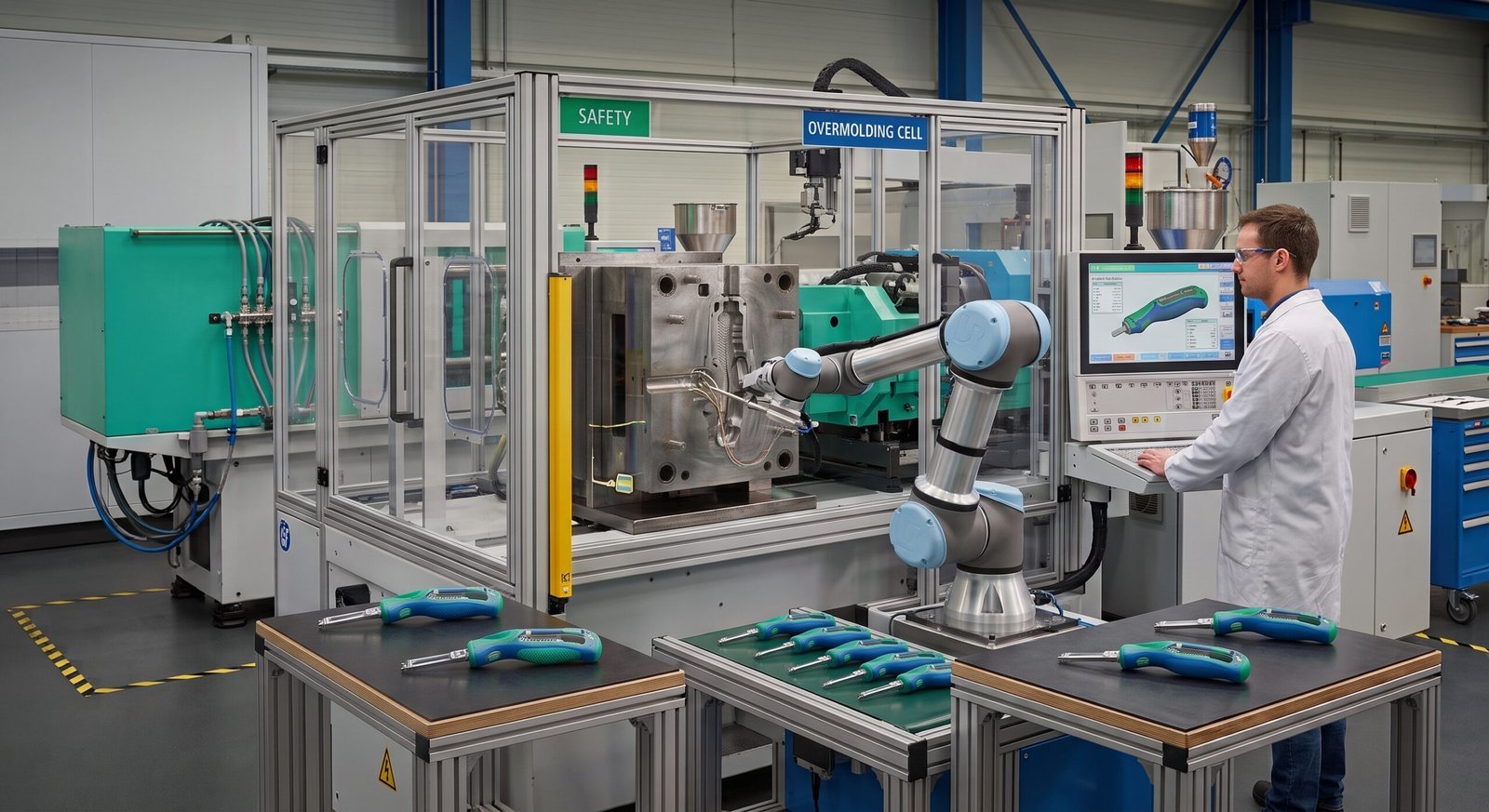
A single-cavity mold makes one part per cycle at the lowest tool price. A multi-cavity mold makes several identical parts per cycle, costing more to build but cutting unit cost at volume. A family mold makes different parts in one shot, saving tooling but adding balancing problems. In single-cavity vs multi-cavity decisions, volume sets the answer.
Three Mold Setups Defined
Single-cavity mold. One cavity, one part per shot. It is the simplest tool to build, sample and adjust, and every part is identical because there is only one cavity.
Multi-cavity mold. Two or more identical cavities, typically 2, 4, 8, 16 or more, filled together through a shared runner. Output multiplies with each cavity, while cycle time rises only slightly.
Family mold. Two or more different parts in one tool, such as the top and bottom halves of a housing. It replaces several small tools with one, but the parts must share a resin and color and run at the same pace.
Comparison at a Glance
The table below compares single-cavity and multi-cavity tools side by side, with family molds included as the third option for matched sets.
| Factor | Single-cavity | Multi-cavity | Family mold |
| Tool price | Lowest | Higher | Lower than separate tools |
| Unit cost at volume | Highest | Lowest | Moderate |
| Output per cycle | 1 part | N identical parts | 1 set of different parts |
| Consistency | Best | Good, if balanced | Hardest to control |
| Changes and repairs | Easy | Every cavity must change | Changes affect all parts |
| Best for | Prototypes, low volume, large parts | Stable high-volume parts | Matched sets at low to moderate volume |
How Cavity Count Changes the Unit Cost
The single-cavity or multi-cavity decision is mostly arithmetic. Unit cost has three parts: machine time, material and tool amortization. More cavities spread machine time across more parts, but the larger tool costs more to pay back.
Unit cost = (machine rate × cycle time ÷ cavities) + material + (tool cost ÷ lifetime quantity)
Worked example (hypothetical prices, for illustration only). Material costs the same either way, so it is left out of the comparison.
- Single-cavity: $12,000 tool, 30-second cycle, press at $30 per hour
- Four-cavity: $30,000 tool, 32-second cycle, larger press at $40 per hour
| Lifetime quantity | Single-cavity total | Four-cavity total | Cheaper option |
| 20,000 parts | $17,000 | $31,778 | Single-cavity |
| 1,200,000 parts | $312,000 | $136,667 | Four-cavity |
The table shows how single-cavity and multi-cavity totals cross over. Break-even here: about 112,000 parts. Below that, the single-cavity tool is cheaper in total; above it, the four-cavity tool wins, and the gap keeps widening. Your numbers will differ, so run the same comparison with real quotes and a realistic lifetime volume, not a best-case forecast.
How Many Cavities Do You Need?
Before choosing single-cavity or multi-cavity tooling, start from demand and machine time:
Cavities = (annual demand × cycle time in seconds) ÷ (available press hours × 3,600 × efficiency)
For 400,000 parts a year, a 32-second cycle, 2,000 available press hours and 85% efficiency, the result is about 2.1 cavities. Round up to a layout that balances well, which usually means 2, 4 or 8, so four cavities would be the practical choice here.
Then check the press limits:
- Shot size. The total volume of all cavities plus runner must sit comfortably within the machine’s shot capacity.
- Clamp force. Projected area of all cavities and runner, times the resin’s cavity pressure, must stay below the clamp tonnage.
- Platen and tie bar space. The mold must physically fit between the tie bars.
A cavity count that forces a much larger press can erase the savings, because the hourly rate climbs with machine size.
Single-Cavity vs Multi-Cavity: Tooling Cost and Lead Time
A multi-cavity tool is not simply one cavity multiplied. The mold base grows, the runner must be balanced, cooling has to reach every cavity evenly, and each insert must match the others dimensionally. That is why a four-cavity tool costs noticeably more than a single-cavity one, though usually far less than four separate tools, and why it takes longer to build.
Sampling takes longer too, because every cavity needs measuring. In a single-cavity vs multi-cavity comparison of lead time, the extra weeks for design, machining and per-cavity approval can matter more than the price if your launch date is fixed.
Tool amortization also changes the picture over time. Once a production tool is paid off, the remaining unit cost is almost entirely machine time and material, which is where more cavities keep paying.
Cavity Balancing and Consistency
Balancing is where multi-cavity vs single-cavity molding differs most for quality. In a multi-cavity tool, every cavity should fill at the same time and pressure. Cavity balancing is done mainly through the runner layout. A naturally balanced runner, such as an H-pattern, gives every cavity the same flow length. Hot runners with separately controlled nozzles allow further fine-tuning.
Even with good balancing, some cavity-to-cavity variation is normal, because each cavity has its own steel, cooling and gate. That spread adds to the tolerance band, which is why tight parts under ISO 20457 or similar standards are often easier to hold in fewer cavities.
Living With Cavity-to-Cavity Variation
The day-to-day side of multi-cavity molding decides quality in production:
- Cavity ID marks. Engrave a cavity number into every cavity so any part can be traced back to its source.
- Per-cavity inspection. First article and capability studies should cover every cavity, not a random mix of parts.
- Blocking a cavity. If one cavity is damaged, many tools can be run with that cavity shut off while it is repaired, at reduced output. Ask whether your tool is designed to allow it.
- Balanced repairs. When one insert is reworked, check that its fill and dimensions still match the others.
Cycle Time With More Cavities
Adding cavities rarely leaves cycle time untouched. A larger shot takes longer to inject, the runner adds mass that must cool, and ejecting and removing more parts takes time, especially if a robot places each one. The increase is usually small compared with the gain in output, but it should be in the calculation. In the worked example above, the four-cavity cycle is two seconds longer, which the formula already accounts for.
Cooling usually sets the cycle, so a well-designed cooling layout that reaches every cavity evenly is worth more than an extra cavity that cools slowly.
Maintenance and Spare Inserts
Maintenance is where multi-cavity vs single-cavity costs diverge after launch. More cavities mean more core pins, ejectors and gates to wear, and a broken core pin in one cavity can stop the whole tool unless that cavity can be blocked.
Plan for it:
- Keep spare inserts or core pins for features that wear or break
- Schedule preventive maintenance by shot count, not by calendar
- Record which cavity each repair touched, so dimensions can be rechecked
Spare inserts cost money up front, but they turn a multi-day tool repair into a short changeover.
Mold Steel and Cavity Count
Steel choice differs for single-cavity and multi-cavity tools. High cavity counts running for years usually justify hardened steel, while single-cavity prototypes and bridge tools can be aluminum or pre-hardened steel. Our guide to choosing mold steel covers the grades.
Scaling From One Cavity to Many
Many programs use single-cavity and multi-cavity tools in sequence. A single-cavity tool proves the design and supports launch, then a multi-cavity production tool takes over once demand is known.
To make that transition smooth, keep the gate position, ejection layout and draft the same in both tools, qualify every new cavity against the approved single-cavity parts, and, where supply is critical, keep the first tool running until the new one is fully approved.
When a Family Mold Makes Sense
Family molds suit matched sets needed in equal numbers, such as two halves of an enclosure, at low to moderate volume. They also suit prototypes and bridge tooling, where one tool is cheaper than several.
Their limits are real:
- Parts of different size and wall thickness fill unevenly, so one part may be overpacked while another is short
- Every part runs at the pace of the slowest to cool
- If demand for one part changes, you still mold the full set, unless the tool has runner shut-offs
- A problem in one cavity can stop production of every part in the set
Our view: choose a family mold only when the parts are similar in size and wall thickness, share a resin and color, and are always needed in equal quantities. Otherwise, separate tools, even single-cavity ones, are safer.
Alternatives to a Family Mold
If several low-volume parts are needed but a family mold’s balancing problems are a concern, two alternatives are worth pricing. Interchangeable inserts in one mold base let you run one part at a time by swapping cavity inserts. Quick-change insert frames, often called unit dies, do the same across a standard base, so each part only needs its own small insert set. Both share tooling cost without mixing parts in one shot. They suit single- and multi-cavity layouts alike.
Single-Cavity or Multi-Cavity: Choosing Your Setup
- Prototype, launch or uncertain demand: single-cavity, possibly in aluminum or as a bridge tool.
- Stable, high demand for one part: multi-cavity, sized with the cavity formula above.
- Matched set of similar parts at modest volume: family mold.
- Very tight tolerances: fewer cavities, even at a higher unit cost.
A common path is to start with a single-cavity tool, prove the design and demand, then build a multi-cavity production tool. Our injection mold cost guide covers how cavity count adds to tool price, and our comparison of 2-plate vs 3-plate molds explains how gating changes with the layout. Component names across the tool follow ISO 12165.
Frequently Asked Questions
How many cavities should my mold have?
Divide annual demand multiplied by cycle time by the press seconds available per year, adjusted for efficiency. Round up to a balanced layout such as 2, 4 or 8, then confirm the press has enough shot size, clamp force and space. Finally, compare total cost with real quotes before committing.
Is a multi-cavity mold always cheaper per part?
Not always. At high volume, spreading machine time across several cavities lowers the unit cost sharply. At low volume, the higher tool price may never be paid back, and a single-cavity tool costs less overall. A larger press, longer cycle or scrap from imbalance can also erode the savings.
What is a family mold?
A family mold produces two or more different parts in the same shot, such as the matching halves of a housing. It reduces tooling cost compared with separate tools, but all parts must share a resin and color and run at the same cycle, which makes balancing and scheduling harder.
What are the disadvantages of family molds?
Different part sizes fill and pack unevenly, so quality varies between parts. Every part runs at the slowest part’s cycle time, and you must mold the whole set even when you need only one part. A fault in one cavity can also stop production of all the parts in the tool.
Can you block off a cavity in a multi-cavity mold?
Often, yes. Many multi-cavity tools can run with a damaged cavity shut off while it is repaired, at proportionally lower output. It depends on the runner and gate design, so ask for this capability at quotation if uninterrupted supply matters. Hot runner tools can usually close individual nozzles more easily.
Picking Single-Cavity vs Multi-Cavity for Your Program
The single-cavity vs multi-cavity choice is a volume decision first and a quality decision second. Calculate the cavities you need, check the press, and compare total cost over a realistic lifetime; reserve family molds for matched sets. At Elite Mold Tech, our DFM engineers can size the cavity layout during plastic injection molding quotes, and production molding runs multi-cavity tools at scale.